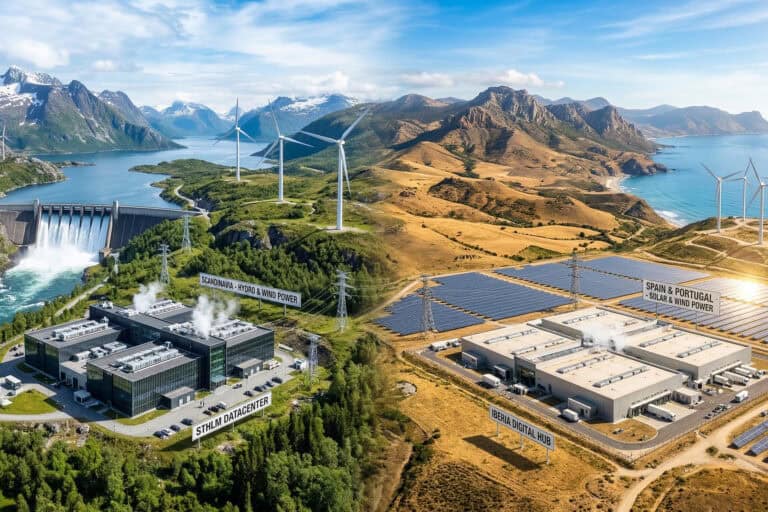
The European data center market is undergoing unprecedented change. Whereas traditional markets such as Germany and the United Kingdom dominated for years, attention is now shifting to Scandinavia and the Iberian Peninsula (Spain and Portugal). Energy access, data sovereignty, and AI workloads are forcing the industry to make fundamental choices.
In an interview with us, Pablo Ruiz-Escribano Rodríguez, SVP Secure Power & Data Center Business, Europe at Schneider Electric, shares his recent experiences. In the year that he has held this position at the company, a lot has happened. The fragmented European market presents unique challenges: each country has its own regulations and market dynamics. This is something Schneider has to be able to deal with.
A year full of challenges and growth
Ruiz-Escribano describes his first year as a “rollercoaster” in which he traveled extensively throughout Europe to meet teams and get to know the market. “Europe is a very interesting area. The US [where he lived and worked until last year, ed.] is easy in comparison. Europe, with all its different countries, different rules, and different interests, is a great challenge,” he explains. In some markets, Schneider is the market leader, in others more of a challenger. This diversity requires a differentiated approach for each country and region.
Shift to Scandinavia, Spain, and Portugal
A notable trend is the shift of data center investments to non-traditional markets. The Flap-D markets (Frankfurt, London, Amsterdam, Paris, and Dublin) are still the leading hubs. In general, they are still growing. Nevertheless, there is a clear shift underway. This shift is mainly towards the North and South. Specifically, this concerns Scandinavia and the Iberian Peninsula (Spain and Portugal), but also southern France.
There are several reasons for these shifts. In Scandinavia, energy is not only cheaper, but the region is also well ahead in the field of renewable energy, Ruiz-Escribano points out. “There is a lot of capacity available. In addition, Scandinavia is also quite well connected to the DACH market and the United Kingdom,” he adds. You can build your data center in Norway and even Iceland and serve those markets from there. Of course, there is also a lot of natural cooling available in those regions. With the trend towards increasingly high-density racks in mind, this is definitely an advantage.
Natural cooling is obviously not an argument for moving to Spain and Portugal. That region is particularly interesting because of its low energy costs and high share of renewable energy. The oversupply of wind and solar energy is so great that production sometimes has to be shut down. This makes the region attractive for data centers that consume a lot of energy.
The choice of a data center location depends heavily on the use case, Ruiz-Escribano points out. For AI training, data centers can be built in remote locations. For inferencing, where AI models work with customer data, it is important to be close to users, partly because of latency requirements.
Sovereignty is an extra piece in the data center puzzle
Ruiz-Escribano is also seeing a lot happening in Europe around sovereignty. He sees several regions in Europe where governments want to build their own infrastructure to be independent of third parties. “Data sovereignty is creating a lot of local demand in France,” he gives as an example.
Sovereignty adds another piece to the data center puzzle that Europe has to solve, Ruiz-Escribano points out. In other words, sovereignty is about a different axis than issues such as energy costs, energy availability, and connections to the power grid. “If there is local demand to build a data center for local data, then it will have to be located in that country,” he says.
Sovereignty does not mean the same thing everywhere
Ruiz-Escribano also sees something else surrounding sovereignty in Europe: “Until now, countries have all been working according to their own definition of sovereignty.” This became clear to us when the German Federal Minister for Digital Affairs actively supported the AWS European Sovereign Cloud during its launch in Potsdam earlier this year. This is in contrast to other countries, including the Netherlands, which view this new offering from AWS with enormous suspicion.
Ruiz-Escribano is confident that these kinds of conflicting signals will eventually disappear. “I think there will come a time when we harmonize the concept of sovereignty at the European level,” he says. That would be nice, but there is still a long way to go before that happens. At least, that is what we expect based on our conversations and impressions.
Challenges for Schneider Electric
According to Ruiz-Escribano, the biggest challenge for Schneider Electric is not so much the technology itself: “The main challenge is that we have to anticipate what is coming.” That may not sound like anything particularly complicated. However, for a player like Schneider, which is very early in the innovation process, this is quite a task. Schneider must ensure that data centers can be properly cooled and supplied with sufficient power. It must also respond to developments in the field of UPS.
The company therefore needs to have a clear roadmap and be prepared for any last-minute changes. In a recent conversation with Steve Carlini, Chief Advocate for AI in Data Centers at Schneider Electric, we heard that the company had to do something similar in the area of power supply for racks. Nvidia developed its own GPU portfolio so quickly that Schneider skipped a planned step from 400V DC to 600V DC and had to go straight to 800V DC. You can imagine that this has quite a big impact on an organization like Schneider Electric. It has to be able to deal with this effectively. According to Ruiz-Escribano, this mainly involves very good and close relationships with chip manufacturers and server manufacturers. “We have a very strong partnership with Nvidia, which means we know what’s coming in the next four or five years.”
Another area where Schneider has to keep up with today’s rapid changes has to do with people. Hiring the right people and teaching them the right skills. “This is the only way we can properly support our customers. It is therefore something we monitor closely,” says Ruiz-Escribano.
The human component is and will remain important. However, Schneider must also pay more attention to the way data centers are designed, particularly in terms of the amount of digitization and automation involved. These things are necessary to enable data centers to function even better with fewer and possibly less skilled employees.
The European data center market is never boring
It is clear that the European data center market is facing major changes. When it comes to data centers, it is never boring anywhere in the world. AI ensures that. The patchwork quilt that is Europe adds an extra layer of complexity (as usual, you might say). Different countries and regions have different priorities and opportunities for hosting new data centers. Data sovereignty does not mean the same thing everywhere, and governments do not treat it in the same way. This certainly does not make the European data center landscape as a whole easy to navigate.
Schneider Electric seems to have most of its pieces in place. However, despite its close ties with other players in the data center market, it will always have to be prepared and ready to change course relatively quickly. Anticipating, investing, and collaborating with the entire supply chain are the key words here.