
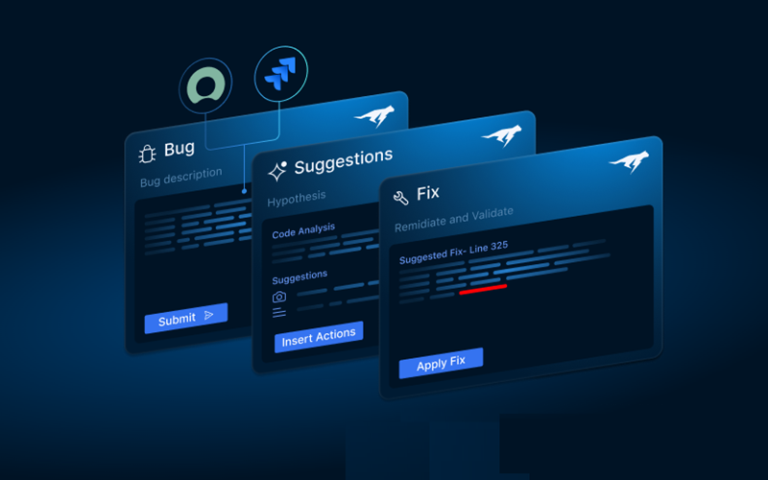
Software reliability company Lightrun has developed a runtime-level AI coding agent service that spans application staging, pre-production and live-deployed production states via Model Context Protocol (MCP). With so many AI coding agents now surfacing to tackle what might be more piecemeal tasks, Lightrun is among a new breed of tools in this space that aim to be more comprehensive and holistic. Coder also has new expanded tools to offer at a not wholly dissimilar level.
Lightrun’s Runtime Context is a Model Context Protocol (MCP) service enabling integrated control for AI code-writing assistants. This technology is said to represent a step change in autonomous code writing that gives tools like Cursor and GitHub Copilot visibility into how code behaves after deployment, filling a missing piece of the AI development ecosystem.
AI assistants can generate code rapidly, but is that code always functional, performant and secure… not to mention compliant?
Traffic, dependencies & workloads
Studies from Stanford and Google suggest that AI-generated code fails at high rates once exposed to real-world traffic, real-world dependencies and real-world workloads. What may be happening here is simple enough i.e. once code leaves an Integrated Development Environment (IDE), AI cannot see what takes place in staging, pre-production, or production. As a result, teams report spending hours debugging and refactoring bad code.
“AI has taken over much of the creative part of coding,” said Ilan Peleg, CEO and co-founder of Lightrun. “However, debugging across environments has remained painfully manual. With Runtime Context, AI can finally participate in the full lifecycle by writing code, validating and debugging it, while also remediating issues based on real-world behaviour. This is the next evolution of autonomous software development.”
From IDE to AI to runtime
Peleg explains that Lightrun’s Runtime Context bridges the gap between the IDE, the AI assistant and runtime, providing context to the agent and the developer behind it.
“Developers can now ask their coding assistant to check staging traffic before writing a module, investigate a production failure, or add the instrumentation needed to validate behaviour. Lightrun’s MCP acts as the secure bridge, enabling the AI agents to add logs and traces in real time, capture snapshots, investigate issues safely and even suggest fixes, all without requiring engineers to manually reproduce issues,” said Peleg and team.
The Runtime Context model enables AI tools to trigger remote debugging sessions inside staging, pre-production, or production; to access production-grade telemetry in real time; to propose fixes based on actual runtime behaviour; and to deliver code that is reliable, stable and deployment-ready.
Lightrun insists its users can now expect faster debugging cycles, higher deployment reliability and AI-generated code that better withstands real traffic and dependencies.
Coder, control for hybrid environments
Logically named open source development company Coder also works in this space. Its newest capabilities bring AI coding agents into secure, self-hosted workspaces. The company’s AI Bridge, Agent Boundaries and major enhancements to Coder Tasks bring security, observability and control to hybrid development environments where humans and AI agents work together.
A recent Cisco study suggests that only 13% of global companies have a defined AI strategy and with much of that AI now being directed towards software application development, that’s not an encouraging statistic.
The rest rely on fragile workarounds such as running coding agents locally, ad-hoc isolated sandboxes, unmanaged key sharing, compliance gaps and GPU-heavy workflows that do not scale. Coder says that developers, data scientists and other software engineers face similar friction: broken environments, identity sprawl and inconsistent access to data and tools.
“AI has broken the software development lifecycle. Bolting AI tools onto the old model, where code lives on local laptops, creates risk, cost and chaos. This gets worse when you add AI agents, which are simply impossible to run concurrently on laptops,” said Rob Whiteley, CEO of Coder. “Coder is transforming the SDLC, making AI development safe, scalable and production-ready. Now, enterprises have a governed foundation where humans and AI agents can build together with consistent security, identity and observability.”
Being intelligent, with intelligence
As tautological as it sounds, it feels like (when it comes to AI coding tools at least) we haven’t always been intelligent, with intelligence. What we need are more secure, governed foundations that treat both developers and agents as first-class users with consistent context, control and efficient compute across every workflow.