
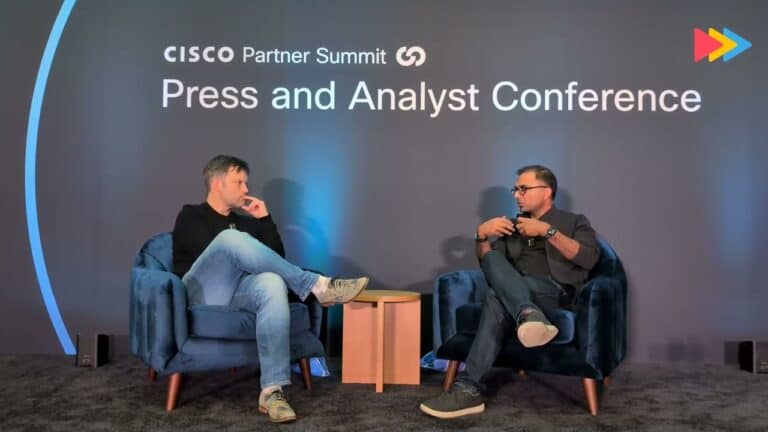
AI Canvas represents Cisco’s different way of thinking about network operations. This new shared workspace for humans and AI agents shifts from reactive AI assistance to autonomous agentic operations. We go in-depth with DJ Sampath, SVP of AI Software and Platforms at Cisco, to see hear how purpose-built models and 30 years of network engineering data are supposedly transforming IT troubleshooting.
The industry has been talking about AIOps for year. However, Cisco believes this term no longer captures what’s happening in enterprise IT. According to Sampath, customers want to move beyond chatbot-style AI applications. They want to deploy autonomous agents that execute complete workflows without human intervention.
“We’re moving from AI applications to agents that just go perform an autonomous execution by itself,” Sampath explains. “When we talk to customers and ask ‘are you deploying chatbots or are you deploying agents?’ the answer is we’re deploying more agents. So we’re already seeing that shift happen.” This shift in how AI operates in IT environments led Cisco to coin the term “agentic ops” to better reflect the autonomous, end-to-end task execution that customers now expect from AI systems.
Three core principles of agentic ops
Cisco has identified three foundational principles that must be in place for agentic ops to succeed in enterprise environments.
Unified data across silos
The first principle addresses one of IT’s biggest challenges: fragmented data. “For agentic operations to be successful, you needed to bring data across different silos together,” Sampath emphasizes. Without unified data access, agents become too chatty with excessive API calls and cannot reason effectively across the entire IT environment.
Multiplayer collaboration
The second principle recognizes that IT problem-solving is inherently collaborative. “Solving problems in the IT space is largely a team sport,” Sampath notes. “Most tools that exist today are fundamentally being designed as a single player game.” The point Sampath wants to make here is that AI Canvas is built from the ground up to support multiple people and agents working together simultaneously.
Purpose-built models
The third and most crucial principle is using domain-specific models rather than generic large language models. “You need a purpose-built model to be able to effectively solve very meaningful problems,” Sampath states. This led Cisco to develop the deep network model specifically for network operations.
The deep network model advantage
Unlike general-purpose AI models, Cisco’s deep network model is trained on three decades of actual human network engineering interactions. This distinction matters significantly in production environments, Sampath argues.
When asked about synthetic data versus real data, Sampath acknowledges both have their place but emphasizes the importance of real-world expertise: “Synthetic data is important and has a place, but you need to have subject matter experts do human eval and provide you with data that makes sense to be able to appropriately guide these models to be able to do the task.”
The deep network model powers AI Canvas’s ability to understand network-specific context, reason about complex infrastructure issues, and recommend appropriate troubleshooting steps based on decades of proven solutions.
How AI Canvas works in practice
AI Canvas introduces a fundamentally different user experience for network troubleshooting. Rather than navigating through multiple dashboards and CLI interfaces, engineers interact with a dynamic canvas that populates with relevant widgets as troubleshooting progresses. You could say that the ‘canvas’ part of the name AI Canvas is the most important part of it. That is, AI Canvas is actually a blank canvas every time you start troubleshooting. It fills the canvas with boxes and on the fly widgets, among other things, during the troubleshooting.
Sampath confirms this: “When you ask a question, it’s using and picking the right types of tools that it can go and execute on a specific task and calls agents to be able to effectively take a task to completion and returns a response back.” The system can spin up monitoring agents that continuously provide updated information, creating a living troubleshooting environment rather than static reports.
From reactive to proactive operations
Currently, AI Canvas focuses on reactive troubleshooting. That is, it responds when someone or something creates a ticket or an issue arises. However, Cisco has clear plans for proactive capabilities. “We hope that we will learn from some of these interactions, that they will allow us to be able to start becoming more and more intelligent about starting to take proactive actions,” Sampath explains. As the model observes patterns within customer environments, it will begin recommending preventive measures before problems occur.
The infrastructure for proactive monitoring already exists through agents running in tools like Meraki, Thousand Eyes, and Splunk. These agents can continuously monitor network health and surface issues before they impact users.
Integration with workflows and assistants
AI Canvas doesn’t exist in isolation. It builds on Cisco’s existing automation foundation. The company previously launched Workflows, a no-code network automation engine, and AI assistants with specific skills for network operations.
“All of the automations that are already baked into the workflows, the skills that were built inside of the assistants, now manifest themselves inside of the canvas,” Sampath details. This creates a continuum from deterministic workflows to semi-autonomous assistants to fully autonomous agentic operations.
Sampath uses an automotive analogy to describe this progression: “You can think about this as moving from L1 autonomous driving to L2 autonomous driving to L3 and so on and so forth. We’re trying to bring that capability into this mix.”
Also available as Techzine TV Podcast
Subscribe to Techzine TV Podcast and watch and/or listen to our other episodes via Spotify, Apple , YouTube or another service of your choice.
Getting started with AI Canvas
AI Canvas is currently in alpha with select customers, starting with campus and branch use cases. The initial implementation focuses on Meraki dashboard integration with Thousand Eyes correlation.
“If you are a customer of Meraki and Thousand Eyes, you can start using Canvas with the different sets of capabilities,” Sampath explains. Even without additional integrations, the deep network model, multiplayer workflows, and collaborative features provide value within the Meraki ecosystem alone, he says.
For customers with Splunk or ServiceNow licenses, AI Canvas can provide even deeper insights by correlating data across these platforms. The full vision comes together with Cisco Cloud Control, which will unify data center, campus, branch, and security capabilities in a single control plane.
The future: vendor-neutral agentic ops
While Cisco would obviously prefer all-Cisco environments, the company acknowledges the reality of multi-vendor networks. Sampath emphasizes Cisco’s history of vendor neutrality: “We’ve always been very neutral, vendor neutral. If you take a look at our history, we’ve always come up with protocols that allow us to work with different ecosystems together.” In the AI space, this is the only way to work anyway, we would like to add here. So there’s not a lot of choice in this matter for Cisco.
The plan includes supporting third-party vendors through Model Context Protocol (MCP) servers. The challenge then becomes model intelligence: “Can the model pick the right tool to be able to solve the right type of problem?” That challenge is bigger than concerns about hallucination, Sampath says.
As AI Canvas matures from alpha to general availability and expands beyond campus and branch to data center and metro environments, Cisco is building toward a future where agentic operations work seamlessly across any vendor’s infrastructure.
Conclusion
Cisco’s AI Canvas represents a significant evolution in how the company looks at IT operations, and in how organizations should handle it. By combining unified data access, multiplayer collaboration, and purpose-built models trained on decades of real network engineering expertise, Cisco is moving the industry beyond simple AI assistance toward truly autonomous agentic operations. At least, that is the plan.
As Sampath notes, customer expectations are sky-high for AI capabilities. According to him, AI Canvas aims to meet those expectations not through hype but through practical, agent-driven workflows that reduce the complexity of modern IT operations.
Also read: Cisco’s AI Canvas goes beyond where SaaS and AIOps fall short