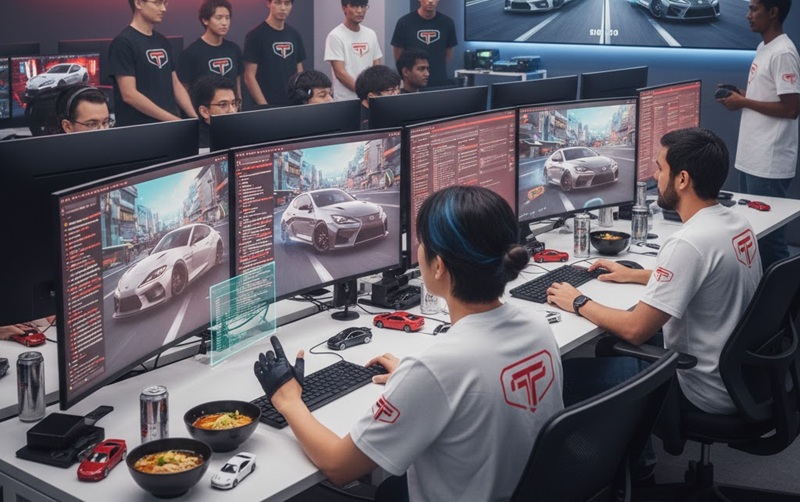
Japanese manufacturing conglomerate Toyotais developing an open source gaming engine. The technology is said to be professionally extensible enough to suit console-grade environments. The work here stems from the Toyota Connected North America workshop unit based in Plano, Texas… so what’s inside this new technology, known as the Fluorite game engine?
Beyond the car plant
Toyota is of course known primarily as an automotive manufacturer, but its Toyota Industries parent division oversees work in areas as diverse as financial services, marine & maritime, housing, aerospace and biotechnology. With all divisions having a significant technology footprint, the company’s Toyota Connected North America unit was founded to work on information and data science projects for in-vehicle services, telematics and AI.
Toyota is using the Flutter toolkit and the Dart programming language to create what is being called a “console-grade” experience, although that “console” appears to be more likely to refer to the dashboard of a Toyota RAV4… onward development may see this technology touch the Xbox or PlayStation in due course.
Texas-based developers from Toyota Connected announced this news at FOSDEM 2026 in Brussels, Belgium. The event is a free, community-driven conference for developers, researchers and users of open source software.
Flutter and Dart
Originated by Google and available as an open source technology, Flutter is the search and cloud giant’s User Interface (UI) toolkit for building natively compiled, visually rich applications for mobile, web and desktop. It works from a single codebase using the Dart programming language, which it dovetails with high-performance widgets. As software engineers will know, Dart is an essentially optimised, object-oriented language that features sound type safety (for guaranteed type correctness), hot reload (for instant code updates) and versatile compilation. Dart is well-suited to fast, high-performance applications, such as modern gaming apps that run on mobile, desktop and web.
For additional context here, Dart’s widgets include the const keyword widget, which works to instruct Flutter that a given widget should never be changed… and this helps software framework efficiency because it can skip it if and when rebuilds occur. Other widgets look after areas such as state management, performance acceleration and some non-UI tasks.
“Think of widgets like blueprints for a house – you can’t renovate the blueprint itself; you need to create a new one. Once you create a widget, you can’t change its properties because widgets in Flutter are immutable,” writes Arslan Yousaf on his own blog.
Fluorite game engine
Aiming to create what the team call stunning interactive experiences, the Fluorite game engine also makes use of Google’s Filament 3D rendering engine, an open source technology that powers a real-time physically based rendering (PBR) engine. Filament is in fact designed for mobile-first efficiency (so that’s obviously not console, generally speaking) but it does offer cross-platform 3D graphics compatibility for Android, Mac iOS & macOS, Windows, Linux and WebGL.

This is not completely new ground for Toyota; the company’s in-vehicle home screen already makes use of an embedded Flutter run-time with Yocto Linux (a distribution known for its use in lightweight Linux-based embedded systems) and Wayland, a modern communication protocol for Linux display servers.
3D scene views
According to the development team behind Fluorite, this is the first console-grade game engine fully integrated with Flutter. “Its reduced complexity [is achieved] by allowing [developers] to write your game code directly in Dart and using all of its great developer tools. By using a FluoriteView widget, you can add multiple simultaneous views of your 3D scene, as well as share state between game entities and UI widgets – all in the Flutter way.”
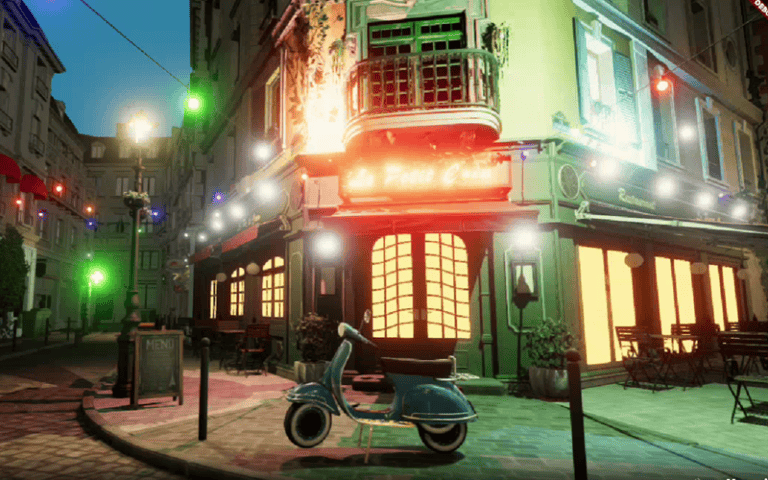
Powered by Google’s Filament renderer, Fluorite makes use of modern graphics APIs such as Vulkan to deliver hardware-accelerated visuals comparable to those found on gaming consoles. With support for physically-accurate lighting and assets, post-processing effects and custom shaders, developers can create visually rich and captivating environments.
Digital cockpits come of age
The team are said to have developed Flourite because the Unity and Unreal engine carried too much resource weight and also came with more onerous licensing fees. Another well-known game engine, Godot, was also rejected due to its resource-intensive neediness and its over-long start-up times.
You can view a working video of the engine here and also here.