
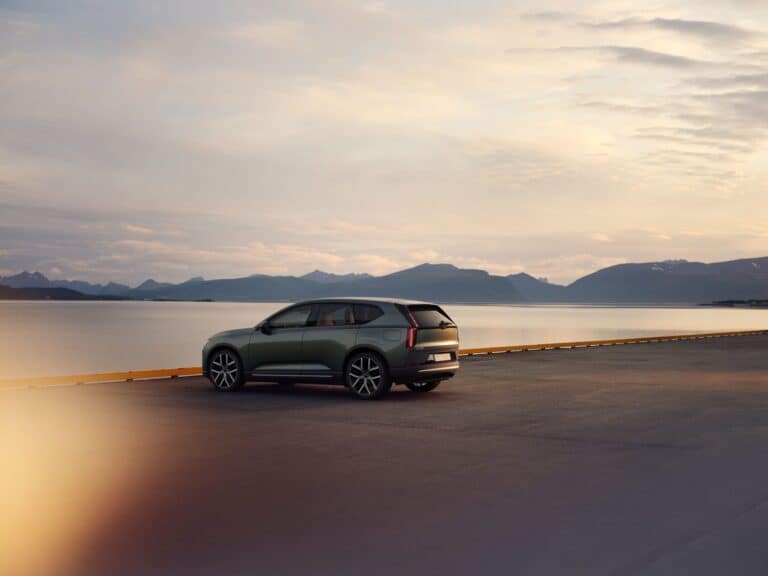
Last Wednesday in Stockholm, Volvo presented the EX60, the first fully electric car built on the new SPA3 platform. With the introduction of HuginCore, its own computing system, the Swedish car manufactureris marking the transition to fully software-defined vehicles. The development took five years and an investment of around €26 million in a 22,000-square-meter software test center in Gothenburg.
Volvo is naming its core computing system for the first time. HuginCore, named after the raven from Norse mythology, encompasses the electrical architecture, the central computer, the zone controllers, and the software that controls the EX60. The hardware consists of NVIDIA’s DRIVE AGX Orin system-on-a-chip with 254 TOPS (trillion operations per second) running on the DriveOS operating system, supplemented by Qualcomm’s next-generation Snapdragon Cockpit Platform for infotainment. “HuginCore, our state-of-the-art system of hardware and software, combines our in-house developed technology with the best services and technologies from tech leaders such as Google, NVIDIA, and Qualcomm Technologies,” says Anders Bell, Chief Engineering & Technology Officer at Volvo.
Zone controllers replace traditional ECUs
The architecture represents a fundamental change in how Volvo works with suppliers. Traditionally, tier-1 suppliers such as Bosch supply complete Electronic Control Units (ECUs) – hardware and software as a single package. With HuginCore, Volvo has developed its own zone controllers, on which it integrates the software from suppliers. These zone controllers act as hubs, managing all sensors and actuators within their physical zone.

“We don’t just take a ready-made ECU from Bosch,” Bell explains in an interview. “We have to work with them, integrate their software into our zone controllers, so that their system works and integrates throughout the car.” According to Bell, this approach reverses the traditional tier-1 business model, giving Volvo complete control over the integration layer.
This control over the integration layer enables Volvo to implement optimizations that were traditionally not possible. Bell illustrates this with a concrete example from the EX60’s thermal management. In extreme cold, around minus 25 degrees Celsius, the battery must be protected from freezing. The common solution is a separate electric heater—a PTC (Positive Temperature Coefficient) element, a ceramic heating resistor, which costs around $175 and adds extra complexity and parts.
Volvo opted for a different approach. “We asked ourselves: can we deliberately make the electric motor produce extra heat in such a situation?” says Bell. By making the motor slightly less efficient in extreme cold, it produces enough heat to protect the battery. This eliminates the need for separate heating.
According to Bell, this discussion between the thermal team and the powertrain engineers would never have occurred under the old organizational structure. At the time, each team optimized its own module without looking beyond its own boundaries. “We calculated that for €8 in additional components in the electric motor, we could remove €150 worth of components elsewhere,” explains Bell. “We still have a motor with 93% efficiency, but by consciously ‘investing’ €8 in that motor, we save €150 on a separate heating system.”
According to Bell, this type of system-wide optimization is one of many examples where HuginCore makes a difference. It requires different disciplines to sit down together and approach the car as a single integrated system rather than a collection of separate modules.
Fleet learning and over-the-air updates
HuginCore uses data from the entire EX60 fleet worldwide. “The car draws on the experiences of other Volvos worldwide, including accidents and near-accidents, to continue to improve over time,” according to the product documentation. The software test center in Gothenburg processes this data to implement improvements.
Features can be added and improved via over-the-air updates. During the presentation, Bell gives specific examples: “We can extend range, enable faster charging, and even add new safety features.” NaviPilot Assist, a Level 2+ driver assistance system for highways, will soon be available via an update.
The EX60 does not include a LiDAR sensor, a notable choice given Volvo’s previous commitment to the technology. In 2020, the brand signed a deal with LiDAR supplier Luminar to make the sensors standard on the EX90 and ES90. That partnership has since ended. Volvo had integration issues with the LiDAR software—the EX90 was delayed by months in 2023 due to what then-CEO Jim Rowan called “the complexity of the software code.” Mercedes-Benz and Polestar also halted their LiDAR programs with Luminar. For the EX60, Volvo opted for a different strategy. “We can go a long way with cameras and radar alone,” says Bell. “Especially now that we are transitioning to end-to-end AI models. We will be able to add many more ‘pluses’ to Level 2 before we really need LiDAR.” This shift to AI-driven automotive systems is a broader industry trend in which software is becoming increasingly important relative to hardware.
Future updates will integrate Google’s Gemini AI assistant more deeply with the car’s camera systems. “Eventually, Gemini will be able to use the EX60’s cameras to see what you see and answer questions about the world around you,” Volvo said in the announcement.
Data architecture: local versus cloud
HuginCore’s data architecture has been deliberately designed with privacy and cybersecurity in mind. Volvo distinguishes between local processing and cloud-based fleet learning. “The cameras in the cabin are used, for example, to detect driver inattention, and images from those cameras are only used in a closed loop,” the company explains in its privacy documentation. “Sensors in the cabin can pick up even the smallest movements, such as the breathing of a sleeping baby, to prevent anyone from being left behind in the locked car,” says Åsa Haglund, Head of Volvo Cars Safety Center, during the presentation. Audio recordings from the cabin microphones are not stored, according to the company.
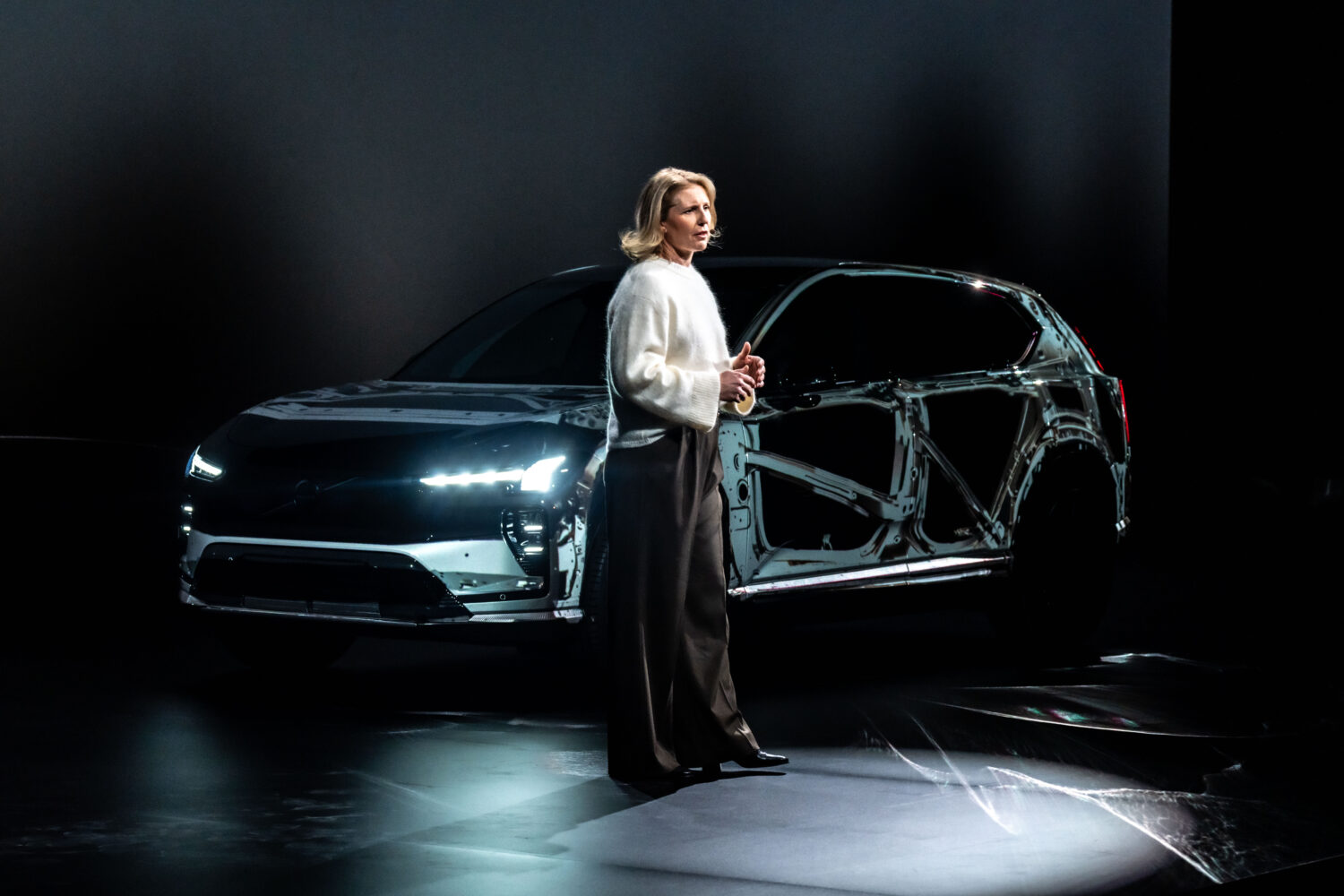
The external cameras, radars, and sensors collect data points to understand the environment. This data is processed locally for driver assistance systems. Only in specific safety-related events can recordings from external cameras be captured. According to Volvo, this separation between real-time local processing and selective cloud uploads is essential to balance privacy and functionality.
Volvo uses aggregated and anonymized data for fleet learning. “Volvo Cars believes that the more vehicles we have sharing real-time connected safety data, the safer our roads can become,” the company says. Volvo is therefore calling on local authorities and other car manufacturers to share anonymized road-safety data.
Cybersecurity according to automotive standards
The vehicles comply with cybersecurity regulations specific to road vehicles (UNECE R155/R156). Volvo actively participates in research and industry organizations, such as AUTO-ISAC (Automotive Information Sharing and Analysis Center). In addition, the company follows international standards such as ISO/SAE and NIST, as well as industry best practices.
“Cybersecurity is an integral part and top priority of our global development work and operations,” the company states. Implementation includes encryption, access controls, and secure development processes. These standards are translated to external service providers. For third-party services, such as Google’s Maps and Assistant, customers must separately agree to Google’s terms of service. These terms specify which vehicle data is shared with Google if the customer chooses to activate the services. “There are also other situations in which customer data is shared with third parties, for example when the customer has given their consent or when we are legally obliged to share data with authorities,” Volvo explains.
Tesla signs mega deal with Samsung for chip production
The importance of testing and safety
The transition to a software-defined vehicle required a different development approach than many traditional software companies are accustomed to. Bell emphasizes the difference in testing intensity. “For automotive, 80 percent is testing and quality assurance. It must always, always be safe.” According to Bell, this intensive testing is necessary because of the nature of the product. “It’s a two-and-a-half-ton object that drives past schools at 130 kilometers per hour. You can’t just throw software at it.” All software must comply with ISO 26262 for functional safety.
The software test center in Gothenburg covers 25,000 square meters, Bell says, and contains various test setups and dynamic test benches. Bell acknowledges that developing the new platform was a difficult process and points to his gray, receding hairline. “Three years ago, this was a huge head of curly hair,” he grins. Then, seriously: “It’s been a tough journey.” The lack of available tools made development even more complex. “There was nothing when we started. Now, more and more toolkits are available, such as software-defined vehicle starter kits. That wasn’t there when we started five years ago. We had to build a lot ourselves.”
Scalability via a single software master
Starting with the EX90, Volvo’s new electric models—the ES90 and EX60—run on the same software master via the Volvo Cars Superset tech stack. Analysts cite Volvo as one of the pioneers in the transition to software-defined vehicles, along with Tesla and BMW. This approach reduces complexity and enables faster updates. Software development is expensive, Bell explains, but once built, the same code can be rolled out to millions of cars without additional per-vehicle costs. “That’s why you need scale to recoup that development investment.” The scalability also extends to the SPA3 platform itself, which can support vehicles from the B-segment to the F-segment. According to Volvo, this modular design and the ability to add features via software updates should lead to lower investment costs and stronger future cash flow.
Akhil Krishnan, Product Line Owner for the 60 series, confirms that the foundation is now in place for faster development. “The key is a platform that can grow and evolve. That requires a lot of conscious design decisions, but if you do it right, making the next car becomes much easier.”
EX60 specifications
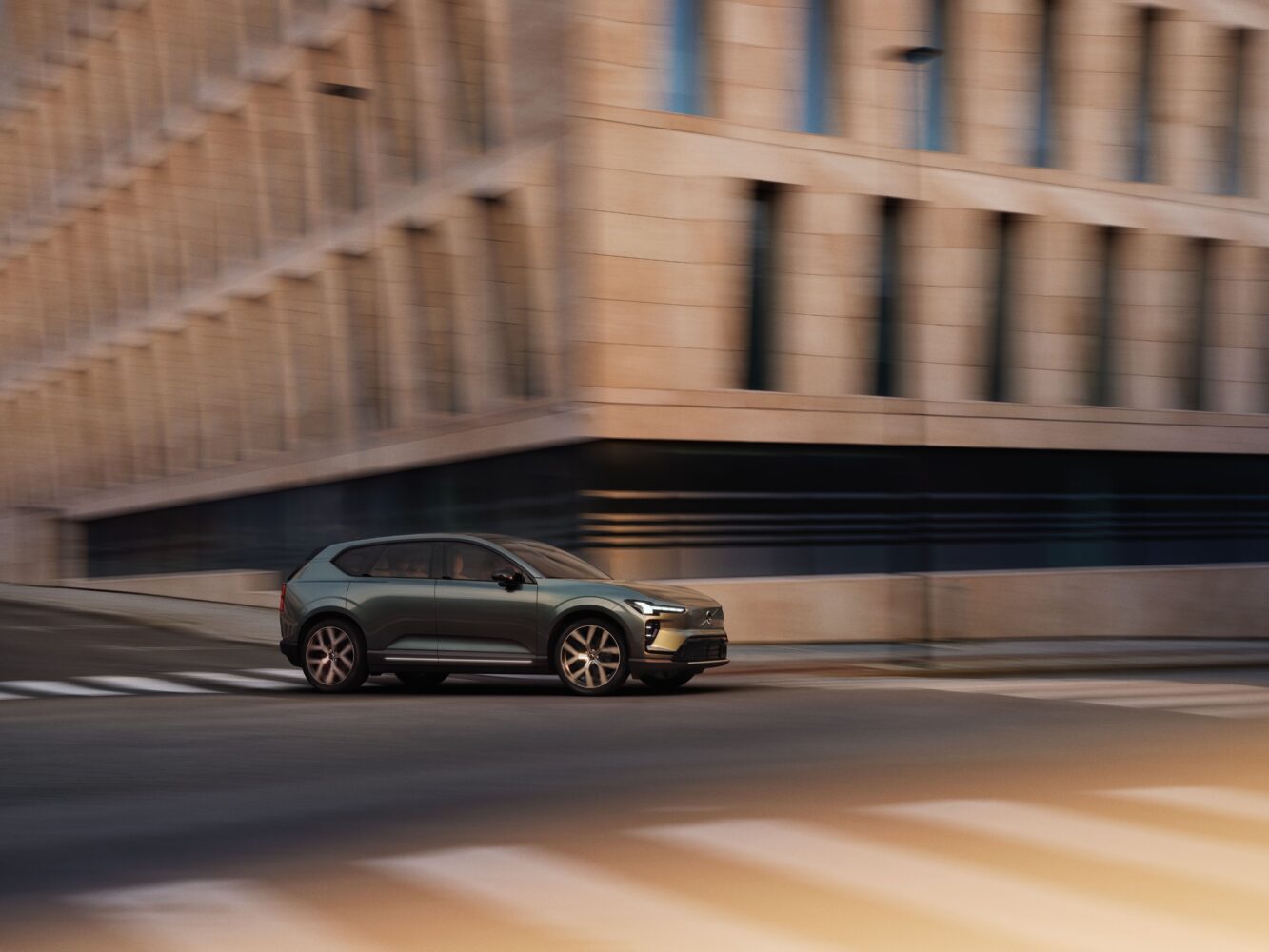
The EX60 offers up to 810 kilometers of WLTP range in all-wheel drive configuration. It achieves a charging speed of up to 370 kilowatts, allowing 340 kilometers to be recharged in 10 minutes at a 400 kW fast charger. The car comes standard with a bidirectional 22 kW charger, which allows energy to be fed back into the power grid (Vehicle-to-Grid), buildings, or other devices. The EX60 is priced at the same level as the XC60 plug-in hybrid, with recommended retail prices in the Netherlands starting at €63,995. Production will start in April in Torslanda, with the first deliveries this summer.
The EX60 is the first production car with integrated Google Gemini AI assistant at market launch. The system offers natural conversation without fixed commands and can switch between multiple languages. The EX60 comes with 48 months of unlimited data for digital services. Connectivity is provided by Qualcomm’s Snapdragon Auto Connectivity Platform.
The car also features new safety technology, including the Multi-Adaptive Safety Belt, which adjusts in real time to the speed and angle of a collision. The battery pack is integrated into the floor structure using cell-to-body technology, reducing weight and increasing interior space. All battery cells are sealed for life, with serviceable components in a separate, accessible space. Volvo offers a 10-year warranty on the battery.