
When Redis changed from an open source BSD license to a proprietary dual license in 2024, six engineers from major tech companies decided the community deserved better. The result was Valkey, a truly community-driven fork now hosted by the Linux Foundation.
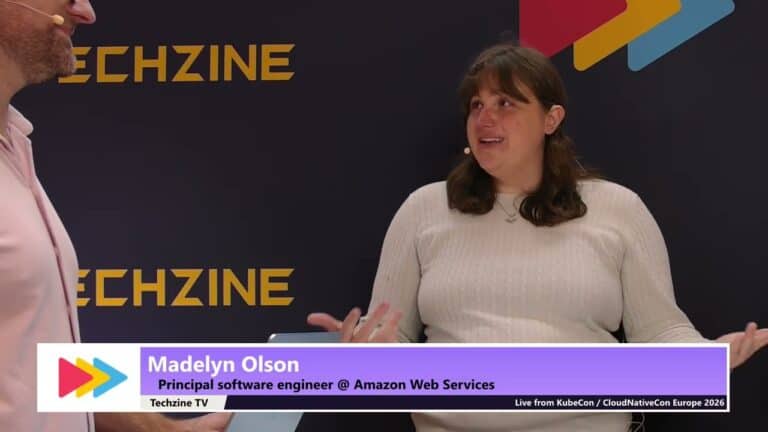
Madelyn Olson, is one of Valkey’s co-founders and spoke with us at KubeCon and CloudNativeCon. Olson talked about the project’s origins, technical direction, and vision for open source database development. As a former Redis maintainer, Olson witnessed firsthand the challenges of contributing to a project with closed governance, even when it was technically open source.
From closed governance to open collaboration
Before Redis’s license change, only two of its five maintainers worked outside Redis Ltd. Olson at Amazon and an engineer named Zhao at Alibaba. When Redis moved to proprietary licensing, and then back to AGPL (which still lacks open governance and includes a CLA allowing future license changes), these maintainers recognized the need for a truly community-driven alternative.
Also read: Flight to Valkey appears to be response to removal of Redis’ open source license
Valky was founded by six engineers from six companies: Zhao Zhao from Alibaba, BinBin Zhu from Tencent, Victor Söderqvist from Ericsson, Wen Hui from Huawei, Ping Xie from Google, and Madelyn Olson from Amazon. This diverse group, representing both cloud providers and telecom companies, established weekly meetings to coordinate development across challenging time zones. The meetings remain open to the public, allowing anyone to drop in and listen to technical discussions on performance trade-offs, memory efficiency, and feature priorities.
Strategic licensing and compatibility decisions
Valkey maintains the original BSD license, ensuring it’s fully open source and avoiding developers having to talk with their legal teams. This choice also means that Redis can incorporate Valkey’s BSD-licensed code into its AGPL project. Valkey, however, cannot incorporate Redis’s AGPL code due to license incompatibility.
Some contributors initially questioned this arrangement, but the team prioritized community benefit and license continuity over concerns about one-way code flow. The BSD license also aligns with the Linux Foundation’s governance model, providing long-term assurance that Valkey will remain open source.
For compatibility, Valkey maintains full API compatibility with Redis 7.2 and earlier, supporting the same RESP protocol. Applications using only open source Redis commands can drop in Valkey as a replacement without modification. Post-fork development has created some interesting dynamics; both projects have independently built APIs that sometimes converge, like the slot statistics feature, which Redis initially rejected but later implemented in a similar form.
Five pillars of technical development
Valkey’s roadmap centers on five core principles: speed, memory efficiency, observability, reliability, and ease of use. These pillars guide feature decisions and community contributions.
Performance and memory optimization
The project has made significant strides in vertical scalability through IO threading, which offloads IO work to background threads. Amazon’s ElastiCache team had built a 15,000-line implementation of this feature, but the Valkey community refined it to just 1,500 lines of C code while maintaining the performance benefits. This focus on memory efficiency proves especially valuable during ongoing DRAM shortages.
Observability improvements
One of Valkey’s first merged features was slot statistics for cluster heat analysis, functionality Amazon tried to contribute to Redis but was rejected. This feature helps identify the hottest slots in Valkey Cluster deployments, enabling better rebalancing decisions. Amazon had maintained this as an internal patch, but Valkey’s open development process allowed it to be merged with full community engagement.
Reliability and ease of use
Drawing on AWS’s operational experience, Valkey emphasizes reliability to minimize customer downtime. The project also maintains Redis’s legacy of flexible, interesting data structures that made in-memory databases accessible to developers. This combination of enterprise-grade reliability with developer-friendly APIs positions Valkey for both production deployments and rapid application development.
Vector search for AI workloads
Valkey launched vector similarity search capabilities almost a year before this interview, positioning itself uniquely in the vector database landscape. While S3-based vector stores offer slow latencies (hundreds of milliseconds) suitable for async workloads, and disk-based solutions like OpenSearch or PGvector provide middle-ground performance, Valkey targets the ultra-low-latency end of the spectrum.
Valkey can do this by keeping the entire vector sets in memory and leveraging the HNSW (Hierarchical Navigable Small World). Valkey handles the random lookups needed to traverse graphs efficiently. This approach delivers high-coverage searches with high recall rates and minimal latency, critical for user-facing AI agents.
For AI inference workloads, Valkey serves as a KV cache backend that’s more memory efficient than older Redis versions while delivering better performance. The caching model extends naturally to vector workloads. Organizations can cache smaller vector subsets in Valkey while maintaining larger sets on slower disk-based systems. This enables faster semantic search and semantic caching that reduces time to first token while slower LLM calls complete.
Community-driven development approach
Valkey’s development philosophy combines pragmatism with openness. The team draws on learnings from proprietary enterprise implementations (like Amazon ElastiCache’s accumulated features), community perspectives from diverse contributors, and continuous engineering innovation. Partners including GCP, Alibaba, Tencent, and Ericsson bring unique perspectives that Amazon alone wouldn’t see.
Since the fork, additional organizations like Percona have joined as maintainers, expanding the community’s diversity. The project actively welcomes contributions that might not align perfectly with initial implementations. The team values taking learnings from big enterprise deployments and refining them into simpler, more elegant solutions. With the goal of serving the broader community.
This collaborative approach has already enabled Valkey to move beyond being just a Redis fork. Initial roadmap items focused on features contributors wanted to add to Redis but couldn’t due to governance dynamics, but the project now charts its own course based on user needs and community innovation.
Looking ahead
Valkey’s trajectory demonstrates that open source database development can thrive under true community governance. Valkey is now innovating independently, supporting diverse use cases from traditional caching to AI inference. It also welcomes contributions from across the industry. The project offers a compelling alternative to proprietary database models.