
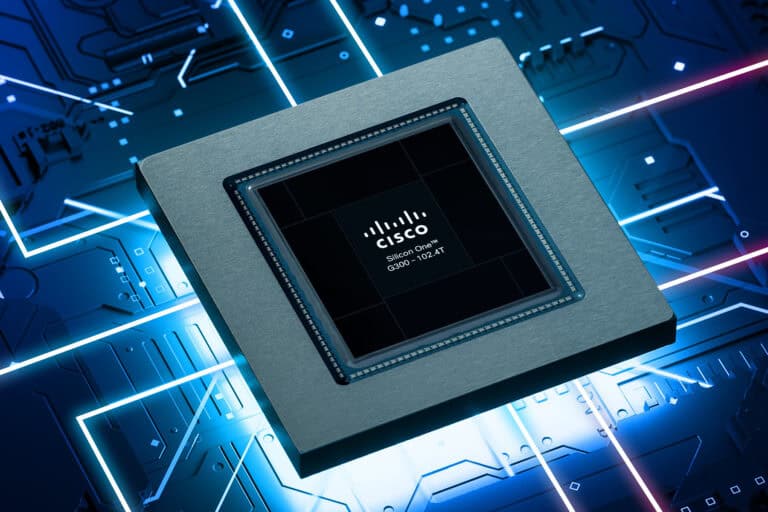
During Cisco Live in Amsterdam, Cisco today announced the new Silicon One G300 chip. Since the launch of Silicon One, this line of chips has played an increasingly important role in Cisco’s story. With the new G300, it sets a new 102.4 Tbps standard for Silicon One and AI networks.
Cisco is now fully committed to Silicon One. In the past, we sometimes wondered aloud what the launch of this line of proprietary network chips would actually bring. This was because the company seemed to have little focus on it. In recent years, however, things have really taken off. Just last October, we wrote about the P200, which is specifically designed to connect AI data centers to each other for so-called scale-across workloads.
Read also: Cisco scales up Silicon One offering with P200 for scale-across workloads
Cisco Silicon One G300
Today, Cisco is adding the G300 to Silicon One. Unsurprisingly, this is the successor to the G200 from 2023. What is surprising, however, is that Cisco has managed to double the throughput speed in just over two and half years. Whereas the G200 (and the more recent P200) delivered ‘only’ 51.2 Tbps, the G300 pushes packets through at 102.4 Tbps.
With this bandwidth, Cisco aims to answer the questions that GPUs pose to the network. Ultimately, in today’s AI world, it’s all about generating as many tokens as possible. Above all, minimizing the number of cycles wasted by GPUs is critical. The network must not be a bottleneck. The G300 is set to become the foundation for building AI networks in the near future. In the words of Martin Lund, EVP of the Common Hardware Group at Cisco, who is responsible for Silicon One, among other things: “The network is becoming part of the compute itself.”
The G300 should enable organizations to deploy AI clusters operating at the gigawatt level, obviously for training, but also for inferencing and real-time agentic workloads.
What makes Silicon One G300 special?
Just before Cisco Live, we spoke with Nick Kucharewski, SVP and GM Cisco Silicon One. Kucharewski joined Cisco not long ago, but his resume includes virtually all the big names in the networking world: Marvell, Qualcomm, and Broadcom.
Kucharewski cites two figures that indicate how much better the G300 is compared to the G200. Although the G300 is a completely new implementation within Silicon One (and is also physically larger than its predecessor), the underlying architecture is more or less the same. According to Kucharewski, this is also important from the perspective of lifecycle management. Cisco’s ability to roll out the same design across the five different series within Silicon One matters as well. “You want a shared base, a single piece of hardware, but different software,” according to Kucharewski.
On top of the shared underlying architecture, the G300 is completely new. It uses more and better engines (the same engines as in the P200, incidentally), more SerDes channels, and so on. The P4 programming language also plays an important role. This is the software Kucharewski referred to above. This programming language deals with what happens deep within the network, at the packet level. Among other things, it looks at the headers of the packets and at any subsequent steps that could speed up their processing.
All in all, according to Kucharewski and Cisco, the G300 should ensure more efficient use of the network. He talks about a 33 percent increase, which should ultimately lead to a 28 percent reduction in the time it takes to complete tasks.
Intelligent Collective Networking
Cisco has captured what makes the Silicon One G300 special in the term Intelligent Collective Networking. This is a suite of features designed to get the most out of the network. For example, the packet buffer is 256 MB. This allows the chip to handle bursts that occur fairly often, especially with AI workloads.
A second component of Intelligent Collective Networking is an intelligent load balancer. Packets can take multiple paths from A to B. The load balancer in the G300 can take into account issues such as errors in the network links or bottlenecks somewhere downstream. This should ensure that packets always take the optimal route. This type of insight also implies that a considerable amount of observability is involved in controlling the chip. Otherwise, it is impossible to know if there is a congestion or bottleneck. Kucharewski calls this “proactive network telemetry.”
The packet buffer primarily ensures a 33 percent more efficient use of the network. This in itself sounds like a significant gain for the network. When you consider that such a gain also means less overprovisioning is needed, it becomes interesting from a financial perspective as well. In other words, infrastructure spending can be reduced. That is certainly an interesting side effect of this efficiency improvement.
Flexible and dynamic
Cisco has ensured that the Silicon One portfolio (and therefore also the G300) is and remains fairly flexible. For example, the way in which the chips process packets is the same. This makes it possible to add features retrospectively, simply by reprogramming or adding extra programming to the chips.
As an example of adding features to a chip such as the G300, Kucharewski mentions optimizing the route that packets take. How a chip chooses the optimal path depends in part on the state of the technology. A new generation of hardware may offer new ways of doing this. The G300 must then be able to support this. Given the substantial Capex investment that this type of hardware entails, this is a crucial part of the platform.
New hardware with Silicon One G300, also with liquid cooling
Along with the G300, Cisco is also announcing some new products. For example, there will be switches in the Nexus 9000 line with the new Silicon One chip. The 8000 series of Cisco routers will also be upgraded with the G300. The new models will be available in a ‘traditional’ air-cooled version, but also in a liquid-cooled version. This means that the new devices will fit into liquid-cooled data centers, which are becoming increasingly common. This is particularly important in the race to 1 MW per rack.
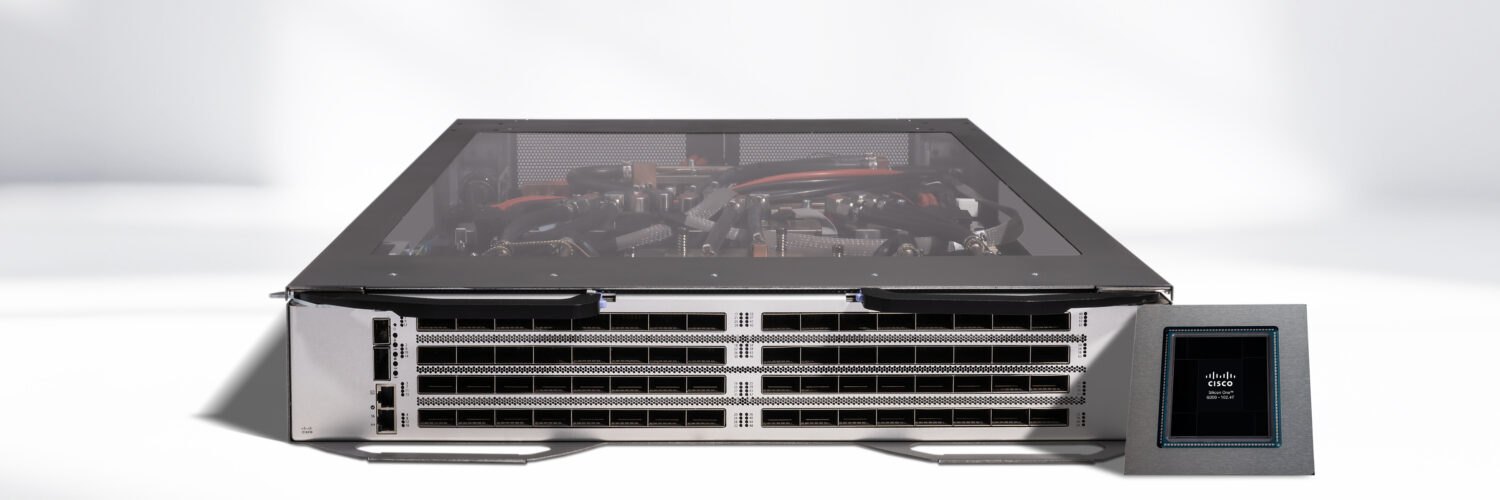
In addition to new switches and routers with Silicon One G300, Cisco is also announcing new optics today. After all, they also have to be part of the race. For example, there will be 1.6T optics that support links between switch and NIC. There will be links of 1.6T, 800G, 400G, and 200G between switch and server. In addition, there will be an 800G LPO. Thanks to the advanced software on top of the G300, it is possible to achieve higher efficiency with the traditionally better performing but less accurate (compared to timed optics with integrated DSP) optics. An additional advantage of LPO is that it consumes less energy. According to Cisco, customers can expect energy savings of up to 30 percent.
As before, the whole system is managed from Nexus One. There is also a link to Hyperfabric, which Cisco announced two years ago. The Cisco N9000 systems form the basis for what Cisco calls Unified Fabric. This should greatly accelerate the rollout and adaptation of networks. Hyperfabric can also be included in this.
The Cisco G300, the systems that use it, and the optics will be available later this year.