
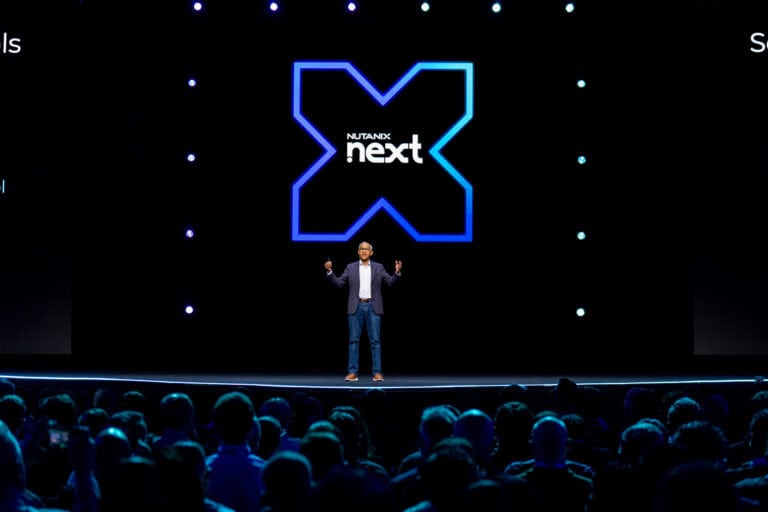
The management of IT environments could be fully automated, but Nutanix isn’t buying into that. Instead, the company is focused on facilitating AI workloads and orchestration wherever possible. Humans remain in the driver’s seat, and surprisingly little changes when it comes to the fundamental tasks of IT infrastructure administrators.
At .NEXT 2026, wishful thinking about AI is hard to find. We’ve actually grown accustomed to vendors making bold promises when it comes to this technology. But, as Dan Ciruli, VP and GM of Cloud Native at Nutanix, points out: fundamentally, the work of Nutanix users isn’t changing. However: “It’s important that people no longer feel intimidated when they hear the word ‘container.’”
Dual-native
AWS EKS, Azure AKS, and Google GKE run virtual machines for Kubernetes nodes by default. This offers simpler management, easier migrations, and better isolation per user than without a hypervisor. Nevertheless, Nutanix now wants to give Kubernetes workloads the opportunity to run with less overhead on bare-metal instances. NKP Metal makes this possible, as we discussed in detail in a previous article. The message here is as follows: Nutanix is now “dual-native,” treating Kubernetes and VMs equally.
Ciruli emphasizes that Kubernetes is still about a workload that can be linked to physical infrastructure and virtualized. He quotes Kelsey Hightower, who has been working on cloud-native architecture and Kubernetes for fifteen years. Nutanix, champion of the“run anywhere” philosophy, now aims to run anything, anywhere. Ciruli therefore does not see the role of Nutanix administrators changing in this regard. It is a reassuring message, as he himself notes.
Furthermore, Ciruli states that 90 to 95 percent of Kubernetes clusters still ideally run within VMs. The bare-metal solution is primarily intended for niche situations such as edge environments with limited computing power or GPU infrastructures that require maximum performance without overhead.
Dealing with scarcity
Equally reassuring is the idea that AI agents can take over the work of provisioning and failovers. The unease arises from the realization that AI is inherently probabilistic and therefore prone to errors. In deterministic IT infrastructures, this can have enormous consequences. Nutanix itself is cautious about the technology, by its own admission. Manosiz Bhattacharyya, the company’s CTO, echoes the familiar philosophy of many tech vendors that humans must be present in decision-making. That is easier said than done. The problem is that agentic AI is still in its infancy in a production setting. When it comes to managing IT infrastructure, the potential use case is enormous. But agents don’t go beyond basic remediation or orchestration. Nutanix is preparing for a future where implementations are more ambitious, with human users acting as curators of a group of agents.
Nevertheless, CTO Bhattacharyya’s vision is unlikely to change anytime soon. “Ultimately, the person in charge is still responsible. You can’t just blame AI for a bug it created. That bug is still yours.” Nutanix is therefore focusing on integrating AI tools within the infrastructure. For example, users can determine which API endpoints are visible to agents via the Nutanix AI Gateway. It is one of the components of Nutanix’s AI proposition, which, in its full-stack form, is called Nutanix Agentic AI. This was already announced during Nvidia’s GTC event and serves as an all-in-one solution for AI adoption. Neoclouds and other IT service providers looking to rent out their hardware, in particular, can benefit greatly from the orchestration layer that the solution adds to everything from CPUs to AI models, GPUs, and database access. In a time of scarcity, Nutanix can thus play a role in the democratization of AI workloads.
Platform company
AI workloads will eventually change the nature of IT infrastructure. To put it another way: AI agents will be capable enough to behave like full-fledged applications and may not require a SaaS layer. This means that Nutanix will eventually host a larger portion of the workload without third-party intervention. In other words: it is increasingly becoming a platform company focused on applications alongside infrastructure. CEO Rajiv Ramaswami acknowledges that the company is undergoing this evolution internally, but that doesn’t mean it can do everything on its own. Nutanix is by no means an Atlassian yet, he emphasizes; the application developer is not yet the persona his company is pursuing.
In recent years, Nutanix has embraced external storage partners, now supporting NetApp, Everpure, and Dell. More partners will undoubtedly follow, but they require validation for this, which apparently isn’t easily arranged. It shows that Nutanix understands it needs to move toward customers rather than imposing an opinionated stack.
Furthermore, the company has seen a notable influx of unusual customers. That is to say: there are now Nutanix users who have nothing to do with HCI, but have chosen the Nutanix Kubernetes Platform (NKP) or Nutanix Database Service (NDB). This means that the “adoption” of Nutanix is not a single phenomenon, but rather multifaceted and diverse. That is clearly the intention: customer choice—and thus flexibility—is a core promise, unlike the competition.
We can’t ignore VMware
The elephant in the room is and remains VMware at every annual Nutanix event. Immediately after Broadcom’s acquisition of VMware, it seemed as though .NEXT revolved around the message “we are not VMware” rather than Nutanix putting itself front and center. That has gradually changed. This year, the migration from VMware to Nutanix appears to have become more predictable. The three-year contracts signed just before Broadcom’s acquisition at the end of 2023 are beginning to expire. Nutanix promises favorable deals for switching parties so there are no duplicate costs during the migration for service partners, but beyond that, the main focus during .NEXT is Nutanix itself rather than VMware, which was just a passing mention.
It has also become clear that the approaches of both parties have little in common, even though both solutions can perform similar functions. Nutanix behaves almost like an open-source player, emphasizing freedom of choice and modular solutions, while VMware by Broadcom, with VMware Cloud Foundation 9, revolves around embracing the full private cloud stack that the company delivers.
Conclusion: Gradual Growth
Nutanix’s continued growth is complex because adoption can now focus on the AI platform, NKP, NDB, or the management layer for a hybrid cloud. But the platform’s further technical development is philosophically very clear. It builds incrementally on its own competencies, emphasizes CTO Bhattacharyya. Tracking core utilization for CPUs is, in fact, not very different from measuring other processors, workloads, or models. Likewise, the adoption of bare-metal Kubernetes via NKP Metal is an extension of what Nutanix has long sought to enable. The stated desire to make workloads flexible and portable gains weight by actually implementing such extensions. That expansion can occur organically through in-house developments, but the acquisition of D2iQ in late 2023, which made NKP possible, shows that inorganic growth is also an option.
Because advanced AI has yet to gain widespread adoption, current developments by IT vendors primarily revolve around proper positioning. How does a solution reach the data? Which platform will host agents? How do they communicate with each other, and which workflows are suitable for which IT environment? Since organizations clearly do not yet have answers to these questions, Nutanix is laying a foundation that provides room to maneuver. This makes .NEXT 2026 somewhat of a formation lap for a race that hasn’t even seen the starting lights yet. Ramaswami notes that organizations aren’t yet ready for agentic workloads, but mostly run AI inference for relatively simple purposes. The idea that organizations may take longer to complete the “AI transformation” requires patience on the part of an IT player—something Nutanix may have already developed, given that the VMware migration is a long-term process. Ramaswami speaks of “waves” of migrations, which will continue to provide ample fertile ground for further growth for the time being.