

HPE’s goal regarding the topics discussed at the RSAC 2026 Conference in San Francisco is clear: it wants to integrate security as deeply as possible into the network. Today, it is introducing the SRX400 Series Firewalls. At the same time, it is also announcing a significant number of other updates. The hybrid mesh firewall is receiving updates related to the use of AI. Significant attention is also being paid to improving organizations’ cyber resilience. This includes the integration of confidential compute into HPE Morpheus Software.
HPE certainly has a quite extensive portfolio in the field of security, especially in the area of network security. This has become even more so following the acquisition of Juniper Networks. The latter was certainly something Juniper had been focusing on for many years.
The SRX portfolio from Juniper (now officially HPE Juniper Networking) is extensive. Most models are designed for medium to large environments, but there are also several models specifically tailored for branch networks. The new HPE Juniper Networking SRX400 Series Firewalls fall into this category as well. Judging by the images (see below), the first model to be released under this brand is the SRX440.
HPE Juniper Networking SRX400 Series Firewalls
The SRX400 series is thus a somewhat more modest firewall for somewhat more modest environments. The idea is that this line will ultimately inherit quite a few of the capabilities and qualities of its larger counterparts. That is why HPE mentions carrier-grade security. It is bringing this to smaller environments with these new models.
Of course, there’s a marketing angle to the statement above. For instance, a firewall from the SRX400 series obviously won’t match the bandwidth of a model from the higher-end lines. That’s not really necessary anyway, since those environments typically don’t require multiple Tbps of bandwidth.
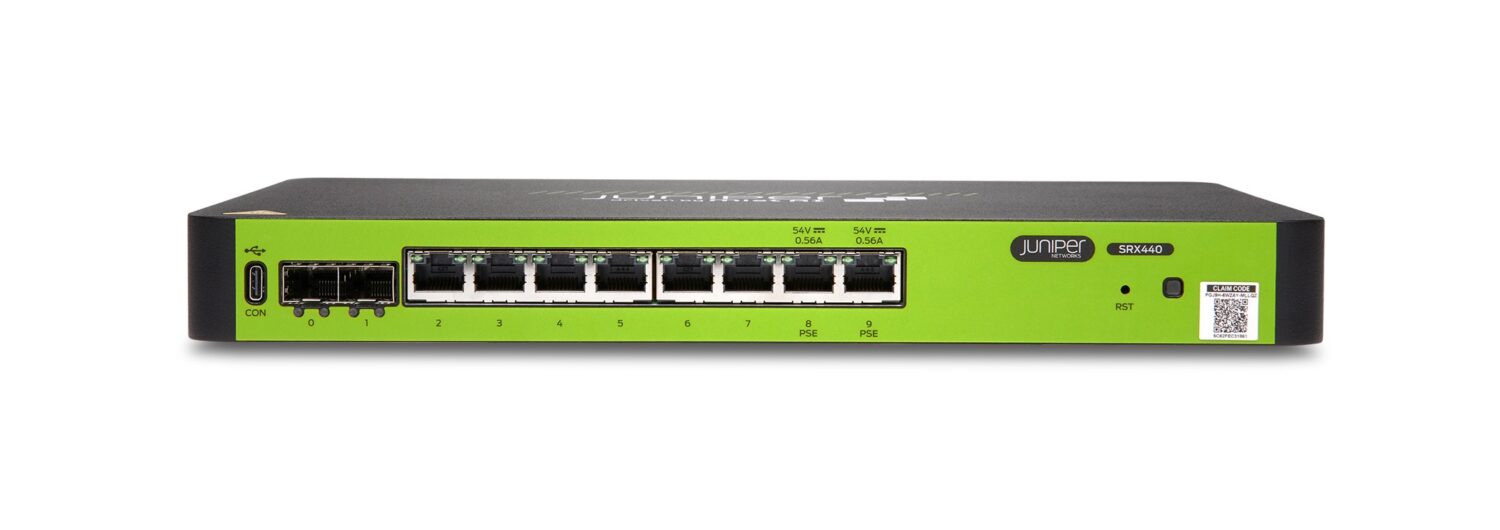
What truly makes this announcement an expansion from the high-end into smaller environments, however, is the fact that the SRX400 series is part of the same ecosystem. The so-called efficacy of an SRX400 (i.e., its performance in blocking threats) is on par with that of an SRX5800, to make an extreme comparison. Beyond that, the firewalls are in no way similar. However, everything runs on the same platform, Junos, with centralized management capabilities.
The network is no longer just infrastructure
The above approach to viewing network (security) products aligns very well with the overarching message HPE aims to convey. We also heard this during an interview just before the RSAC 2026 Conference from Jeff Olson, Director of SASE and Security Product and Solutions Marketing at HPE: “The network is no longer the infrastructure. It is the enforcement point of security, governance, and resilience.” In other words, security must be built directly into the network. It should not be tacked on later.
Elsewhere, HPE refers to its vision as “integral security.” The ultimate goal is a single stack where, among other things, policies are set once and then remain in effect across the entire stack. One advantage of this is that organizations no longer have to deal with an abundance of different security tools. After all, more and more of them are becoming part of the bigger picture.
In essence, this is the platform-based approach to security that we’re also seeing from other players. “No matter how powerful a single tool may be, if it isn’t integrated, you can’t benefit from it,” Olson explains during our conversation. He envisions an “AI-native integrated network and security in one architecture.”
We wonder whether the vision that Olson and HPE have is truly fully achievable. After all, there’s always a new technological development, for which a security tool inevitably becomes available. So a platform approach will always lag behind to some extent. That doesn’t mean, however, that a player like HPE shouldn’t try to offer as much as possible within a single environment. And that is clearly what the company is doing.
Hybrid mesh firewall: monitoring AI usage
In addition to the somewhat bigger news that the SRX400 firewalls are on the way (in Q2 of this year), HPE also has the necessary updates in other areas. For example, the hybrid mesh firewall, which is designed to enable centralized monitoring and management of hybrid and distributed environments, will receive the necessary updates (also in Q2 of this year). The focus here is primarily on (what else?) AI.
The new capabilities of HPE’s hybrid mesh firewall are designed to provide greater visibility into how AI is being used, deny access to AI, and proactively block access to dangerous AI websites across the organization. In addition, prompt-level inspection will be available. This allows content to be filtered and intercepted without compromising productivity. Both updates are linked to the user’s identity. This should result in policies following the user and the workload, rather than the device.
Built-in resilience
Beyond network security, HPE is also announcing improvements in the area of cyber resilience. HPE Zerto Software 10 U9 will gain support for AI-related workloads. This includes support for vGPU, new recovery runbooks, and integration with Microsoft Defender.
Starting in Q3 2026, HPE will integrate confidential computing into HPE Morpheus Software. This combines so-called Trusted Execution Environments from AMD and Intel with key management via Thales CipherTrust. This ensures that data remains encrypted, even during processing. This is particularly relevant for IT environments dealing with issues surrounding sovereignty or sensitive data, including in air-gapped environments.
Finally, HPE is adding post-quantum cryptography to Junos OS Evolved. This is in line with NIST standards. Broader support for Junos will follow in the summer of 2026. HPE ProLiant Compute Gen12 servers with iLO 7 have already been equipped with PQC features.
Read also: HPE Networking goes for Cisco crown with first integrations between Juniper and Aruba