
This week, Nvidia is launching its compact Grace Blackwell workstation: the DGX Spark.
According to The Register, the small but powerful system delivers up to one petaFLOP of computing power and has 128 GB of shared memory. With this, Nvidia is targeting developers and researchers who need an affordable but professional AI workstation solution.
The DGX Spark was announced earlier this year at CES under the name Project Digits. The system is about the same size as an Intel NUC and runs a modified version of Ubuntu Linux rather than Windows. According to Nvidia, the device is intended for developers in artificial intelligence, robotics, and data science who want to run models with up to 200 billion parameters without relying on large server setups.
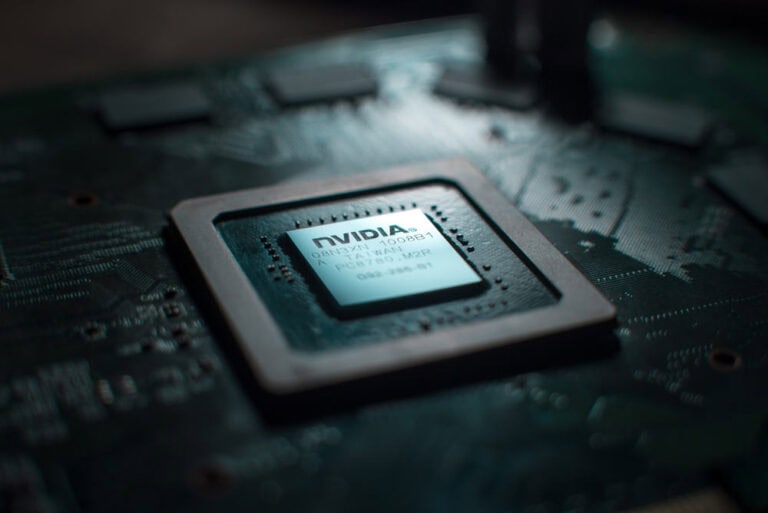
The DGX Spark is powered by Nvidia’s new GB10 chip, a compact version of the Grace-Blackwell Superchip that is also used in the large NVL72 data center systems. The GB10 combines a GPU and CPU in a single system-on-a-chip and uses an NVLink connection with a bandwidth of 600 GB/s. The GPU can deliver up to 1 petaFLOP of FP4 performance or 31 teraFLOPS at FP32 precision, comparable to a high-end consumer card, but with significantly more memory.
Collaboration with MediaTek
The CPU was developed in collaboration with MediaTek and consists of 20 ARMv9.2 cores: 10 high-performance X925 cores and 10 energy-efficient Cortex A725 cores. The CPU and GPU share the same pool of LPDDR5x memory, providing a bandwidth of 273 GB/s. This integrated architecture allows the system to handle memory-intensive workloads much more efficiently than traditional workstations.
With a starting price of around $3,000, the DGX Spark is not cheap, but it is significantly less expensive than traditional AI workstations. For example, a professional GPU such as the RTX Pro 6000 with 96 GB of memory costs more than $8,000, excluding the rest of the system. The DGX Spark should therefore be an attractive alternative for smaller AI projects or local model development.
Nvidia positions the system as an entry-level DGX model, intended for individual developers and research institutions without data center infrastructure. Despite its compact size, the company claims the system is suitable for training and inference of models with up to 200 billion parameters, a scale that typically requires data center hardware.
A notable feature of the DGX Spark is its integrated ConnectX-7 networking technology, with two 200 Gbps QSFP Ethernet ports. These can be used to connect two DGX Spark systems directly. In that configuration, users can run models with up to 405 billion parameters with 4-bit precision.
The DGX Spark will be available through various hardware partners, including Acer, Asus, Dell Technologies, Gigabyte, HPE, Lenovo, and MSI. The market launch is scheduled for October 15. With the launch of this system, Nvidia appears to be creating a new category of workstations: compact, energy-efficient, and powerful enough for modern AI applications outside the data center.