
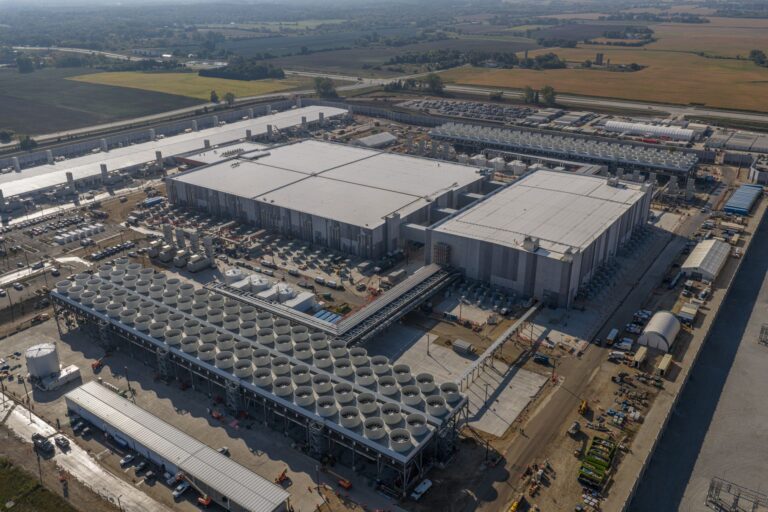
Microsoft and Google keep the energy consumption of their Dutch data centers secret, despite European reporting obligations. The Netherlands Enterprise Agency (Rijksdienst voor Ondernemend Nederland, RVO) received blank forms or no data at all. The Dutch newspaper NRC reports that the government has no legal means to request the actual figures.
The new European Energy Efficiency Directive (EED) requires large companies to report their energy and water consumption annually from 2024 onwards. Data centers with at least 500 kW of installed IT capacity must report to national authorities such as the RVO by May 15 at the latest. However, compliance appears to be problematic: of the 160 Dutch data centers, 104 submitted something, but 27 left crucial fields blank. All but three of these were American-owned. The NRC writes about doctoral researcher Marloes de Valk, who thought she would be able to get to the bottom of the matter thanks to the EU rules introduced in 2023, but nothing could be further from the truth.
Invoking business confidentiality
Google writes that it does not share data due to “business confidentiality, as stipulated in the European directive.” Microsoft states that the reporting “meets the requirements, carefully balancing transparency, security, and business confidentiality.” The RVO confirms that companies were indeed not required to provide commercially sensitive information in 2024. They will have to do so in 2025, but they may indicate that this information is commercially sensitive.
Postdoctoral researcher Fieke Jansen of the University of Amsterdam criticises this position. According to her, Tennet and Liander can share this information if the government requests it, but the political will to do so is lacking.
Growing demand on the Dutch power grid
The Central Bureau of Statistics calculated that the total electricity consumption of data centers will rise to more than 5,000 gigawatt hours in 2024 – 4.5 percent of total Dutch electricity consumption, equivalent to 2 million households. Grid operators expect this to grow from 5 to 15 percent of the total in the Netherlands in five years’ time.
This problem is occurring worldwide, even though there is a much more acute shortage in Europe than in North America, for example. The hyperscalers are also taking other steps there, as Techzine reported earlier. Last month, it was announced that Alphabet is acquiring the American energy company Intersect Power for $4.3 billion to secure its own power supply.
Local administrators in the dark
The lack of transparency also hinders local politicians in making policy, concludes the NRC. This became apparent this month during the decision-making process on a new high-voltage line for the heavily overloaded electricity grid in North Holland. Various authorities are at odds over where the high-voltage line should be located and the best location for a new high-voltage substation right next to the hyperscales in Middenmeer.
Microsoft announced major expansions of its data center in Wieringermeer, while the North Holland grid is now so full that new applicants for a power connection have to wait ten years. This is the grid that contains the massive Amsterdam region as well as many smaller municipalities that hyperscalers have flocked to. Local administrators do not know how much power these companies consume, even though municipalities and provinces are the competent authorities for the arrival of data centers. The strategic position of the Amsterdam data center hub is not easy to assess, but it is certain that there are plenty of other locations within Europe that would love to take capacity (and relevance) away from the AMS region.