
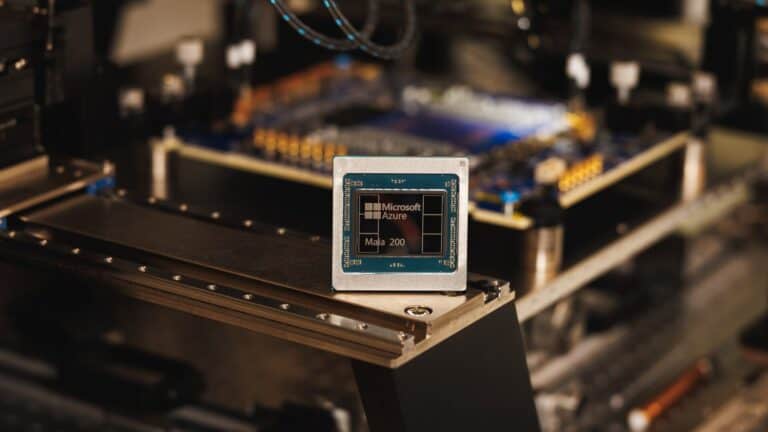
Microsoft introduces Maia 200, an AI chip that the company claims is significantly faster than competing products. The accelerator is specifically designed to run large AI models and offers 30 percent better performance per dollar.
The chip is manufactured on TSMC’s 3-nanometer process and contains more than 140 billion transistors. Microsoft positions Maia 200 as the most powerful first-party silicon of all hyperscalers. In addition to the speed gain on Trainium 3 in FP4 computation (3x faster), Microsoft claims that the chip also outperforms Google’s seventh-generation TPU in FP8 computations (5,072 for Microsoft versus 4,614 for Google).
Each Maia 200 chip delivers more than 10 petaFLOPS of computing power in 4-bit precision and over 5 petaFLOPS in 8-bit precision. All this within a power budget of 750 watts. The memory subsystem consists of 216GB of HBM3e memory with a bandwidth of 7 TB/s and 272MB of on-chip SRAM.
System and network design
Microsoft has opted for a two-layer architecture based on standard Ethernet. Each Maia 200 system offers 2.8 TB/s bidirectional bandwidth and can support clusters of up to 6,144 accelerators. Within each tray, four Maia chips are fully connected via direct, non-switched links.
The chip integrates seamlessly with Azure and is already being used for services such as Microsoft 365 Copilot and Azure Foundry. OpenAI uses Maia 200 for GPT-5.2 models, while Microsoft’s Superintelligence team uses the hardware for synthetic data generation and reinforcement learning.
Maia 200 is currently running in the US Central data center region near Des Moines, Iowa. The US West 3 region near Phoenix, Arizona, will follow soon. Microsoft has not yet announced any other regions in its announcement. Microsoft is now offering a preview of the Maia SDK, complete with PyTorch integration, a Triton compiler, and access to a low-level programming language.
The SDK also includes a Maia simulator and cost calculator to help developers optimize early in the development process. Developers, AI startups, and academics can sign up for early access to the tools.
Tip: AWS is working on new Graviton and Trainium chips as an alternative to Nvidia