
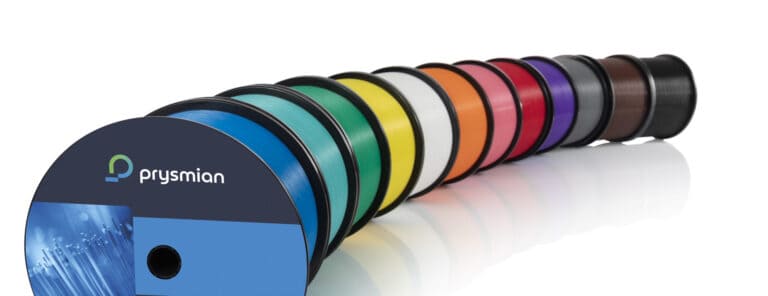
Prysmian has unveiled a new single-mode fiber optic cable with a coating diameter of 160 microns. According to the company, this is the first bend-tolerant fiber of this size to become commercially available.
The development is aimed at further miniaturization of fiber optic cables, so that more fibers can be accommodated in the same physical space.
The smaller diameter allows cables with a higher fiber density to be designed. This is particularly relevant for environments where space is limited, such as underground conduits, buildings, and data centers. Thinner cables make it possible to use existing infrastructure more efficiently and to expand without major civil engineering work.
The new fiber is based on Prysmian’s BendBrightXS technology. According to the R&D team, this technology makes it possible to significantly reduce the dimensions of cables while maintaining their bending performance. This gives cable designers more freedom to create compact designs with a higher fiber concentration than was previously possible.
Despite the thinner coating, the glass diameter remains 125 microns, the same as that of conventional single-mode fibers. The cross-sectional area of the fiber is therefore more than half that of the standard 250-micron variant. The fiber complies with the international ITU-T standards G.652 and G.657.A2 and is compatible with existing single-mode glass fibers. The ColorLockXS coating system is used for mechanical protection and bend insensitivity.
Network densification
The introduction is part of Prysmian’s broader R&D strategy, which focuses on supporting growing bandwidth needs and further network densification. As data traffic continues to increase and networks become more complex, the demand for cable solutions that are both compact and reliable is growing.
This issue is particularly acute in some countries. Network operators need to accommodate more and more fiber optics in densely built-up areas and within existing duct systems. The available space in underground infrastructure is often already maximized, while demand for capacity continues to grow due to data center connections, fiber optic rollouts, and mobile networks such as 5G.
According to Prysmian, the 160-micron fiber offers operators extra flexibility within their current infrastructure. By accommodating more fibers in existing conduits, networks can be expanded without large-scale modifications, which can be a practical advantage, particularly in renovation and densification projects.