
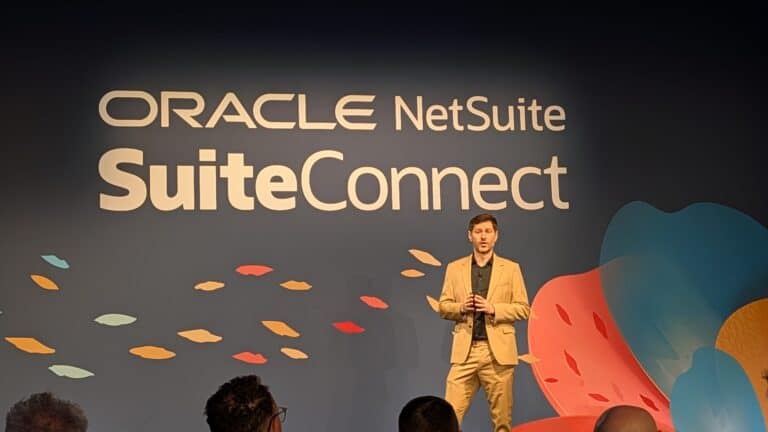
During SuiteConnect London 2026, Oracle NetSuite announced three new extensions for the AI Connector Service. But behind those announcements lies a strategic choice that goes beyond features alone: NetSuite has decided not to enter the model war, but to bypass it. In a conversation with Craig Sullivan and Patrick Puck, it becomes clear what that looks like in practice.
Last year, we asked Sullivan and Puck during SuiteConnect London whether external AI models could also access NetSuite data. The answer was still very cautious at the time, and implementation proved to be quite difficult even then. This year, we asked the same question again, and the answer is radically different.
“It was an inflection point, really only in the past year,” Sullivan admits. The maturity of models like Claude and ChatGPT played a role, but the real game-changer was the arrival of the Model Context Protocol. “As soon as OpenAI adopted MCP, we jumped on it right away,” says Sullivan. “We were probably the first ERP system to embrace MCP as a means of connecting AI to core business systems.”
That’s a remarkable shift in perspective for a company that previously wanted to apply AI primarily within its own platform. The market is simply forcing that openness. Organizations are already using Claude or ChatGPT, separate from their ERP. The question is no longer whether those tools exist, but how to make them work responsibly with your business data.
Three extensions with the same AI strategy
The announcements at SuiteConnect London are essentially three extensions with the same AI strategy. The AI Connector Service Companion helps you ask the right questions of your data. Over a hundred financial prompt templates, tailored to NetSuite’s data structures, roles, and terminology. A CFO doesn’t need to be a prompt engineer to ask meaningful questions. The templates are organized by business process and user role, from Controller to Treasury Analyst.
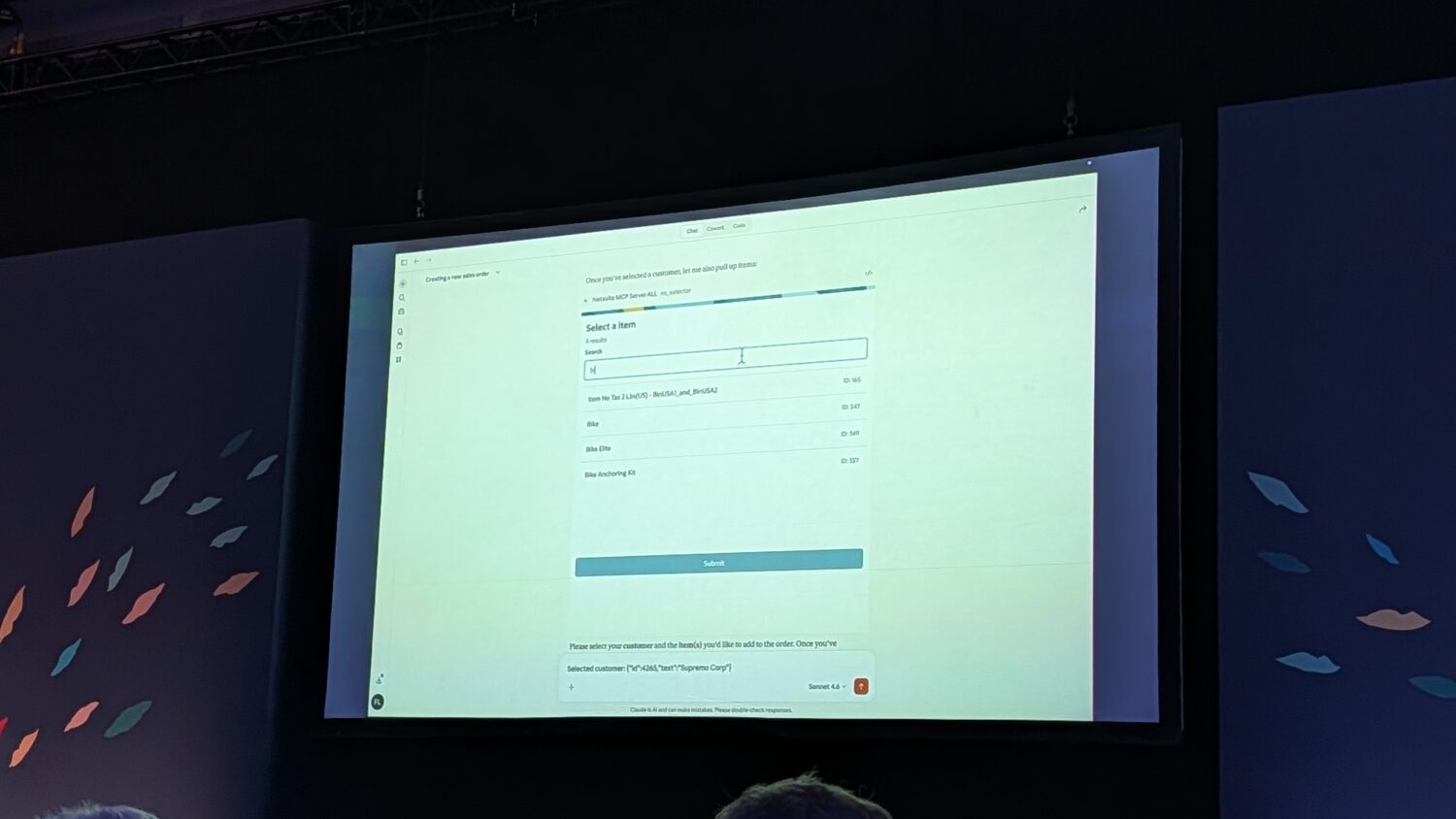
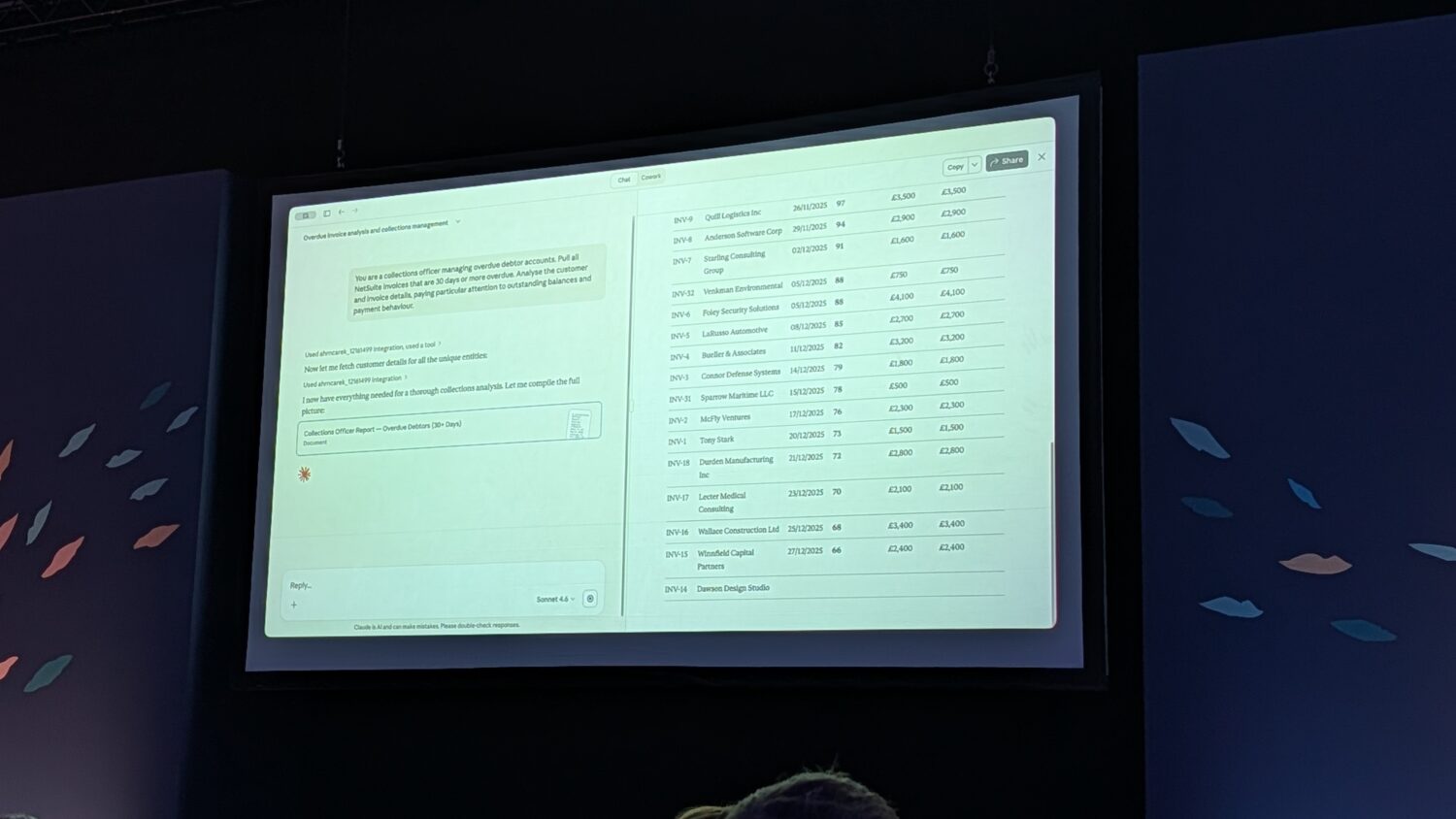
In addition, there are MCP Apps (AI apps) that solve the user interface (UX) problem. Instead of an empty text box, they bring familiar NetSuite interfaces, complete with filters, selections, and reports, directly to the external AI assistant. For example, we saw a demo of Claude that can generate dashboards and HTML pages with full reports, which are immediately visible within Claude. In ChatGPT, that visual layer works via native UI support. Gemini isn’t compatible yet, but as soon as it becomes possible, it will be supported as well. “If they support MCP as a client, it works for them right away,” says Puck. “We don’t block anyone.”
The latest announcement is NetSuite Analytics Warehouse, which opens AI access to historical, analytical, and external data. This allows an AI to perform analyses not only on today’s transactional data but also on multi-year trends, Shopify data, or other systems connected via the warehouse.
Read also: NetSuite Expands AI Connector Service with MCP Apps
The knowledge of 43,000 customers in a prompt library
On paper, the Companion is a library of prompt templates. But in practice, it’s something fundamentally different: it’s the professional expertise of an experienced accountant translated into software. It ensures that even people with less financial knowledge can easily ask the right questions of the data.
When we ask Sullivan how NetSuite determines what goes into those prompts, the answer is telling. “Industry experts, and what we learn from our 43,000 customers, and counting,” he says. “The insights that come from implementations, from conversations with customers who are helping shape the next generation of the platform.” Puck adds, “This is actually the super exciting part of the journey right now. There’s a lot of value in creating these prompts and best practices.”
Critical market and industry knowledge translated into reusable prompts. A good controller knows what questions to ask at the end of a quarter, how to interpret a cash flow variance, and when a reconciliation discrepancy is an error versus a timing issue. That knowledge is now embedded in a prompt template. It’s now available to everyone.
We ask Sullivan directly: Are you replacing employees with this? He chooses his words carefully. “I’ve been around this industry for a long time and talked to lots of customers. It’s rare for a client to say their employees have too little to do. There’s always more work than there are people to do it.” His perspective is that AI enables people to contribute to tasks they never got around to. The prompts don’t replace the thinking; they elevate it to a higher level.
Internal versus external: not a choice but a combination
A logical follow-up question: if you integrate external AI models, can you also replace the internal model? The answer is no, and that is a deliberate architectural choice. Ask Oracle, NetSuite’s proprietary AI assistant, is deeply embedded in the NetSuite architecture. External AI tools work alongside it, not in place of it.
But what happens under the hood of Ask Oracle is more interesting than it seems. NetSuite doesn’t use a single model for everything. “We use the right model for the right task,” says Puck. That sounds obvious, but there’s an underlying layer that selects the right model.
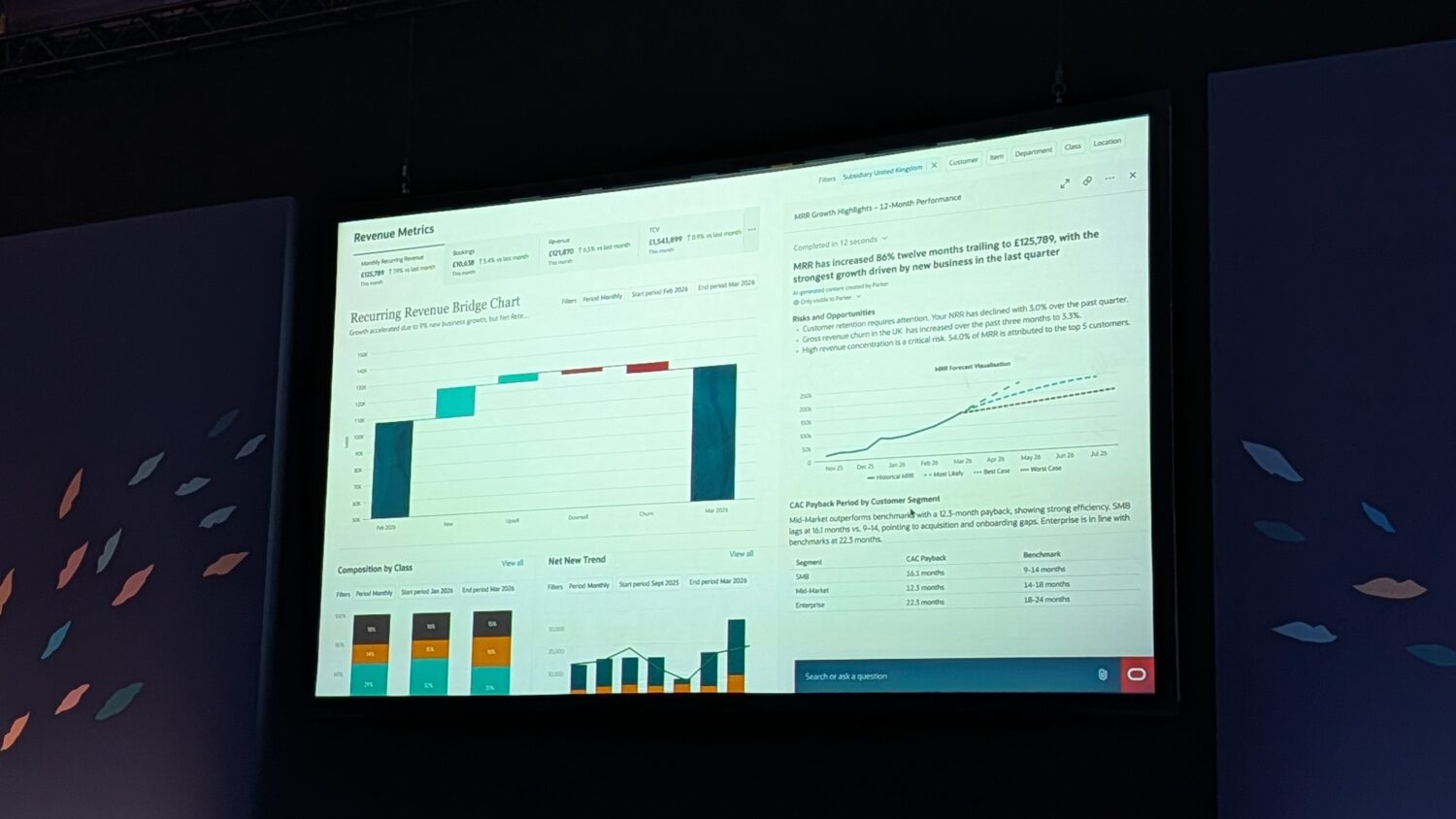
We also asked about the development of relational foundation models. These types of models are specifically designed for reading and analyzing financial data. They can make predictions based on smaller datasets without any training. Puck responds: “It’s a really interesting space. We’re keeping a close eye on it, and there’s a lot of internal research underway, though we can’t talk about it yet.”
What he can say is this: NetSuite builds its own machine learning models for specific use cases and combines them with LLM models. The direction is clear: agentic AI that can also make predictions with the right support, context, and data. “Bringing together agentic AI and predictive AI, there’s a lot of very interesting use cases for making agents able to predict outcomes and then use the reasoning capabilities to make recommendations and take actions,” says Puck. Sullivan calls this the Oracle advantage: through the OCI infrastructure, NetSuite has access to a range of models, including LLMs, predictive models, and proprietary ML models, which are seamlessly and invisibly combined for the user. Anyone typing in the text field gets the best answer, regardless of which model produces that answer.
Conclusion: the platform wins, not the model
NetSuite’s AI strategy is open, just like the platform. By committing to an open standard (MCP) while simultaneously strengthening its own AI with a combination of LLMs, predictive models, and in-house ML, NetSuite aims to become a reliable, context-aware AI platform for financial processes. It doesn’t matter to them which AI model the customer chooses to use.
The direction is clear. The implementation, however, is still very much a work in progress. OpenAI and Claude are up and running; Gemini seems to be just a matter of time. But given the pace of innovation in the AI world: who knows, we might be having a completely different conversation next year.