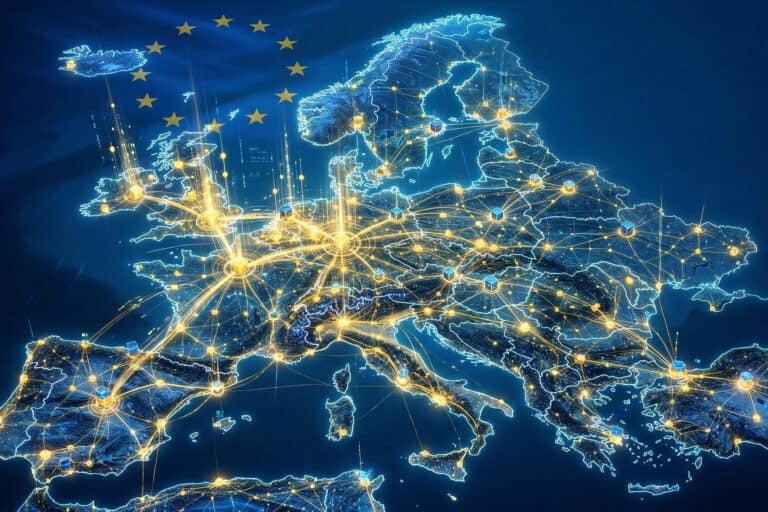
In just twelve months, the expected investment amount for European data centers has doubled from €80 billion to over €170 billion. This robust growth can be seen as a turning point in the European tech industry. Can Europe gain a better competitive position vis-à-vis the rest of the world, and in particular American hyperscalers?
It sometimes seems as if Europe always wants to portray itself as the weak brother on the world stage when it comes to developing its own technology. We sometimes seem to take pleasure in explaining once again that we are hugely dependent on American (cloud) technology and that European alternatives are nowhere near as good as that technology.
To a certain extent, the above description is quite accurate. Europe has no counterpart to AWS, Azure, GCP, or OCI. In fact, these players continue to fill Europe with new data centers. However, something does seem to be changing, according to Michael Winterson, Secretary General of the European Data Centre Association (EUDCA), speaking at Kickstart Europe.
Much more investment in Europe, but from whom?
The latest edition of the EUDCA’s State of European Data Centers report states that €176 billion will be invested in data centers between 2026 and 2031. According to Winterson, this is a significant increase. Last year, investments worth ‘only’ €80 billion were expected for the period from 2025 to 2030.
In other words, future investments in European data centers have doubled in the space of a year. That certainly sounds promising. However, when we ask where these investments are coming from, the picture becomes somewhat less rosy when viewed through the lens of sovereignty. According to Winterson, “by far the largest share” of these investments comes from American players. These could be hyperscalers, but also large AI providers. A few months ago, we wrote about new AI data centers for Microsoft being built by Nscale.
Europe is becoming more ambitious
Nevertheless, Winterson also sees some shifts happening here. He sees European companies receiving more investment from Europe and cites nLighten as an example. This development is crucial to the discussion surrounding digital sovereignty. If Europe wants technology to be a success for European companies, the capital must also come from Europe. The fact is that investors in America are generally able and willing to take significantly more risk than investors in Europe. Winterson is well aware of this, of course. He does believe that there are currently more “Europeans who want technology that helps Europeans become better at what they do.” In this regard, he mentions sectors such as manufacturing, but also healthcare and infrastructure, for example. This should ensure that more investment comes from Europe.
With the rise of AI, it is now perhaps more important than ever to give Europe a solid boost in terms of data center expansion. This has also been stated by Henna Virkkunen, Executive Vice-President for Tech Sovereignty, Security and Democracy at the European Commission. If it were up to the Commission, the total data center capacity in the EU would triple within five to seven years. The emphasis of these investments is, of course, partly on the development of AI Factories, but also on capacity for other workloads.
Why has Europe failed to invest?
It should be noted that improving the investment climate in technology is not a simple task. Winterson cites a Competitiveness Report prepared under the leadership of Mario Draghi. It indicates that there are good reasons for Europe’s failure in this area. Technological services are highly fragmented within Europe, and there is also a lack of a capital market of any substance. Finally, according to the report, there is no competitive energy market. These were and are issues that had to be resolved before more investment could come in. According to Winterson, the European Commission is now working quickly to resolve these issues. In his opinion, this is never fast enough, but the discussion surrounding sovereignty and dependence on technology from other parts of the world is certainly accelerating this process.
Expansion to new hubs
There is undoubtedly a strong desire to increase data center capacity in Europe and, preferably, to finance this with European investments. However, where the expansion will take place is also an interesting part of this development. The traditional five major European data center markets (FLAP-D: Frankfurt, London, Amsterdam, Paris, Dublin) are reaching their limits. Not so much physically, but in terms of energy supply. In other words, data centers need to be spread more widely across Europe. This should not only ensure better provision of workloads where they are consumed. It should also enable the load on the power grid to be spread more evenly.
Winterson therefore expects Europe to have around twelve hub cities within five years. Portugal is an interesting target due to the arrival of subsea cables and a surplus of renewable energy. Genoa, Bordeaux, and other cities are also working on long-term plans, often fifteen years or more. These will not so much take over the role of the current hub cities, but rather complement them. This is a logical development as more and more investments are made. “Data centers are being pushed out because the local economy offers sufficient demand and can afford it. This ensures that these services can become available in that market,” adds Winterson.
These new hubs will initially have more edge characteristics. But in time, they will grow into fully-fledged hubs. In Winterson’s words: “We want centralization to achieve economies of scale. When local demand is large enough to attract investment and, with it, other players, you create a new hub.”
Europe is good at long-term planning
So a new hub does not happen overnight, despite the strong growth in investment in Europe. And that is only the part that we can see relatively easily. There is also a considerable process that precedes it. A good example of this is the new Start Campus location in Sines, Portugal , which we visited last year. According to Winterson, this was a process that took no less than 15 years. Fifteen years of public-private partnership to set up a data center in Portugal, where an undersea cable comes ashore.
“I have been involved in similar projects in Genoa and Bordeaux,” Winterson continues, explaining what is involved in setting up a new location for something that could become part of a new hub. “After the arrival of a submarine cable, it is important to get the local community excited about building a new data center. Then you have to work with telecom operators, among others. These things take a lot of time,” he says.
According to Winterson, long processes are typically something we are good at in Europe. “Europe is looking at the idea of having hubs in every country in Europe and large hubs in twelve countries, and then wants to make plans with the industry as a whole to have a clear picture of what it will look like in advance and not leave it to chance,” Winterson says.
Energy and sustainability
Nowadays, making big plans for data centers inevitably leads to (justified) questions about energy consumption. Additional data centers also mean additional pressure on the power grid and an increase in energy consumption. No one can escape that. It is therefore not surprising that in a country such as Portugal, there is a lot of enthusiasm for building new data centers. That country generates a lot of renewable energy (solar and wind energy). In fact, it has a surplus that it can sell to data centers.
However, this situation does not apply to all parts of Europe where new data centers are to be built. You also have to ask yourself how stable an energy grid is that relies too heavily on solar and wind energy. Not only is it less stable in terms of energy supply, but it also causes problems with inertia. This ensures that any short-term peaks or other deviations from the normal load on the power grid can be absorbed. Solar and wind energy are generally unable to do this. Winterson sees a role here for nuclear energy, whether or not in the form of Small Modular Reactors (SMRs). “Nuclear energy can form the basis for the energy supply and provide a minimum amount of inertia,” he says. This would allow renewable energy to fluctuate without impacting stability.
Can Europe keep pace?
It seems certain to us that data center capacity will increase significantly in the coming years. However, the question remains whether we in Europe can keep up with other parts of the world, particularly America. Winterson readily admits that investments from that corner in Europe will not decline very quickly. Based on the current distribution, we estimate that this would not be desirable either. It would leave a considerable gap.
When it comes to the distribution between investments from the US and Europe, the issue of sovereignty quickly arises. Much of the investment from America in infrastructure on our continent comes from the major cloud players. Think of AWS, Microsoft, Google, Oracle, Meta. AWS, for example, regularly mentions that it has invested some $230 billion in Europe over the past 20 years. It is also pumping a whopping $7.8 billion into the new European Sovereign Cloud.
It is clear that Europe is and will remain an important market for these players. Sovereignty is a sensitive issue in this discussion, Winterson agrees. However, he also wants to add some nuance to this. “The problem is that the word sovereignty initially evokes something vague in people’s minds. Only when you sit down with someone and ask them what they understand by it do you realize that sovereignty has multiple layers,” he says.
Do we always have to talk about Europe vs. the US?
According to Winterson, it is precisely the layered nature, complexity, and nuance surrounding sovereignty that should be a reason not to take a polarizing approach. In other words, for some issues, complete sovereignty is definitely a good idea, but for others, it is much less relevant. Where a YouTube video you are watching is located is much less important than where patient data is located, for example.
To further support the above position, during our conversation Winterson cites how the European Commission views sovereignty within the Cloud Sovereignty Framework. It contains five levels of what it calls Sovereignty Effective Assurance Levels (SEAL). Each organization’s Sovereignty Objective corresponds to a SEAL, where SEAL-0 means no sovereignty, SEAL-1 means that EU legislation applies, SEAL-2 implies data sovereignty, SEAL-3 is defined as digitally resilient, and SEAL-4 as fully digitally sovereign.
Assessment is the first step
Based on the division above, it is possible to conduct an assessment. The result of such an assessment will very rarely be that everything must be SEAL-4. This has important implications for the supply in Europe and therefore also for where the investments come from. In the words of Winterson: “Anyone who has gone through this process [realizing that not everything needs to have the same level of sovereignty, ed.] understands that it doesn’t always matter whether the investment is made in dollars or euros.”
With the above statement, Winterson indicates, among other things, that organizations can continue to use the offerings of the major American players without having to worry about sovereignty. Not because such concerns are unfounded, but because organizations can conduct an assessment in advance. They can use this as the basis for a risk analysis, which takes sovereignty into account.
It is, of course, worth noting that Winterson, or at least the EUDCA, has an interest in seeing more investment in European digital infrastructure. The above nuance is therefore certainly linked to some self-interest. Nevertheless, in our opinion, it is also simply a matter-of-fact way of looking at things. In any case, make sure you know what sovereignty means for your organization. We believe that is an excellent basis and a good starting point.
The real value of data centers
All the attention paid to issues such as sovereignty, but also the sustainability of data centers, is certainly justified. Data centers have made serious strides in the area of sustainability in recent years. According to Winterson, the sector has shown that it is on the right track. Not everyone will agree with this, of course, but he indicates that the sustainability targets set seem to be reasonably easy to achieve.
Data centers can certainly be seen as important infrastructure. However, it is still difficult to accurately assess their value. That value is often still measured in terms of the number of jobs a data center creates or the industry’s share of GDP. This is in contrast to traditional infrastructure, where this is never really an issue. “When a new road is built, no one asks the government how many jobs it will create or how much revenue it will generate,” according to Winterson. The question is much more “what happens on that road?”
For its next report, the EUDCA wants to focus primarily on that last question: what do people use data centers for? In other words, what is the socio-economic impact of data centers? You could call that the real value of data centers. That value is not always clear at the moment, partly because other important questions need to be answered first. Once we have those answers, we can start to assess digital infrastructure in the same way as analog infrastructure.