
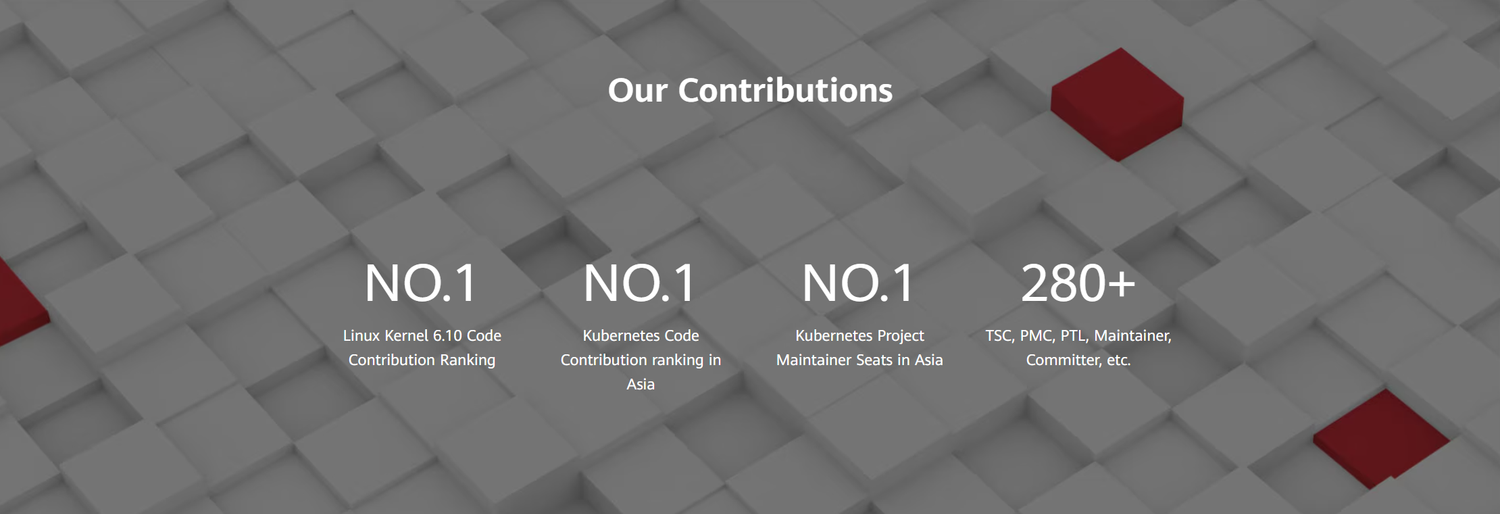
Today, Huawei’s infrastructure contains a vast number of open-source components. Given the importance of distinctive software, this is actually the key to success in the worlds of AI and infrastructure. While the hardware is proprietary, the software layer on top is widely open-sourced. This has resulted in quite a few projects being transferred to foundations and a substantial number of code contributions to the Linux kernel and Kubernetes.
When you look at how Huawei competes with other brands in infrastructure (storage, compute, networking, servers), its open nature is quickly praised. This can be an advantage over proprietary AI stacks from the West, although there are, of course, plenty of possibilities there as well. In the East, however, Huawei and several other major tech companies have thrown their weight behind open-source software, and they are increasingly reaping the benefits.
Which projects stand out?
Huawei recently announced the new Atlas 960E SuperPoD, a product that clearly reflects its open-source strategy. This SuperPoD connects up to 4,096 NPUs within a single system and can scale up to one million NPUs within a SuperCluster. It is the first SuperPoD based on near-packaged optics, with 8 EFLOPS of FP8 performance, up to 16 EFLOPS of FP4 performance, and up to one petabyte of HBM capacity. The system is fully liquid-cooled and is positioned for the training and inference of models with ten trillion parameters.
So what does that look like exactly at the software level? In our view, many aspects of this trace back to the infrastructure and chip layers. In the former case, the hardware component is proprietary, but open components also come into play. CANN, short for Compute Architecture for Neural Networks and a counterpart to Nvidia CUDA, forms the basis of the Ascend chip ecosystem. Huawei has further opened up this layer to community-driven development, giving external contributors a greater say in the platform’s direction. For a long time, this software was considered Huawei’s proprietary foundation. External developers now make up the majority within CANN, accounting for 61 percent. More than 5,200 active developers are now working on it every month.
In addition, Huawei works closely with the Linux Foundation. Ascend is fully integrated into key frameworks such as PyTorch, TensorFlow, vLLM, and Triton. However, Huawei often offers equivalents, such as MindSpore and MindSpeed. Huawei’s proprietary server operating system is openEuler, which is fully open source. Customers can also use alternatives such as CentOS or SUSE. We can imagine this is of interest to European companies, which often employ professionals fully trained and certified in such Western-style frameworks.
Huawei also points out that, with support from the Linux Foundation, Ascend has become the first Chinese computing platform officially listed on the PyTorch website. More than 40 AI models have been natively pre-trained on Ascend and CANN, which, according to Huawei, means that the entire pre-training process can run on the platform.
The model and agent layers
In addition to the infrastructure and chip layers, much of the innovation at the software level focuses on models and agents. Huawei states that it supports more than 65 open-source models, including DeepSeek, Qwen, Llama, and Mistral. Through a “model-as-a-service” platform, developers can access the various models. This complements Huawei’s own foundational models, such as openPangu, which have been made available to the community to prevent vendor lock-in.
For building and managing AI agents, the company relies on a hybrid model. There is a commercial enterprise platform called AgentArts. And there is openJiuwen, an open-source platform for building multi-agent systems using thousands of components based on the Model Context Protocol.
Kunpeng and openEuler continue to grow
During our visit to the company, Huawei also shared new figures illustrating progress on the software front. For example, the Kunpeng ecosystem, built around Huawei’s server processors, now boasts more than 4.16 million developers and over 7,200 partners worldwide. That community supports more than 560 open-source projects.
openEuler is also growing. Huawei states that the operating system has been installed more than 20 million times and holds the top position in the Chinese market for server operating systems. With Kunpeng, Huawei aims to offer an alternative to Intel by explicitly combining hardware and open-source software development.
The Linux Foundation is the partner backing this initiative
At the event we attended with Huawei, the Connect 2026 conference in Shanghai, Linux Foundation CEO Jim Zemlin also spoke. His presence underscores Huawei’s commitment to open-source software. He reflected on the progress made in open source over the past decade. In 2016, about 80 percent of the software in technology products was open source. According to him, that share is now significantly higher; in fact, 98 percent of software worldwide uses open source.
Zemlin states that every layer of the agentic AI stack runs on open source: Linux and Kubernetes at the infrastructure level, PyTorch for training, vLLM and Ray for inference, and protocols such as MCP and A2A at the agentic layer. According to him, the cost per token is now ten times lower due to the rise of open-weight models.
“In a competitive world, open source is a non-zero-sum game,” Zemlin observes. By this, he means that sharing code and knowledge increases the total value rather than dividing up a fixed resource. He cites research from Harvard Business School which, according to him, shows that every dollar invested in shared code yields $2,000 in shared value for everyone who builds on it.
One caveat, however, is that open source for AI models is still debated. “Open weight” is not the same as fully open source code. This nuance also applies to CANN: Huawei speaks of community-driven development, not of a full release under a permissive license.
Huawei says it plans to further expand its collaboration with external developers and open-source projects in the coming period. Zemlin adds that he expects Huawei to continue contributing to shared projects in the agentic AI era. A great partner to reinforce your open-source message.
Tip: Huawei Atlas 960E scales up to a SuperCluster of one million NPUs