
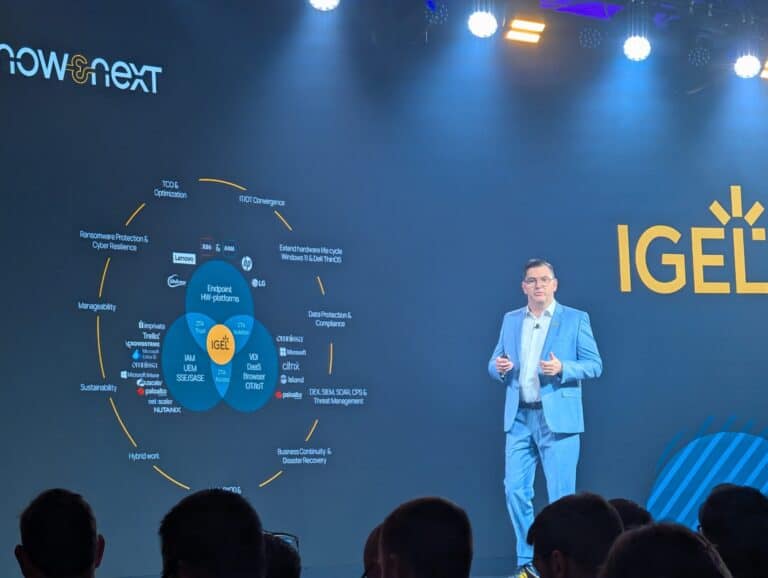
OT machines too often run unchecked and unsecured on their own isolated islands. But if IGEL has its way, those days are over. The IGEL platform is expanding rapidly to bring the manageability and security features it offers IT to OT as well. In an interview with Techzine, CTO Matthias Haas explains that IGEL Managed Hypervisor and IGEL Managed Containers play a key role in this. This IT/OT convergence, along with the Adaptive Secure Desktop and business continuity in the event of attacks or outages, is at the top of the priority list.
During the Now & Next 2026 event in Miami, IGEL made no fewer than 23 new announcements. Things are moving at a rapid pace in that regard, but so much news can simultaneously make it difficult to identify the platform’s overarching direction. When we ask Haas to choose three trends that really matter, his answer is clear. At the top is Adaptive Secure Desktop, the layer that streamlines endpoint management and security by delivering, based on a persona, only the things a user needs. Think data and applications. For IGEL, this principle guides its IT efforts, which aim to support businesses.
The foundation of that vision is the Preventative Security Model (PSM). Haas explains that traditional devices are packed with code that companies don’t actually need, and then cluttered with additional agents. “The Preventative Security Model puts an end to that endless workflow of monitoring, detecting, and remediating,” the CTO outlines. “We want to ensure that we prevent attacks as much as possible.” The PSM operates across three layers: the hardware layer with TPM and root of trust, the application layer for secure connections, and the security UEM layer for integrations with partners such as SASE and SSE solutions. IGEL OS is immutable within this framework; the system cannot be modified during use, forming a concrete line of defense.
OT is no longer a closed island
The second priority—one we see frequently in keynotes—is the convergence of IT and OT. In the OT world, the long-standing principle was that devices could simply run for years on end—air-gapped and unmanageable from an IT perspective. Those days are over, says Haas. OT environments now require update capabilities and must be part of modern network infrastructures.
Although IGEL is now really stepping up its game in this area, it has been focusing on integrating OT more into the platform for some time. The first steps in OT security were taken a few years ago, when the company began supporting HMI (Human Machine Interface) machines via RDP, Citrix, and browser-based applications. Together with Honeywell, it built operator desks for large industrial complexes. And the major automaker Audi can now proudly share an OT use case. The car brand is equipping its entire production lines with IGEL devices. Now, IGEL is also focusing on companies that must comply with regulations such as NIS2 and IEC 62443.
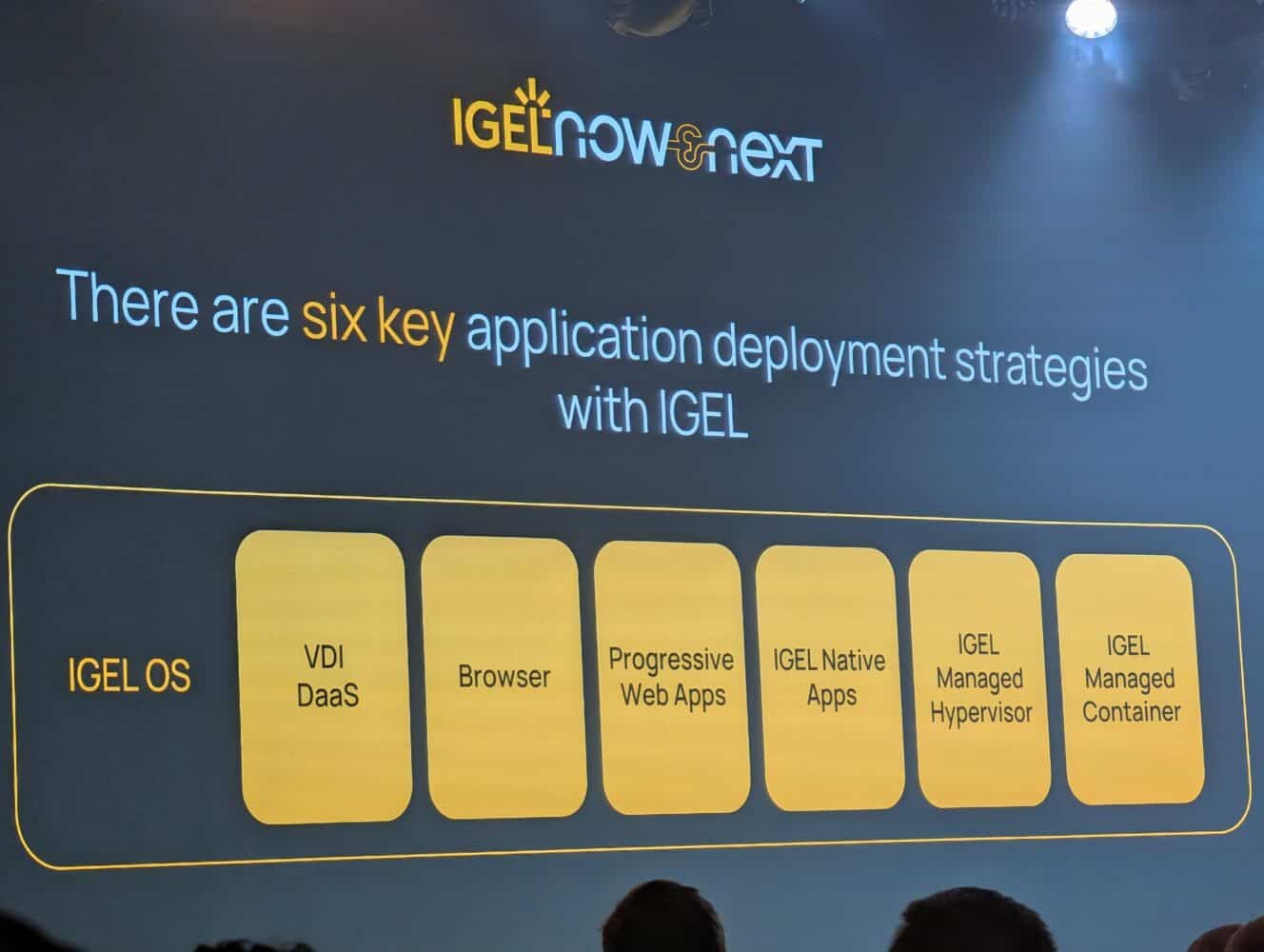
Technically, this OT support is enabled by two components: the IGEL Managed Hypervisor (IMH) and IGEL Managed Containers (IMC). The hypervisor virtualizes legacy hardware, so that older operating systems such as Windows XP are no longer dependent on outdated physical hardware that is now hard to find. We understand from Haas that these outdated Windows versions are still frequently found in production environments. IMC is based on the open-source project Podman, which supports both Podman and Docker containers. This component enables specific workloads to be executed securely on edge devices. ISVs building applications on IGEL OS can thus easily manage and keep their Linux layer up to date.
We also note that the move toward OT may also mean that completely new technology partners need to be brought on board. In principle, IGEL is building on its existing IGEL Ready partner program for further OT integrations. Partners such as Zscaler are already active in IT and OT convergence projects, and IGEL can leverage that. Traditional OT suppliers are gradually being added to this mix. Haas also points to standardization in the OT world. PLC suppliers are increasingly switching to browser-based management interfaces and open APIs, which simplifies integrations. Linux Margo, an industrial consortium of suppliers, helps further standardize these integrations.
Tip: IGEL brings ‘smarter Zero Trust’ Contextual Access to endpoints
BCDR: Keeping the Lights On During an Attack
The third priority is business continuity and disaster recovery. IGEL understands that customers do not exclusively deploy IGEL devices; Windows remains a reality in many environments. BCDR fills that gap. In the event of an attack or IT outage, organizations can quickly launch an alternative work environment with access to critical applications and communication tools.
Haas describes it as “keeping the lights on.” Not all functions are available, but employees can send emails, communicate, and continue their core processes. In healthcare, this involves access to EHR systems within a secure infrastructure. In OT, it involves restarting central control systems so that production lines can continue running. In financial services, it involves continuing to process transactions. After an attack, the organization can decide whether to return to the original environment or reinstall devices.
ARM and AI: Growing but Careful Steps
In addition to the three main priorities, IGEL is also working on ARM support, something that is also important in the OT sector. For ARM, the company is collaborating with Qualcomm, specifically around the Snapdragon 6490 chipset, suitable for small form factor devices up to laptops. The biggest challenges with ARM are peripheral support and application support. IGEL tackles this on a per-device basis; each device, even with the same chipset, requires its own implementation. Announcements regarding specific supported devices are made in collaboration with hardware partners.
AI security is currently a hot topic within the industry. It isn’t immediately among the top three topics we initially ask Haas about, but it certainly isn’t ignored. IGEL focuses on how customers can securely deploy and manage AI workloads on endpoints. Shortly after our conversation with Haas, one of the 23 announcements was made that falls under the AI category. IGEL OS can now run local AI models via Ollama, supplemented by AI Armor for secure and controlled use of AI at the endpoint. Companies in highly regulated sectors, where IGEL has significant market penetration, can thus continue to leverage AI. Adoption in those sectors is now beginning to grow rapidly.
Tip: IGEL is introducing reference architectures for secure cloud desktops