

As cyber threats grow in scale and complexity, protecting network-connected devices has become a strategic priority across industries. Network cameras, as essential IoT endpoints, must adhere to advanced security models – including zero-trust frameworks – to withstand increasingly sophisticated attacks. Robust cybersecurity measures are essential to ensuring long-term resilience in modern surveillance infrastructures.
Axis Communications has embraced a cybersecurity-first design philosophy from the outset. With each generation of the ARTPEC chipset, security capabilities have been systematically expanded – building on foundations like secure boot, hardware-accelerated encryption, and strong authentication.
ARTPEC-9, Axis’ System-on-Chip (SoC) in its ninth generation, represents a pivotal step forward, introducing deeper device-level safeguards and enhanced threat mitigation to fortify modern video surveillance networks. In today’s digital landscape, where security is a baseline expectation for network-connected devices, Axis’ embedded architecture positions it as a leader in secure surveillance technology.
The strategic impact of ARTPEC-9
Cybersecurity is no longer exclusive to critical infrastructure – it is a business-critical concern for organizations in every sector across the whole socio-economic ecosystem. Industries such as logistics, retail, transportation, and data services face growing challenges from distributed endpoints and regulatory requirements. With 71% of organizations naming cybersecurity a top priority, 1 and breach costs rising and regulatory demands increasing with breach costs averaging $6.08 million in the financial sector and regulatory pressures growing, preemptive device-level protection is indispensable for operational continuity and risk mitigation.
ARTPEC-9 integrates seamlessly with the Axis OS firmware to deliver comprehensive security solutions. This synergy makes it indispensable for high-security deployments and businesses reliant on digital systems and sensitive data. Robust software security must be firmly rooted in trusted hardware, which is why Axis designs the chip in-house.
The expanding threat landscape
Cybersecurity focuses on hardening systems to prevent breaches through proactive protection. Surveillance systems now integrate AI, real-time analytics, and cloud-connected capabilities – features that require internet connectivity and expose systems to new attack vectors. In air-gapped or restricted environments, cloud-based functions are limited, heightening reliance on embedded cybersecurity.
Hardware-based safeguards like secure boot, trusted execution environments, and encrypted file formats play a decisive role in maintaining data integrity and preventing unauthorized access – even in isolated deployments.
As surveillance devices become smarter and more interconnected, they also expand the attack surface for threats such as:
- Unauthorized access and data breaches: Hackers exploiting system vulnerabilities to gain access to video feeds.
- Man-in-the-middle (MitM) attacks: Cybercriminals intercept and manipulate communication between two parties, allowing them to steal or alter live surveillance data for malicious purposes.
- Firmware & software exploits: Attackers injecting malware through compromised updates.
- Insider threats & unauthorized personnel access: Unintentional or malicious internal breaches.
Beyond compromising surveillance, these vulnerabilities can turn cameras into gateways for broader IT infrastructure attacks. To counter this, manufacturers must embed multi-layered cybersecurity directly into their products.
In response to the evolving threat landscape, video security manufacturers must incorporate robust, multi-layered cybersecurity measures directly into their products – encompassing both hardware and firmware components. ARTPEC-9 and Axis OS address these risks with a unified platform that combines intelligent processing with built-in security features like encryption, authentication, and hardware-backed identity – protecting sensitive video data and reinforcing system integrity across the lifecycle.
ARTPEC-9: a next-generation cybersecurity engine
Building on a legacy of secure design, ARTPEC-9 enhances the hardware-based Axis Edge Vault platform introduced in ARTPEC-8. Together with the Trusted Execution Environment (TEE) and Axis OS, these components form a tightly integrated cybersecurity architecture that ensures device integrity and trust at every operational layer.
Axis Edge Vault is a dedicated hardware cybersecurity platform embedded in Axis devices, combining hardware-based protection with secure firmware architecture. Optimized for edge deployment, it safeguards critical functions using secure boot, encrypted key storage, and hardware-backed identity. ARTPEC-9 deepens this combined integration with tamper-resistant authentication and system-level verification, supporting zero-trust environments and regulatory compliance.
One of Axis Edge Vault’s key strengths is its ability to protect the operating system through Signed firmware and Secure Boot. Firmware signatures are verified twice – before upgrades and during boot-up – to ensure only authorized firmware is executed. This dual-layer validation is critical for organizations with strict supply chain requirements. Both hardware and firmware are developed in-house, ensuring transparency and protection against counterfeiting or manipulation.
Axis Edge Vault also manages device identity via the Axis Device ID – a unique certificate with corresponding keys that verify authenticity and simplify onboarding. Each device is factory-provisioned with this ID, securely stored and maintained throughout its lifecycle. Compliant with IEEE 802.1AR (IDevID), it enables secure, automated identification and strengthens network-wide cybersecurity.
The encryption and cybersecurity mechanisms
Axis Edge Vault’s security measures include:
- Secure Boot & Firmware Integrity
ARTPEC-9 validates digital signatures during updates and startup, ensuring only authenticated code is executed and blocking unauthorized changes. - End-to-End Encryption & Secure Data Transmission
ARTPEC-9 integrates AES-256 encryption with TLS 1.3 to protect video streams and ensure secure transmission. - Advanced Authentication & Access Control Mechanisms
ARTPEC-9’s deeper integration with Axis OS strengthens role-based access, mitigating risks from unauthorized logins and internal breaches.
This layered approach establishes a robust foundation for defending against sophisticated cyber threats.
Finally, Axis Edge Vault includes Axis Signed Video, which applies a cryptographic signature to each frame of the live video stream. Linked to the device’s unique identity, it verifies footage authenticity and prevents tampering. This enables forensic validation and tamper-proof evidence.
The signing method supports both offline signing and verification – key requirements in the security industry. Signed Video is especially valuable for law enforcement and other stakeholders relying on video evidence. Now supported by ONVIF, it aligns with industry standards for secure integration into professional workflows.
In conclusion, ARTPEC-9 and Axis Edge Vault form a comprehensive embedded security framework – combining verified firmware, encrypted transmission, and device authentication to protect sensitive data. Secure boot and end-to-end encryption ensure device security throughout its lifecycle, supporting operational and regulatory demands in critical environments.
Trusted Execution Environment (TEE): isolated protection for sensitive data
ARTPEC-9 prioritizes security through advanced cryptographic modules, including a Secure Element for key protection. Building on the TEE introduced in ARTPEC-8, ARTPEC-9 expands integration with TPM 2.0 – available as an optional hardware module in selected Axis products. MACsec (IEEE 802.1AE) now benefits from broader implementation, enabling encrypted communication at the data link layer.
The TEE establishes a secure processor area for sensitive operations and cryptographic assets, protected by strict access controls. These assets are accessible only to the system, ensuring confidentiality even in cases of physical access.
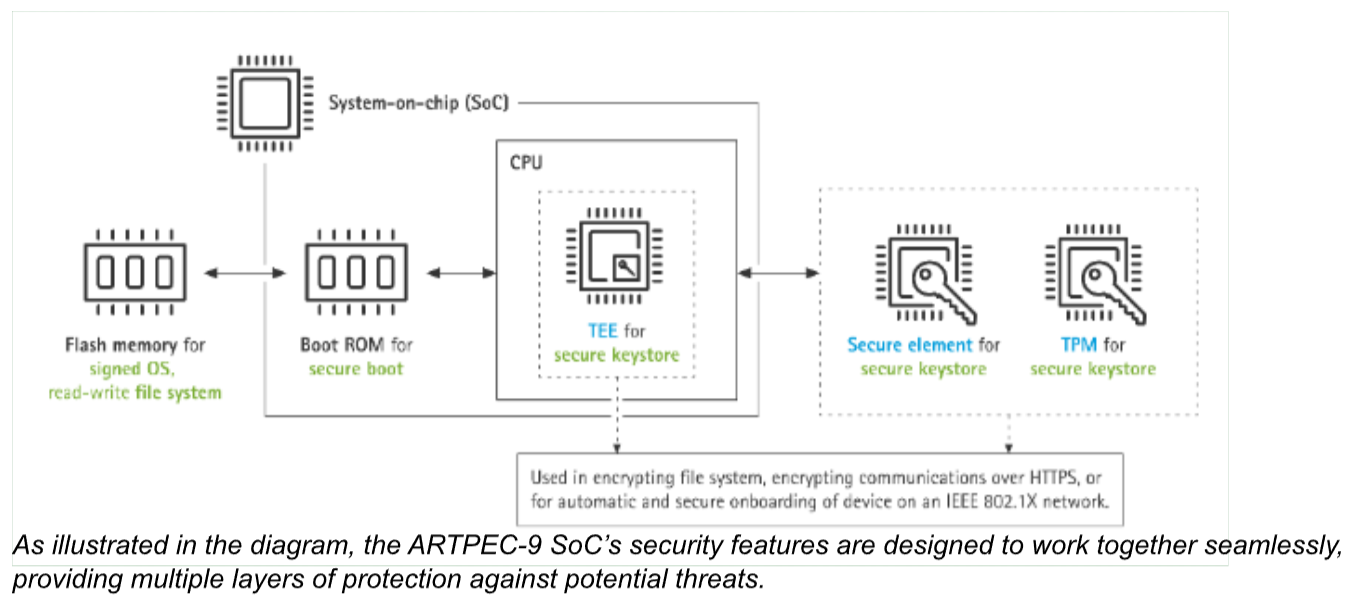
Integrated directly into the processor, the TEE allows trusted code to run securely, working in concert with other protection layers – such as encrypted file formats and Secure Element key storage – to prevent unauthorized access.
While TEEs are common in mobile and banking applications, Axis has adapted this technology to support tamper resistance, system integrity, and resilient data protection in surveillance environments with elevated security expectations.
Structured patching & coordinated vulnerability remediation
ARTPEC-9 supports secure lifecycle management through authenticated software updates. Its patching mechanism verifies firmware enhancements before deployment, reducing the risk of new vulnerabilities.
Axis also collaborates with external security researchers via its bug bounty program and serves as a CVE Numbering Authority (CNA), helping identify and resolve risks early and reinforcing AXIS OS integrity.
Compatibility with leading security platforms
ARTPEC-9 is engineered for interoperability with top-tier VMS platforms, enabling organizations to enhance security without overhauling existing infrastructure. Benefits include:
- Unified Security Management – ARTPEC-9’s cybersecurity features can be combined with existing security software to streamline operations.
- Optimized System Efficiency – Reduces complexity in environments that deploy multiple security systems.
- Scalability & Flexibility – Supports security deployments ranging from small enterprises to large-scale networks with diverse needs.
Reducing cloud dependencies & ensuring on-premises security
As the latest addition to Axis’s renowned ARTPEC chipset family, ARTPEC-9 reinforces secure, on-premises data processing – minimizing reliance on external cloud infrastructure. This localized approach enhances privacy and reduces exposure to network-based threats.
By executing analytics and encryption directly on-device, ARTPEC-9 uses embedded protections – including Secure Boot, TEE, and Axis Edge Vault – to guard against intrusion, firmware manipulation, and supply chain threats. These safeguards support compliance with privacy regulations and secure deployments in high-risk sectors like energy, government, and industrial networks.
With its vertically integrated architecture, deep hardware-software cohesion, and alignment with global cybersecurity standards, ARTPEC-9 stands as a trusted foundation for next-generation surveillance – enabling secure, scalable, and regulation-ready solutions across mission-critical environments.
Also read: Axis Communications builds cyber wall around popular IoT devices