
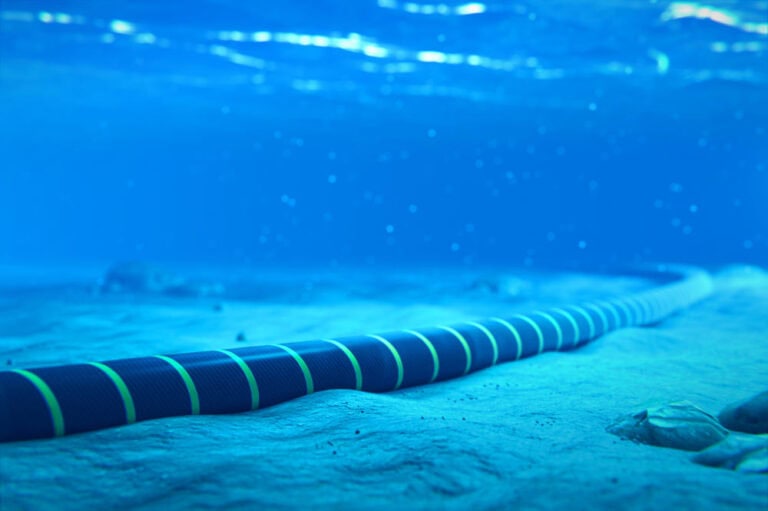
Ten countries agreed at the North Sea Conference in Hamburg to jointly improve the security of internet cables, energy pipelines, and transformer platforms. The agreements are intended to prevent sabotage by countries such as Russia.
The Netherlands and Belgium are working together with Germany, Denmark, France, Norway, Ireland, Iceland, Luxembourg, the United Kingdom, and the European Commission to strengthen the protection of critical infrastructure. The countries will conduct more military exercises in the North Sea to be better able to respond to sabotage and other illegal activities on the water.
These concerns are not unfounded. Last year, a Russian spy ship sailed for two hours above a crucial transatlantic cable north of Terschelling. The ship, Eagle S, part of the Russian shadow fleet, is equipped with equipment to monitor NATO activities. Russia is suspected of having damaged several internet cables and may have been involved in the explosion of the Nord Stream 2 gas pipeline, although Ukrainians are the main suspects in this case. It has not yet been conclusively proven who was responsible for the sabotage.
Wind farms for energy independence
In addition to security, the countries have agreed to invest nearly €10 billion in wind farms in the North Sea. By 2030, this should lead to significantly more capacity, with the goal of generating 100 GW of electricity by 2050. Europe wants to become less dependent on third parties, including Russian gas. However, the development is not without obstacles: energy companies consider the risks too great due to increased costs and uncertainty about future demand. The Netherlands is therefore resuming subsidies for the construction of offshore wind farms this year.
The collaboration extends to the construction of electricity cables and transformer platforms between countries. Electricity can then be transported to the country with the greatest demand, reducing the need for backup gas-fired power stations.
Major impact
Amsterdam is considered a major connectivity hub via AMS-IX. If large-scale sabotage were to occur to and from this region via submarine cables, the effects would be immediately felt. The Border Gateway Protocol (BGP) would attempt to reroute all traffic, for example via Dublin, Bordeaux, or Lisbon, for a connection to Europe. Some data would suddenly be redirected, ending up in North America, for example.
For end users, the initial consequences would be increased latency and poor accessibility of some services due to the enormous congestion. It is likely that many online services would then fail completely. The recovery operations would also be costly, which means that a proactive approach, as is currently being suggested, could prevent a great deal of damage.
Read also: Advisory body examines vulnerable submarine cables