
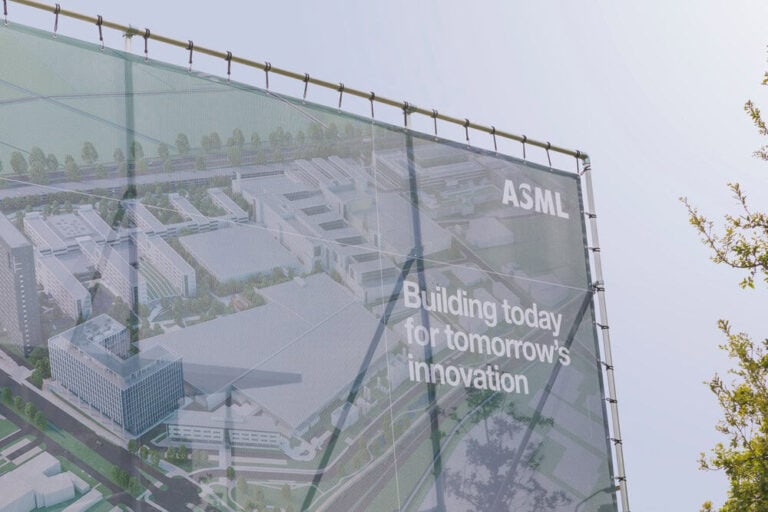
Due to ASML’s significant importance to the Dutch economy, the Netherlands stands as an exception to Europe’s struggle to capitalize on global investments in AI. Economists at ING do warn, however, that the growing dependence on a single company could pose an economic risk.
According to an ING analysis, ASML’s direct contribution to the Dutch economy could reach 1.6% by 2026. In 2025, this figure stood at 1.3%. If you factor in the many domestic suppliers and investment-related activities, the economic impact could rise to 2.2%.
The chip equipment manufacturer is thus a key driver of Dutch economic growth. ASML accounts for about half of the Dutch machinery industry’s revenue, and its extensive supplier network generates additional economic activity.
The growing demand for AI infrastructure strengthens ASML’s position in the global semiconductor industry. The Veldhoven-based company is the world’s sole supplier of advanced extreme ultraviolet (EUV) lithography equipment, which is essential for producing advanced chips.
ING estimates that domestic suppliers could add 0.4% to Dutch economic output by 2026, with investment-related activities adding 0.2%. The benefits extend beyond revenue and employment, as suppliers can improve their productivity and technological capabilities through collaboration with ASML.
Risk of a Nokia-style scenario
ING warns that increasing concentration of economic activity around ASML could make the Netherlands more vulnerable to semiconductor market fluctuations. The economists compare the situation to Nokia, which accounted for approximately 3.8% of the Finnish economy in 2000. After smartphones rose, Nokia lost its dominant market position. By 2011, its contribution to Finland’s GDP had fallen to about 0.5%.
Although the Dutch economy is more diversified than Finland’s was during Nokia’s heyday, ING believes the comparison highlights the risks of heavy dependence on a single company.
Geopolitical tensions pose another challenge. U.S. export restrictions are already hindering ASML’s access to the Chinese market, while disruptions among international suppliers could hamper production.
Domestic constraints, including a shortage of skilled labor and limited space, could also hinder further expansion. Despite these risks, ING expects ASML and the surrounding semiconductor ecosystem to remain key drivers of Dutch economic growth in the coming years.