
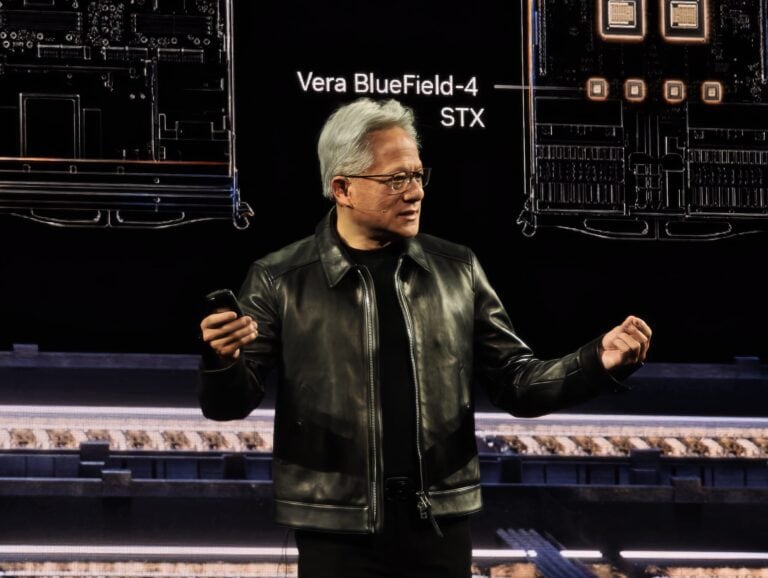
At GTC in Berlin, Nvidia is casting a wide net. After all, expanding AI in Europe requires a broad range of companies. “Extreme co-design” is necessary to make optimal use of the many facets of Nvidia’s computing power and software, says CEO Jensen Huang.
Huang refers to “processing the entire agent,” from the NVL72 compute node for model processing to Vera MGX, CMX (storage), and RTX nodes. A single “computer” can be pulled from a rack as a single, cohesive unit. New chip technologies based on photonics, developed in collaboration with TSMC, were necessary to achieve the desired bandwidth and speed.
DSX POD AI Factories reduce idle time
The hardware is already familiar, but during GTC Berlin, Nvidia announced a new packaging solution for it. DSX POD AI Factories are containers equipped with all the computing power needed for AI workloads. DSX POD itself is a reference design that vendors such as Dell, HPE, Schneider Electric, Vertiv, and Bull are bringing to market.
The solution has many predecessors: compact IT clusters are more than happy to use the ISO 668 standard container format for this purpose. Nvidia states that wider adoption of this approach will reduce deployment time from months to days. The units will be pre-tested, allowing clusters to go online without the construction time required for large data center campuses. Designs based on the DSX POD AI reference will be available in early 2027.
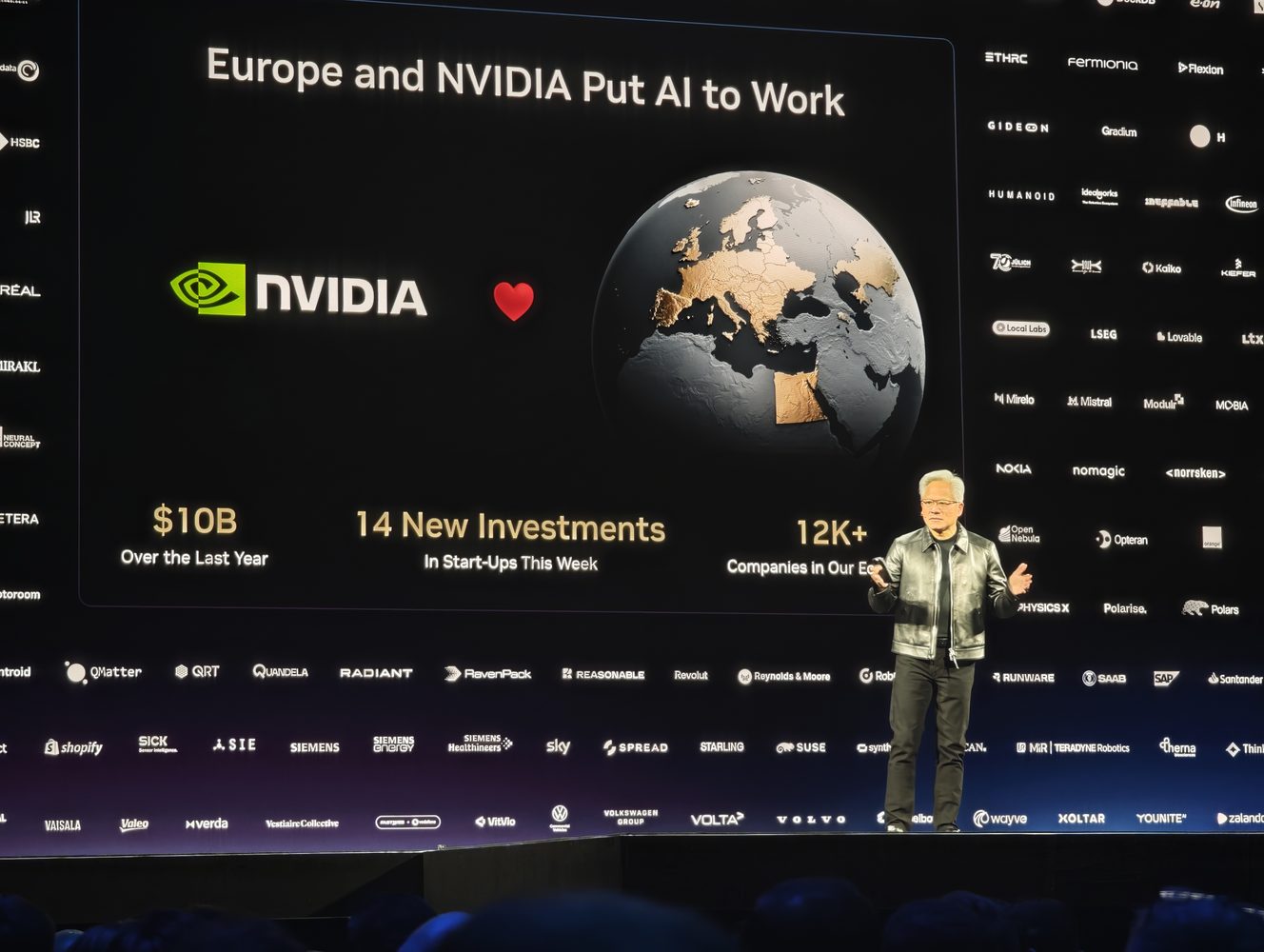
Lower power consumption, less water
DSX returns as the name for the entire architecture of an AI factory. This encompasses everything within the IT stack, from computing power to the network, storage, software, power, and cooling. To broaden the adoption of AI tools beyond just “AI-native” players, as Huang describes them, it is necessary to manage available water and power resources more flexibly and cautiously.
Vera Rubin, for example, supports cooling at 45 degrees Celsius, using closed loops and dry coolers to eventually reduce water consumption to zero. According to Nvidia, this saves about 54 million liters of water per day for a 2-gigawatt cluster. As is often noted, that is equivalent to the water consumption of 180,000 households.
Nvidia positions DSX MaxLPS as a smart way to manage power. Dynamic allocation of available energy should result in 30 percent less power consumption within a given budget, while maintaining the same number of tokens as output. At the level of the broader power grid, DSX Flex reduces a cluster’s power consumption by up to 40 percent. Note: this is a simulation conducted by Nvidia itself. Through DSX OS, users can utilize a Config Manager, Rack Management Service, and Cluster Readiness Engine to optimize the daily use of the IT infrastructure.
Conclusion: A solution to severe problems
For many, the required hardware and substantial costs associated with AI deployment are no longer particularly appealing. Setting aside the economic instability that may accompany this, there are simply barriers that have nothing to do with those direct costs or supply issues. Limited capacity regarding power, water, and approval from both political and societal spheres all lack concrete solutions. However, a temporary workaround and some relief are on the horizon: more efficient consumption, smarter configurations, and greater transparency are the solutions Nvidia offers.
It is telling that Nvidia is emphasizing this during the European edition of its largest event. While Europe may be lagging behind when it comes to AI value creation and model development, it is by no means clear that AI labs such as Anthropic and OpenAI actually have a sound, sustainable business plan. For AI use in a general sense, there appears to be a path toward profitability and meaningful exploitation. This involves eliminating problems rather than producing new chips.
That “extreme co-design” is thus partly a collaboration between companies such as Nvidia and TSMC for photonics, but it is just as essential for the rollout of AI infrastructure as a whole.
Read also: Nutanix bets on Nvidia Rubin for AI infrastructure