
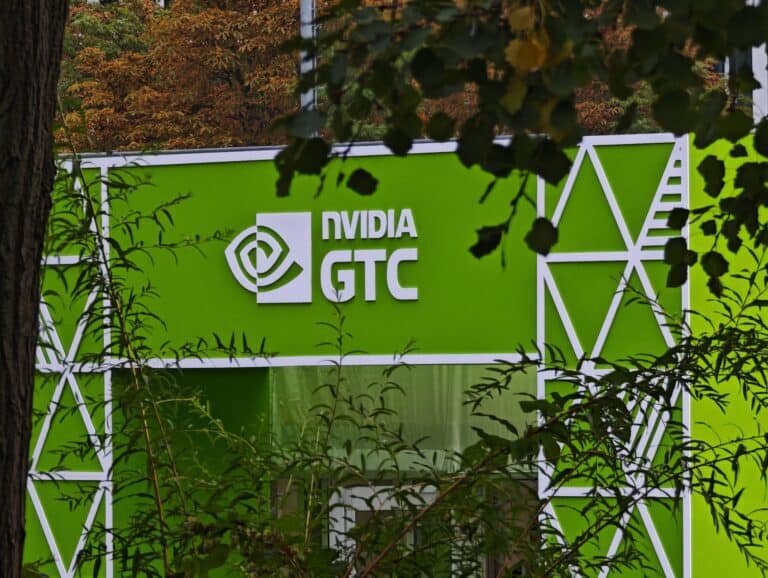
Nvidia GTC is currently taking place in Berlin, with an army of partners from the GPU industry in attendance. Below is an overview of the announcements that Dell, Nutanix, and CoreWeave shared with us regarding the event.
Dell Technologies
As a hardware supplier, Dell Technologies is one of the first providers of new Nvidia chips. These days, that includes more than just the GPUs that have made Nvidia the world’s most valuable company. For example, the Vera Rubin architecture features an Arm-based Vera CPU with 88 Olympus cores and up to 1.2 TB/s of memory bandwidth. Nvidia claims that the chip is up to twice as efficient as traditional rack CPUs and offers 50 percent higher performance.
The Dell PowerEdge M9882 uses 256 Vera CPUs in a 48U rack, running orchestration, tool usage, and code execution for AI workloads alongside inference on GPU clusters. The air-cooled PowerEdge R8822 uses two Vera sockets per rack and accommodates four double-wide GPUs.
In addition to CPUs and GPUs, Nvidia’s Groq LPUs are now also available. Dell integrates these massive chips, featuring on-die SRAM for the fastest inference, into the PowerEdge XE9810. Groq 3 LPUs are distributed across 16 liquid-cooled compute trays. Dell is also introducing a Modular Data Center based on Nvidia’s DSX Reference Design. Simply put, it’s a data center in a container. This is a well-known concept and is suitable for rapid deployments where building a campus takes too long.
In March, Dell updated the AI Factory for Vera Rubin. More than 6,500 organizations are now running on the platform, a significant increase from the 5,000 reported a quarter ago. In the workstation segment, the Dell Pro Precision with GB10 will be released on October 23 in a 64GB configuration; it is essentially Dell’s version of the DGX Spark that Nvidia released last year.
CoreWeave
While Dell is considered a traditional Nvidia partner despite its chip variety, CoreWeave represents a new generation. Neoclouds, in some cases, remnants of the crypto hype, offer a large amount of computing power in a scalable form. Often, it is exclusively Nvidia chips that fill these providers’ data centers.
CoreWeave is now also adopting the same approach as Nvidia in other areas. CoreWeave Physical AI Launchables will be unveiled at GTC Berlin. This is a catalog of workloads specifically suited for physical AI, such as robotics, self-driving cars, and digital twin simulations. Common tasks in this field can be initiated with a single command via the Launchables.
CoreWeave views this addition as a solution built on top of the existing stack. According to the “neocloud,” the infrastructure, observability, and the ability to improve models and agents are already being fully utilized by customers. Now, a new category of customers is being added, including those from heavy industry and OT environments.
Nutanix
During GTC Berlin, Nutanix announced that it is making the CPU more ready for AI use. Agents have shifted their focus from just GPUs and their interconnectivity to a combination of chips, with the CPU, among others, serving as a crucial component for agentic actions. Any process that goes beyond the model (i.e., all actions performed by an agent) depends on CPU computing power. Nutanix emphasizes the importance of security in this area: agents require sandboxing, tool calls must not exceed these boundaries, and existing IT systems require integration with these AI solutions.
Nutanix Kubernetes Platform (NKP) Bare Metal will now support Vera workloads to provide that security and sandboxing. Nutanix’s goals revolve around VM-level sandboxing or sandboxing for containerized environments, in addition to Zero Trust networking via DPUs and an Agent Gateway for matters such as token limits and MCP access.