
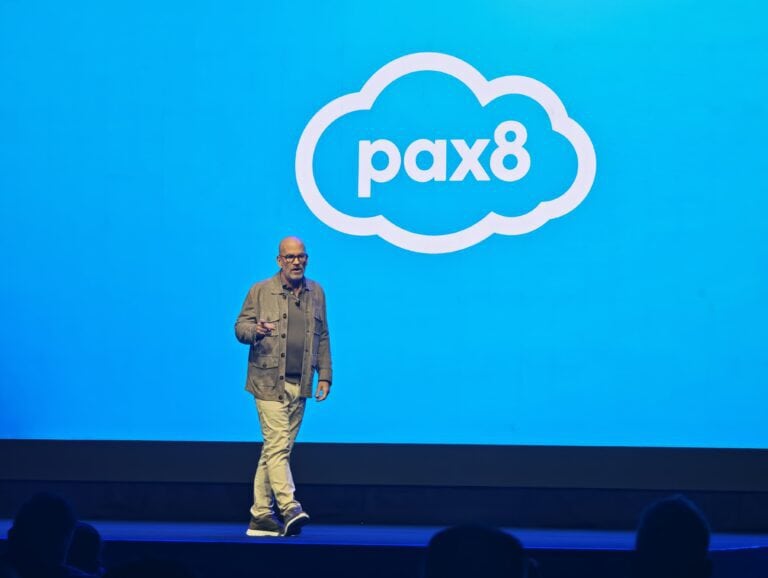
As is often the case with new technologies, AI doesn’t fit neatly into any existing category. That’s why, at Beyond 2026, Pax8 is introducing a new dashboard for IT providers that offers predictable AI costs and results. 8os is the name of the operating system for AI agents, through which SMBs can also consult 8bot.
Pax8 research highlights what other IT stakeholders have also pointed out: AI usage in organizations is full of ambition but lacks coherence. This leads to unpredictable and often high costs for the 90 percent of SMBs experimenting with AI. Only 23 percent of these organizations have eliminated one of the biggest culprits; they do, in fact, have a documented AI policy.
Competition leads to fragmentation
Since AI has proven to be genuinely useful for the majority of developers and a growing range of fields, several software companies have attempted to become the AI governance layer. Each vendor presents this in a way that positions it at the center of AI governance, resulting in numerous “AI OS” solutions. Pax8 notes that an “increasingly fragmented” group of agents and bots within companies leads to the discovery of shadow AI in 47 percent of organizations. For the sake of simplicity, we’ll assume that there is regularly unknown AI usage among the remaining 53 percent.
This fragmentation can be explained by the pressure to move quickly that organizations face. 65 percent believe they need to move fast when it comes to AI, and 84 percent rely on an external advisor for this. 70 percent state that a partner like this is necessary to fully realize the value of AI.
8os as a governance panel
Pax8 CEO Scott Chasin (pictured) describes 8os as a panel for deploying, managing, optimizing, and offering AI systems as a product. MSPs can determine which models to select for specific tasks, what those tasks might be within specific organizations, and what the budgets are. Think of it as an abstraction layer on top of the AI layers, each of which has its own rules but requires all sorts of context switches to control them separately.
Pax8 aims to provide MSPs with the framework to serve as advisors and partners to SMBs. Note that Pax8 has renamed this group of managed service providers “MIPs”: Managed Intelligence Partners. OpenAI CEO Sam Altman suggested earlier this year that AI will be billed as a utility. A MIP is an extension of this idea, with the important caveat that it is up to IT players like Pax8 and its customers to deliver that utility.
The tasks for MIPs vary, with six “plays” from a playbook. These partners discover, purchase, sell, build, implement, and manage AI-related solutions. Customer knowledge should lead to a detailed use case for AI, featuring both off-the-shelf agents and custom variants for domain-specific purposes.
8bot is an AI colleague for SMBs
Pax8’s strategic plan has thus been discussed in broad terms. However, the specific implementation of the built-in AI colleague 8bot still has a somewhat vague added value as presented at Beyond 2026. It is a managed agent for employees and teams, but no specific AI model was mentioned, nor were the skills that 8bot directly provides.
More importantly, we don’t know whether this is a repackaged Claude or an open-weight model, an SLM for local use, or simply a harness for any model.
Whatever form it takes, competition in this field is fierce. Ultimately, AI won’t have a single winner, but the LLM players hope their own solutions will bring them as close as possible to the end user, while virtually all other vendors hope to build an intelligence layer on top of or around it. Pax8 rightly emphasizes that all these players together are creating quite a bit of clutter. Someone could clean this up; for MSPs, it would be very beneficial if this turned out to be the solution.
A managed alliance
Pax8 is one of several parties that share this line of thinking. The new Managed Intelligence Alliance of the Global Technology Industry Association (GTIA) clearly demonstrates this. Founders include Microsoft, CrowdStrike, and NinjaOne, with Pax8’s CVP of Community & Ecosystems, Rob Rae, serving as chair. Pax8 itself is the so-called “Charter Member.”
Over the past few decades, IT security has evolved from improvisation to managed services, whether for firewalls and antivirus software or for backups and cloud services. One of the many potential futures for enterprise AI is that it will be sold as a utility in the same way. The Managed Intelligence Alliance builds on this idea with four priorities, each of which makes sense but faces competition from rival concepts.
Open specifications, competency standards, accreditation programs, and technical research form the foundation of the alliance. Once again, the alternative comes from AI providers: an API or platform to access all AI capabilities without an intermediary. To deliver those skills at scale, such a decentralized approach cannot lead to a true “intelligence layer.” That is Pax8’s goal with its proprietary 8os and 8bot, as well as the Managed Intelligence Alliance.
See also: Pax8 aims to transform MSPs into Managed Intelligence Providers