
Organizations are increasingly deploying AI agents, but in practice, it’s difficult to ensure they operate autonomously, cost-effectively, and securely at the same time. Without clear boundaries, costs rise and new security risks emerge. ServiceNow addresses this challenge with stricter controls, without sacrificing the agents’ autonomy.
For the ServiceNow AI Platform, keeping AI under control, allowing AI to operate autonomously, and keeping everything secure are crucial principles. The company believes this is precisely where the problem lies for many organizations. For example, investments in AI are rising significantly, while only a small fraction of organizations actually see a return on investment from autonomous work. Organizations are spending tokens on prompts and deploying advanced models unnecessarily for simple tasks.
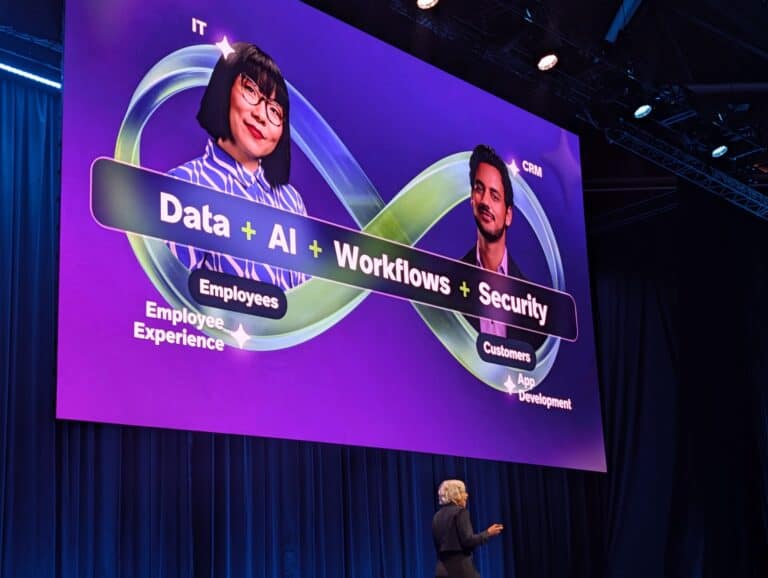
ServiceNow’s platform therefore brings together data, AI, workflows, and security. It can integrate with virtually any cloud, model, data source, or agent. The company’s workflow expertise can help combine these elements with new AI capabilities and possibilities. Over more than 20 years, large companies across a wide range of sectors, both regulated and unregulated, have built their workflows on the platform.
ServiceNow Otto plays a major role in the AI narrative. This name may feel somewhat new, as this AI assistant has only been known by this name for a few months. It can be seen as a rebranding of Now Assist, naturally incorporating new features. A major factor in the AI assistant’s expansion, for example, is the addition of Moveworks technology, which was further integrated into ServiceNow following the 2025 acquisition. This brings RAG search across dozens of external sources simultaneously, a powerful reasoning engine that creates a step-by-step plan based on a question and handles a request, and ready-to-use connectors for external systems (previously built manually) to ServiceNow’s AI capabilities.
A passport for every agent
To deploy AI agents safely in an enterprise environment, the company is also accelerating the rollout of an AI Passport. This gives autonomous agents their own identity with defined boundaries, which can be verified at multiple points. The passport falls under the AI Control Tower, ServiceNow’s central management layer for AI agents, models, and workflows. For example, an agent’s identity indicates what that agent does, but not whether it is currently authorized to perform a specific task with specific data. The AI Passport addresses this.
This can be useful, for instance, for a third-party agent that must automatically process refunds up to a certain limit. The Control Tower can then monitor whether a limit is maintained for each transaction and whether only the necessary skills are used.
The Control Tower itself does more than just inventory management. The system detects hallucinations, bias, data leaks, and anomalous behavior in real time. When necessary, it automatically initiates recovery workflows. Users can also assess use cases against frameworks such as the EU AI Act and ISO standards. The platform also displays token consumption per user and per department, along with features such as shadow AI detection, value intelligence, and access mapping.
Sense, decide, act, secure
When ServiceNow began to refine the integration of agentic AI with workflows, it concluded that four elements are particularly important: sense, decide, act, and secure. “Sense” involves gathering data and context from various sources, such as a CMDB or ServiceNow’s RaptorDB. The latter plays a key role within the ServiceNow platform as a database engine that combines operational and analytics workloads. The Workflow Data Fabric brings everything together, making data from various systems available in real time to workflows and AI agents. For example, you can aggregate network and monitoring alerts to convert them into automated IT workflows.
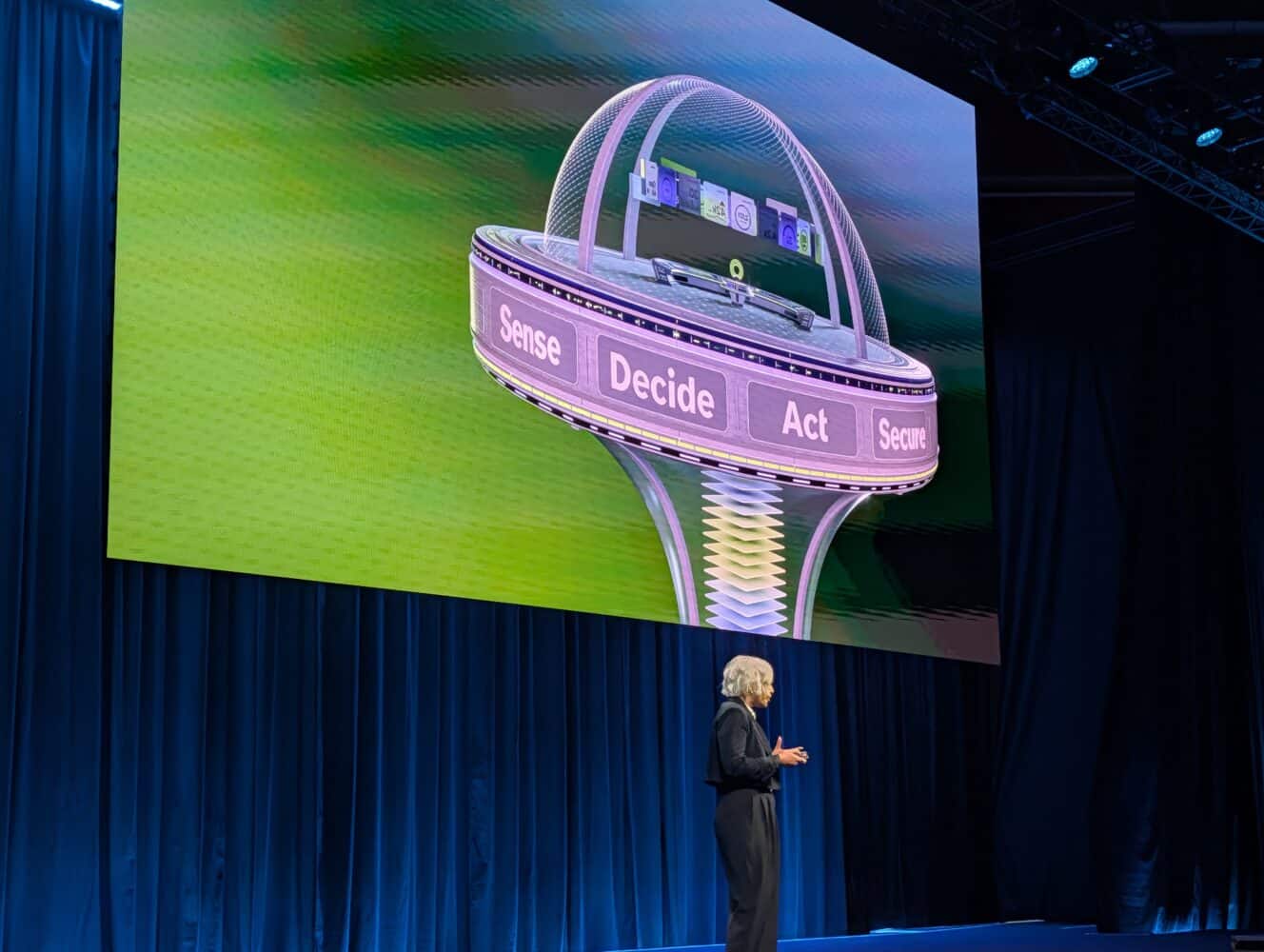
Decide, in turn, uses AI models, contextual grounding, and multi-agent orchestration to determine what needs to be done. The ServiceNow Context Engine specifically addresses this. LLMs are trained on the internet and don’t know exactly how a specific company operates. The Context Engine fills that gap by combining the knowledge graph, the CMDB, the cyber asset graph, and a decision graph. ServiceNow refers to this as a “graph of graphs.” The system records every decision made by a human or an agent so it can learn from it.
In the “act” phase, everything revolves around autonomy: executing actions via workflows, autonomous agents, or applications. For example, ServiceNow offers the L1 Service Desk AI Specialist on its platform. Such an AI Specialist is less an AI agent that performs a single task or a few actions and more an AI component assigned to automate related tasks end-to-end. The L1 Service Desk version takes full control of an incident and, if necessary, engages a catalog agent. ServiceNow previously introduced these AI specialists as “Autonomous Workforce.” Specialists for operations and demand management, among other areas, will follow shortly.
Shift zero with Armis and Veza
Secure is the final piece of the strategy, focusing on ensuring access, governance, and compliance. ServiceNow surveyed thousands of security leaders worldwide and concluded that nine out of ten organizations experienced a security incident involving agentic AI in the past year. Only 36 percent contained such an incident within 24 hours. ServiceNow calls its response to this “Shift Zero”: eliminating risks before they become incidents.
To achieve this, the company is leveraging two recent acquisitions. Armis, which was acquired for $7.75 billion, maps connected devices in IT, OT, and IoT environments. According to ServiceNow, some of these devices are invisible to traditional security tools. ServiceNow acquired Veza for more than $1 billion, and it maps over 120 billion permissions for people, machines, and AI agents. This ensures each agent receives only the permissions it needs. The two products come together in Autonomous Security & Risk, which is linked to the Context Engine and the AI Control Tower.
ServiceNow offers three pieces of advice: choose a workflow everyone complains about, establish governance from the start, and scale up once savings in hours, tickets, or costs become apparent. This ensures that workflows and AI agents operate securely and remain manageable within an organization.
Tip: 91% of Dutch organizations have experienced an incident involving an AI agent