
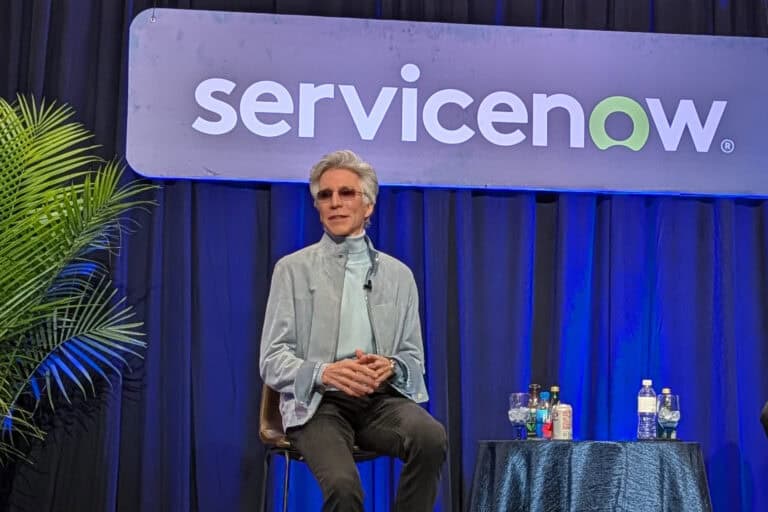
Bill McDermott states that ServiceNow will become the leader in enterprise AI within organizations. According to him, no one else is capable of doing so, because ServiceNow’s portfolio is so broad that it can be the agent of agents. It’s a compelling narrative, accurate in many respects, but there is still one competitor that comes close. McDermott tries to ignore this. Meanwhile, ServiceNow’s own product management confirms that the governance claim over external platforms is technically far more limited than the CEO suggests on stage.
During Knowledge 2026, we asked Bill McDermott a direct question: if ServiceNow, Salesforce, SAP, Workday, and others are all building their own AI platforms, their own governance layers, and their own control towers, and most large enterprises are customers of all those platforms at the same time, who ultimately has control over enterprise AI?
McDermott’s answer is strategically strong but technically rather evasive. He uses Workday as an example. Workday handles HR, he says, and can never manage the end-to-end business processes that ServiceNow manages. “We manage everyone else’s agents. They can’t manage my agents, because they don’t do what we do, the way we do it.” ServiceNow plays chess. The rest play checkers. It’s a good story, but not entirely accurate, because Salesforce is playing chess too.
ServiceNow isn’t the only one that can play chess
Every year, we see ServiceNow and Salesforce moving closer together. The platform now covers Sales, Service, Field Service, Marketing, Commerce, ITSM, HR workflows, and with Agentforce a full-fledged AI agent layer that operates across all those domains. Then there’s MuleSoft for integration, Informatica for serious data governance, and Slack is the communication platform through which Salesforce reaches millions of enterprise employees every day.
That’s not just checkers, but chess as well. That’s the same breadth that McDermott claims as ServiceNow’s unique selling point. These are two platforms that claim exactly the same thing, and most Fortune 500 companies are customers of both.
What the product manager explained
We also spoke with Bhakti Pitre, vice president of AI Platform Security Product, who delves deeper into the technical reality of the governance claim at ServiceNow. Her answer is more honest and nuanced than the stage pitch. ServiceNow strives to gain visibility into all AI within organizations and, ideally, to manage it; technically, however, that is extremely challenging.
For agents running on the managed runtimes of AWS, Azure, and Google, ServiceNow does indeed have deep observability via Traceloop and OpenTelemetry; prompts, reasoning steps, decisions, and token usage are all visible. That is substantial. But for closed SaaS platforms, the picture is different. SAP has announced OTEL support for Joule for later in 2026, but Pitre is clear: “SAP is currently a closed platform. If they don’t publish OTEL, we can’t retrieve it via the OTEL framework.” Furthermore, she explicitly confirms that SAP is on the list of 30 enterprise connectors for discovery, not for observability. That’s a big difference. Workday has its own observability layer that is not based on OTEL and operates primarily at the application level. In Salesforce Agentforce, traces first go to Data Cloud and cannot be streamed in real time to an external platform such as ServiceNow. Visibility is certainly possible, but control is still a long way off.
Also read: ServiceNow moves beyond control tower to govern and kill enterprise AI
AI Gateway as a man-in-the-middle
The most interesting aspect is the AI Gateway. ServiceNow positions this gateway as a man-in-the-middle for all MCP traffic. It intercepts the connection between agents and the tools they use. The idea is that organizations route all their agents through this gateway, allowing ServiceNow to monitor and control them without the underlying platform needing to support OTEL. This is exactly what Salesforce does with MuleSoft Fabric. Pitre implicitly confirms this as well: “For us, the AI Gateway isn’t a traffic solution; it’s a security solution. That’s where you can add access scopes, add identity tokens, and track them.” It’s a smart architectural choice, but it only works if agents actually go through that gateway.
Pitre is also strikingly honest about the kill switch: “This is on the roadmap, but isn’t fully ready yet.” In practice, the kill switch works by revoking LLM and tool access via the AI Gateway, and by removing permissions via Veza and identity tokens via, for example, Okta. But if an agent still has active tokens, it will continue performing actions until those tokens expire. That means even ServiceNow cannot intervene if an agent chooses an undesirable path within a closed SaaS environment like Workday.
McDermott says, “We manage everyone’s agents.” His own product manager says, “We manage them where technically possible.” That is a fundamental difference.
The parallel with the 2008 financial crisis
During the conversation, McDermott provides the best description of the risk he himself faces. He compares the current AI wave to 2008, when the financial crisis broke out. Back then, CEOs chose to decentralize all IT decisions to line managers. The result was not good; enterprises now have hundreds of applications, fragmented data, and an application and data chaos that will take years to clean up.
“AI needs a clear path to be fully activated within a company,” says McDermott. “If you always do what you’ve always done, you’ll get what you’ve always gotten.”
He’s right. But the irony is that the current landscape of competing enterprise applications, ServiceNow, Salesforce, SAP, Workday, Microsoft, and Google, all come with their own version of the control tower. That creates exactly the repetition of fragmentation he describes. Every vendor claims to be the central control point. None of them seems truly willing to let the other in.
So who wins?
McDermott argues that ServiceNow will win because it’s broader than anyone else. End-to-end business processes, IT, CRM, HR, and security all on one platform. “We are the AI of the AIs.”
That’s a defensible argument for now. ServiceNow does indeed have a breadth that many others cannot match. But it’s becoming increasingly difficult to deny that argument to Salesforce. It’s not a complete overlap; both have their own specializations. Salesforce has Slack, which gives them a powerful application to deploy AI to business users. ServiceNow on the other hand has an advanced security portfolio and extensive workflow engine.
The deeper question isn’t who has the broadest platform. The question is who sets the standard for sharing or retrieving observability data across platforms. As long as each platform builds its own governance silo and keeps the data locked away, no single control tower solves the real problem. Then the enterprise doesn’t have one boss over its AI, but about five. Each sees a different piece, and none of them sees the whole picture.
McDermott is aware of this, which is why he doesn’t name the competition. He argues that organizations want to spend money only once to manage all their AI, and he wants to win that budget battle with ServiceNow.
Conclusion
ServiceNow is seriously building the governance layer that enterprise AI needs. The technical building blocks, Traceloop, Veza, and Armis, are impressive and are all recent acquisitions. In that regard, ServiceNow is certainly on the right track. For hyperscaler environments, the observability claim is also demonstrably defensible. But the “agent of the agents” positioning has a structural problem: it only works if the others, and especially SaaS providers, join in. However, they are trying to build exactly the same thing and, in many cases, are not very open.
What would help is the rapid emergence of an open standard like OTEL or MCP, but for governance and agent management. Everyone would, of course, then have to support it. That would make it a level playing field, and ServiceNow is in a very strong position, especially since it’s investing heavily in security. In that case, ServiceNow could indeed become the leader in enterprise AI. McDermott also said that it wouldn’t surprise him if ServiceNow becomes more of a security company by 2031 or 2032.
Until then, we’ll have to wait and see who is the most innovative in working around it. But for now, managing everyone’s agents is as much ambition as it is reality.