
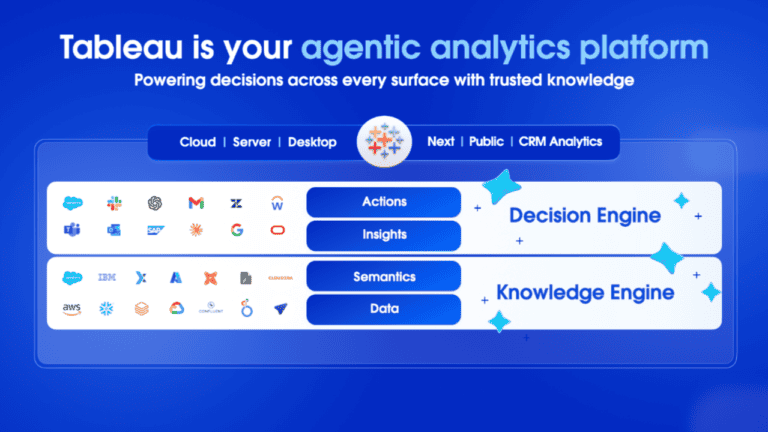
The new Tableau Agentic Analytics Platform is designed to function as a knowledge and decision engine for the agentic enterprise. The platform is built on six pillars and integrates with tools such as Slack, Microsoft Teams, and Salesforce.
The company announced this during the Tableau Conference. The new platform can be seen as a repositioning of the product from a visualization tool to a combined knowledge system and decision engine. With the Agentic Analytics Platform, Tableau aims to provide AI agents with the business context they need for reliable, autonomous actions.
Context is the keyword here. Raw data does not provide AI agents with enough to rely on. The platform combines data with business logic, semantic models, and metadata into a knowledge layer that agents can use. Previously, Tableau Next was released for this purpose—the agentic platform that uses semantic layers to bridge the gap between business users and data.
Six pillars of agentic decision-making
The platform consists of six components. The Knowledge Engine builds on 33 million semantic models that Tableau users have built up over more than a decade. Together with Snowflake and dbt Labs, Tableau is working on Open Semantic Interchange to make that knowledge base widely available.
The Conversational Analytics component brings natural language interaction to all Tableau products—Server, Cloud, and Next—so users can ask questions without needing to know SQL. From there, it moves on to Headless Analytics: through an open MCP server architecture, Tableau delivers insights directly into Slack, Microsoft Teams, Claude, ChatGPT, and other work environments. New integrations for Microsoft Teams, Slack, and Google Workspace are generally available today.
The Decision Engine connects insights to actions. The platform triggers workflows directly from an analysis, such as creating a Salesforce case when customer satisfaction scores drop. The Agentic Analytics Command Center provides governance functionality. IT administrators can see which agents are active, what data they are accessing, and whether all actions comply with company policies. Finally, the Security pillar combines the security infrastructure of Salesforce and Tableau, including role-based access control and audit logs.
Tableau Agent conversational analytics is now generally available, with new dashboard functionality coming in June. The Tableau MCP servers are available for Tableau Next, Cloud, and Server. The Auto Knowledge Graph follows in July. The Agentic Analytics Command Center will be rolled out in the fall.