
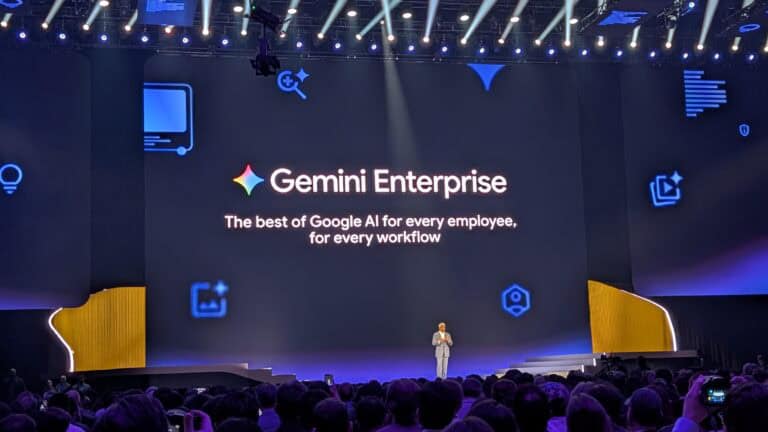
Gemini Enterprise was introduced a few months ago as the new AI tool for business users. At Google Cloud Next, Google is taking the next step: expanding Gemini Enterprise with a full-fledged development platform for AI agents, new governance tools, and agents capable of working autonomously for days on end. It sounds impressive on paper, but isn’t a platform designed for both business users and developers too complicated?
Google introduced Gemini Enterprise last October; at the time, the platform was still relatively modest in scope. A single environment for business AI, building on what was previously known as Google Agentspace. The ambition turns out to be much greater. The implementation may have felt a bit thin back in October, especially given the lack of third-party AI models, but that feeling has quickly disappeared. Google is set to significantly expand Gemini Enterprise.
The key announcements are the Gemini Enterprise Agent Platform and the enhancements to the Gemini Enterprise app. Together, they are intended to turn Gemini Enterprise into an end-to-end system that enables organizations to build, scale, and manage hundreds or even thousands of AI agents.
Agent Platform: the successor to Vertex AI
Google describes the Gemini Enterprise Agent Platform as the successor to Vertex AI. All Vertex AI services and the roadmap will now be delivered exclusively through the Agent Platform. For organizations that have been working with Vertex AI for years, this is a major change.
The platform offers access to over 200 models via Model Garden. These include not only Google’s own models such as Gemini 3.1 Pro, Gemini 3.1 Flash Image, and open-source Gemma 4, but also Anthropic’s Claude Opus, Sonnet, and Haiku. This is a smart move: business customers want flexibility and choice. Sticking exclusively to proprietary models would certainly drive potential customers away.
The Agent Development Kit (ADK) has also received a significant upgrade. Whereas ADK previously operated in a fairly linear manner, it now supports a graph-based framework in which agents can operate as a network of sub-agents. That may sound complicated, but it means complex workflows can be divided and executed by different (sub)agents who collaborate. This should lead to better and faster results. In addition to Agent-2-Agent, Google will now fully support MCP (Model Context Protocol). This aligns with a broader industry trend in which MCP is rapidly becoming the standard for agentic connections.
Agents that remain active for days and have long-term memory
The updated Agent Runtime promises significant improvements. For instance, it should be possible to cold-start an AI agent within 1 second. That’s technically quite challenging, but Google seems to have found a solution. But perhaps even more important is that AI agents will also gain long-term memory where necessary. This means they won’t just know what they did during that session, but can also build on previous interactions and conversations. As a result, important knowledge isn’t lost. This allows an AI agent to better understand and support the user.
Google enables agents to run for days on end. This is useful, for example, when you’re working through a sales prospecting sequence or when you need to analyze data from one system and add it to another. All without a human having to constantly monitor it.
Governance: finally getting serious attention
Organizations often still have many doubts about the control and oversight one can have over all AI agents. We are seeing more and more solutions emerge that enable observability or attempt to provide insight into exactly what agents are doing. Google is introducing a comprehensive governance package that is included as standard.
At the core of that governance package is Agent Identity. It assigns each agent a unique cryptographic ID, ensuring every action is traceable. Agent Registry also provides a central catalog of all approved agents and tools. Finally, Agent Gateway acts as a traffic controller for the entire agent ecosystem and enforces security policies. Within that ecosystem, Model Armor actively protects against prompt injection and data leaks. However, all of this is limited to agents on the Google platform and does not extend beyond it.
Another new feature is Agent Simulation, a tool that allows you to stress-test agents with synthetic user interactions and virtualized tools before they go live. Agents are automatically scored on task completion and security across multiple conversation rounds. Combined with Agent Observability, which provides real-time insight into an agent’s reasoning, and Agent Optimizer, which automatically clusters recurring errors and suggests improved instructions, this is the most mature testing and monitoring framework for AI agents that a hyperscaler has offered to date. For enterprise IT teams responsible for reliability and compliance, this is a substantial part of the announcement.
The Gemini Enterprise app is the central interface
In addition to the platform, the Gemini Enterprise app is also expanding. The most notable addition is the revamped Agent Designer, which lets employees build complex agents in plain language or via a visual interface, without writing a single line of code. The designer also supports fixed workflows. There are also moments in AI where you want an action to follow a fixed path with predetermined steps. Some actions simply must always be executed the same way and are not subject to the AI agent’s discretion. Especially for sensitive processes, this is not a luxury but a compliance requirement.
There will be a new Inbox, a central management portal for all active agents. Users can immediately see which agents require input, what errors have occurred, and which tasks have been completed. Projects provide a shared workspace for teams and agents, with a centralized context that persists even when team members leave. Canvas enables the co-creation of documents and presentations, including export to Microsoft Office formats.
Relevant for IT admins is that Google is also introducing “bring your own MCP,” allowing administrators to connect their own MCP servers to the Gemini Enterprise app. This enables agents to connect to applications not included in the standard list of connectors. This significantly increases practical applicability for organizations with custom systems at their own data centers.
Furthermore, the Agent Gallery has been significantly expanded. From within the app, you can now directly activate agents from partners such as Salesforce, ServiceNow, Adobe, and Workday without leaving your workflow. Every partner agent in the gallery has been validated by Google for security and interoperability. This prevents IT departments from having to review each integration separately.
Gemini Enterprise for the business user: how realistic is that?
Google explicitly positions Gemini Enterprise as a platform for everyone in the organization, including developers, IT, and business users. The app side of the platform is specifically geared toward this. For example, Google is introducing Skills: reusable workflows that an employee defines once and that can then be used throughout the entire organization. Think of a skill that applies brand guidelines to every new document or a skill that automatically categorizes incoming support requests.
In addition, Google is launching two ready-to-use agents specifically for business users. The Data Insights agent analyzes data from both structured sources, such as databases and data warehouses, as well as unstructured sources, such as documents and email. The agent can also automatically generate SQL queries and visualizations, providing answers not only to the question of what the data contains, but also why. The Deep Research agent independently performs complex, multi-step research tasks based on both the open web and internal company data, delivering reports with source citations. Both agents are available immediately.
Still, it’s fair to ask how realistic the “no-code” narrative is in practice. Building a simple agent via the Agent Designer will be feasible for many employees. But as soon as a workflow involves multiple systems, needs to handle exceptions, or has compliance requirements, things quickly become a lot more difficult. And who is responsible if such a self-built agent makes a mistake? Google offers governance tools, but the organizational question of who is allowed to build, test, and release agents remains a challenge.
What does this mean for the market?
With Gemini Enterprise as an end-to-end agentic platform, a well-stocked Agent Gallery featuring partners like Salesforce, ServiceNow, Adobe, and Workday, and an open ecosystem via MCP, Google appears to be making significant strides and is ahead of other hyperscalers. For developers in particular, Google is currently the most compelling option for developing AI agents.
At the same time, competitors aren’t sitting idle. Microsoft is building a similar offering through Copilot Studio and Azure AI Foundry, and Salesforce is positioning Agentforce more aggressively as the central agentic platform for business users. Google currently leads in some technical areas, especially in the depth of its governance tools and its long-running agents. However, the barrier to entry is quite high, as it’s a rather complex system, which means converting this into broad enterprise adoption can be difficult. Google faced exactly this problem with Vertex AI, which many organizations found too complex to adopt at scale.
Part of the complexity may stem from the fact that Google aims to serve two distinct target audiences with a single platform. Appealing to both developers and business users through a single product is difficult. Experience shows that platforms that try to be everything to everyone often end up serving no one well. Microsoft learned this the hard way with Copilot, which was too technical for regular users and too limited for developers. Google knows this risk by now, but whether they’ve resolved it remains to be seen in the coming months. In our view, the biggest risk factor for adoption is not the technology, but the complexity.