
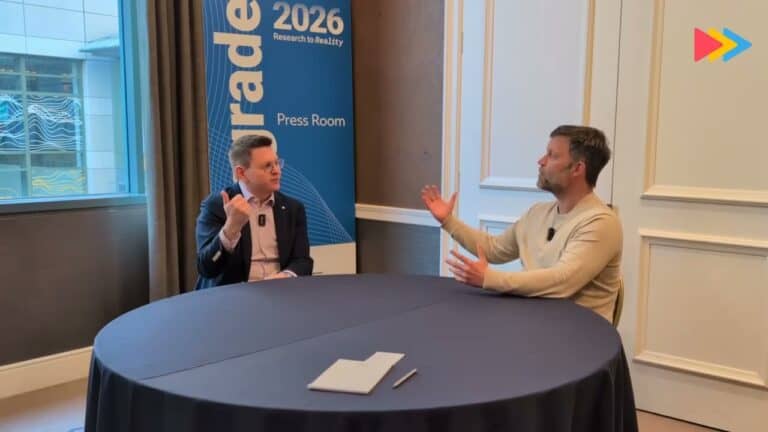
Edge AI and private 5G are becoming essential infrastructure for manufacturers seeking real-time insights and operational efficiency. That is what NTT Data thinks at least. At NTT Upgrade 2026, we sat down with Paul Bloudoff, senior director of Edge AI at NTT Data, to discuss this. How do these technologies work together to transform factory floors?
When discussing edge computing, definitions vary widely across the industry. While telecom providers might consider anything outside major data centers as “the edge,” NTT Data takes a more focused approach. “When NTT Data talks about edge, our team likes to think about what’s inside of our customers’ premises, what’s inside their OT environments,” Bloudoff explained.
This proximity-focused definition emphasizes placing compute resources where they can make the biggest impact. That is, directly on the factory floor. The implementation varies by use case: it could be small NUC-sized devices, Nvidia Jetson devices, large AI servers in nearby closets, or even portable data centers brought on-premises.
The symbiotic relationship between edge AI and private 5G
Bloudoff describes a “symbiotic relationship” between edge AI, edge compute, and private 5G. Private 5G networks provide secure, low-latency, high-bandwidth connectivity that enables real-time data processing essential for AI algorithms.
“We’ve seen workloads at the edge require more and more real time data that private 5G is very good at delivering,” Bloudoff notes. The deterministic latency of 5G over 4G LTE makes it particularly valuable for time series data processing, which is central to physical AI applications.
NTT Data has seen significant adoption in private 5G. Cargill, for example, has deployed private 5G networks across more than 50 manufacturing facilities, with plans to expand further this year. These networks enable everything from digitization initiatives to autonomous robots that perform routine inspection tasks.
Full-stack solutions from sensors to cloud
NTT Data differentiates itself by offering complete end-to-end solutions. “NTT Data does a full stack solution. So it’s everything from the sensors that can collect the data, the connectivity layer that brings that data from the sensors onto the edge compute platform, the algorithms that run on those edge compute platforms, a managed service to ensure that everything is running, and delivering the outcomes that our customers are requiring,” according to Bloudoff.
This comprehensive approach extends to the connectivity between edge platforms and both private and public clouds, all managed by NTT Data. According to Bloudoff, the company maintains flexibility by working with multiple vendors for private 5G, edge hardware, and AI platforms, ensuring customers aren’t locked into a single ecosystem.
Also available as audio-only Techzine TV Podcast
Subscribe to Techzine TV Podcast and watch and/or listen to our other episodes via Spotify, Apple , YouTube or another service of your choice.
Physical AI and rapid deployment
One of the most significant developments Bloudoff wants to highlight during our conversation is the evolution of physical AI and machine vision. Traditional machine vision projects required training models with 50,000 images over nine months. Now, foundation models can be trained with approximately 40 hours of video or less, he says.
“We’re seeing manufacturers being able to get up to speed and show real world use cases with proven value in weeks, not years,” according to Bloudoff. This rapid deployment capability allows manufacturers to pivot quickly and optimize processes through fast feedback loops.
Use cases span predictive and preventative maintenance, task verification on assembly lines, and anomaly detection across various sensor types including vibration, radar, and lidar. NTT Data works with partners like Nvidia for AI models and physical AI companies like Archetype AI to deliver solutions tailored to specific customer needs.
Calculating ROI and driving adoption
Private 5G adoption has historically faced challenges around pricing and ROI calculation. Bloudoff acknowledges that deployments typically require multiple use cases to justify investment. “One use case is generally not enough. Deployments happen when there’s two or three or more use cases that align, that drive the value of the overall deployment,” he says.
Safety use cases often provide the initial justification. A single safety accident can cost companies significantly, making prevention through camera monitoring and PPE verification highly valuable. Preventative maintenance offers another compelling ROI by reducing unplanned downtime.
Importantly, pricing for private 5G has come down significantly and now aligns with previous LTE network costs, Bloudoff says. The ecosystem has matured, making it easier to find 5G-connected devices like cameras without complex workarounds.
The path to automation
Looking forward, Bloudoff sees automation as the next frontier. The key question is determining where humans remain in the loop versus where AI algorithms can operate autonomously with sufficient training data.
“I think the automation is really going to drive efficiencies,” he says. “We’re seeing it with manufacturing where we can now identify when steps in a manufacturing process aren’t completed properly.” AI can verify that manufacturing steps A, B, and C were completed correctly and flag potential issues for human review.
Ultimately, the goal is better insights, improved observability, modern monitoring, and more accurate digital twins that enable predictive capabilities. That way it is possible to prevent problems before they occur rather than having to react to them.
Partnership ecosystem drives innovation
NTT Data maintains a strong partnership ecosystem to deliver the best-in-class solutions it wants to deliver, Bloudoff says. The company has a global partnership with Nvidia and works closely with private 5G vendors including Ericsson and Nokia, as well as edge hardware vendors and connectivity device manufacturers like Qualcomm.
This approach should give customers flexibility to adapt as technology evolves. “We know that our customers need that flexibility and the ability to move to different vendors when pricing requires it, when technology changes,” according to Bloudoff.
As edge AI, private 5G, and physical AI continue to mature, NTT Data believes that manufacturers have opportunities to transform operations through real-time intelligence and automation. With full-stack solutions and proven deployments at scale, the company thinks that the technology is there to do just that.
Also read: NTT Research wants to accelerate innovation with Scale Academy: SaltGrain is the first result