
AI hardware manufacturers are increasingly consolidating computing power. The result is that a highly compact IT infrastructure can deliver impressive performance. HPE and Contour Advanced Systems have opted for a hardware deployment in a familiar format: the container. During a visit to the Contour facility in the Dutch town of Varsseveld, we learn what the benefits are.
Software today needs to be “composable.” In other words: scalable and flexible. Hardware—and specifically the data centers that house it—faces challenges that require a similar approach. In addition to sensitive issues like land and power shortages, the typical construction of a traditional data center results in a lead time of about three years, sometimes much longer. HPE and Contour believe they can roll out a site three times faster using their modular method.
Parallelization
The similarity between software development on the one hand and hardware development on the other goes further. The solution to bottlenecks in applications and the development of AI has been found in parallelization, or performing calculations simultaneously rather than sequentially. HPE and Contour Advanced Systems have adopted this approach for their joint solution.
The modular units, built by Contour and equipped with HPE hardware, are created in parallel. While the ground is being prepared for a data center, Contour builds the containers and integrates the IT hardware off-site, so that they are ready for use at the physical location as quickly as possible.
A new modular pod will go live within a few months at Era4, a British company focused on AI infrastructure. According to the company, the ground in Sheffield was still mud at the start of this year, but customers will already be using the hardware by mid-year.
Mod Pods
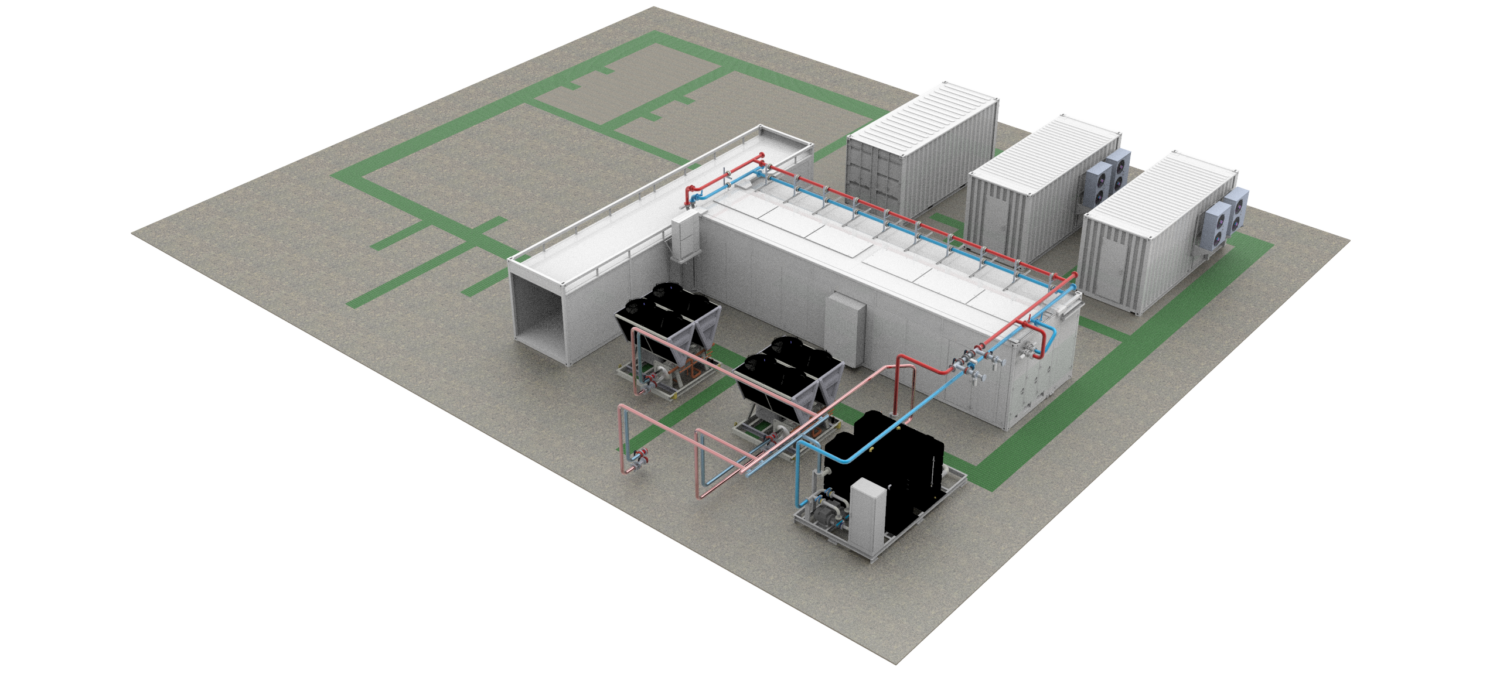
Before we dive into the containers, it’s helpful to clarify what HPE’s philosophy on modularity looks like today. With a “LEGO-like” architecture, HPE delivers modules that can be scaled independently of one another. Not every data center has the same requirements, ranging from direct liquid cooling to air or hybrid cooling, and in the most extreme cases, 600 kilowatts per rack for AI chips. For now, HPE supports up to 400 kW per rack via its fanless, direct liquid-cooled systems. Nvidia’s roadmap indicates that even a megawatt will eventually be required, so HPE knows where it needs to grow with the Mod Pod concept.
The advantage of having freedom of choice in data center, cooling, and power modules is that you avoid overprovisioning. For specific use cases, such as an AI startup that wants to rent out its GPUs, the requirements are completely different from those of companies running their less demanding workloads on-premises. For the former, the most advanced cooling and high power density are required, which HPE can address with the Mod Pod concept. That concept can be dynamically split or expanded. Here we see another parallel with the software domain: containers, or clusters of containers, can be deployed and linked as desired.
Containers
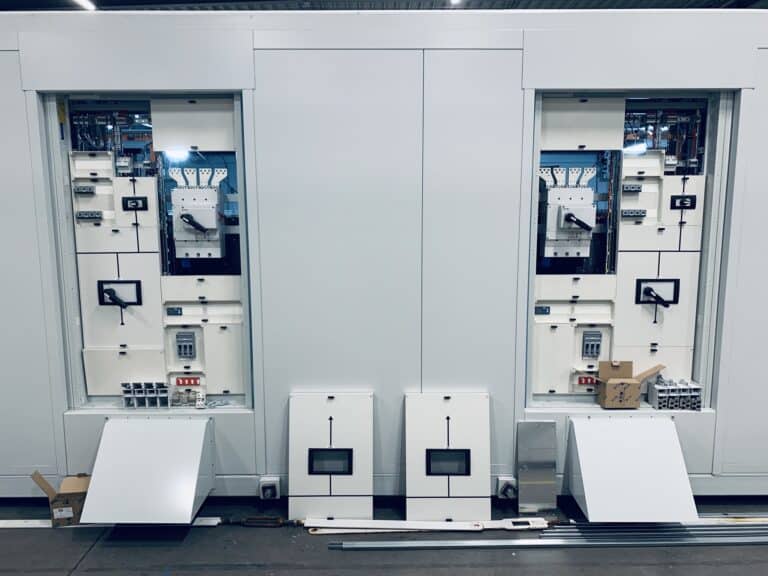
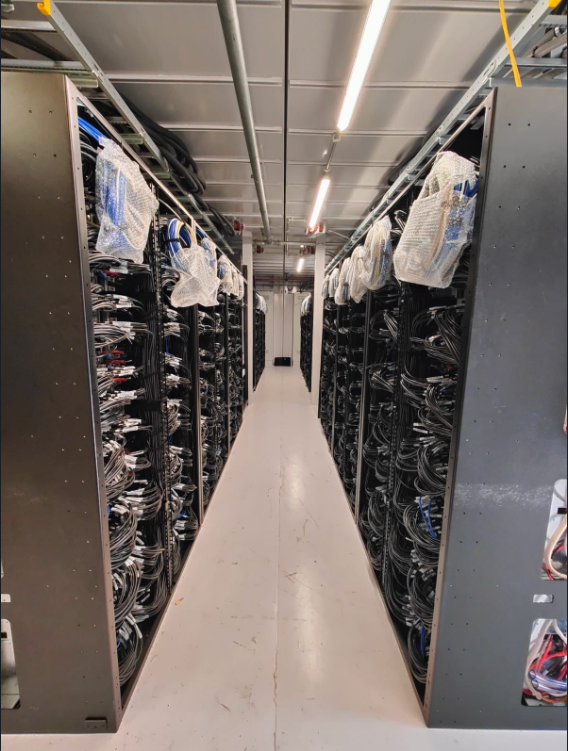
The word “container” may conjure up the image of a weathered, dark red metal box with a half-peeled coat of paint. Apart from their standardized dimensions, the systems at Contour Advanced Systems are a far cry from that. The brand-new-looking, snow-white units would fit just as well on the back of a truck or on a train car, but a glimpse inside reveals them to be clearly complex IT systems. Everything you’d expect to find in a data center is present here in a relatively miniature form: the colored cabling in the usual ducts, flat floors, and black server racks. The water-cooling and electrical system serves as a hub for the connections that run visibly outward.
Although each container houses all the IT hardware and appears as an integrated whole, external utilities are required. Electricity and water flow into the containers via facilities that make the footprint of an operational installation larger than just the sum of the containers.
Nevertheless, an infrastructure based on these modular data centers lacks the typical “gray box” that characterizes the public perception of such a location. Those unfamiliar with the exact utility systems might not even realize that a Contour and HPE customer is a user of advanced IT hardware. After all, only the containers and the surrounding electrical infrastructure are visible.
Conclusion
Modularity is not new, nor is the idea of reusing a container. However, the application has become much more relevant over time, now that ambitious construction plans often fail to materialize or face years of delays. The phased, modular construction demonstrated by Contour, utilizing HPE hardware, aligns well with a market that, above all, craves deployments that can be expanded later. We see ample opportunity for HPE and Contour to capitalize on tomorrow’s developments, with increased power consumption and the resulting heat as the primary challenge. For now, the flexibility lies in the modular racks and structures, achieved by deploying more of them at a faster pace than is possible elsewhere.
Read also: HPE gives data centers a new network foundation with the Juniper PTX12000 series