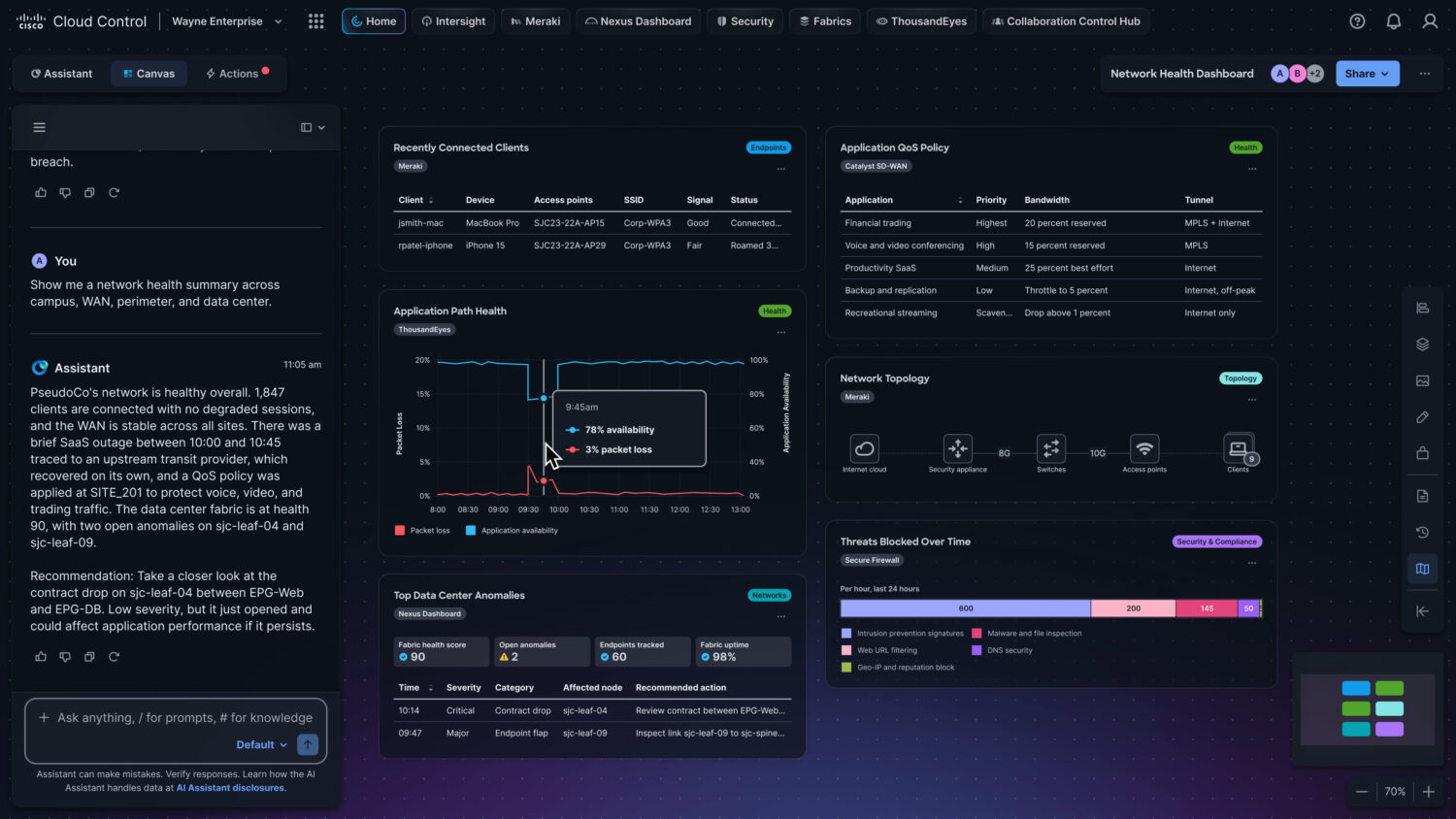
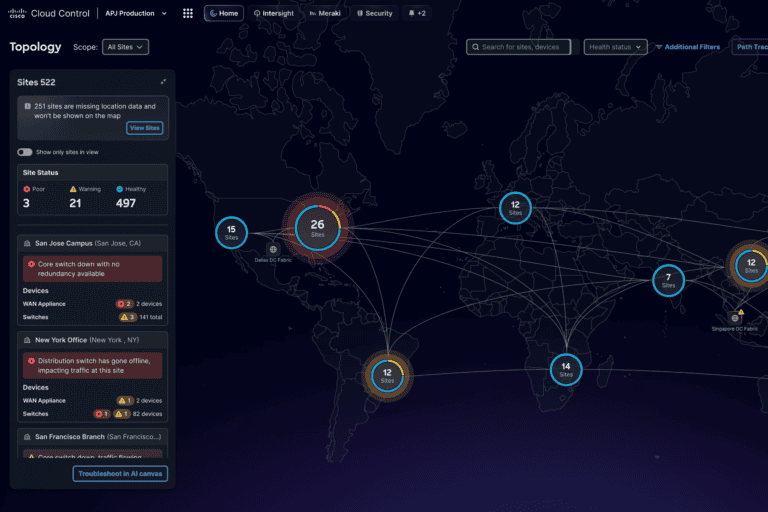
Cisco is sometimes accused (also by us) of being able to come up with and tell a great story, before actually being able to execute on it. Today, the company is introducing Cisco Cloud Control to put this image behind it once and for all. On the one hand, this is a logical consequence of what Cisco has built and announced in recent years. It is one of the most ambitious projects the company has built and launched in its more than 40 years of existence. You can read why we think and feel that way in this article.
Cisco has been working for years to consolidate and merge various parts of its offering into a single platform. Consider the development of full-stack (AI) infrastructure to boost its adoption (and its own business, of course), but also the discussions from about three or four years ago regarding full-stack observability and the Networking Cloud and Security Cloud.
The ultimate goal of all these steps was always to give organizations the right insights and the right overview to fully align their infrastructure with the ambitions they had and continue to have. That always sounded a bit esoteric. Among other things, it was supposed to become possible to fundamentally link networking and security so that the two components could effectively no longer be separated. A change in the networking part of an environment would automatically also mean an adjustment in the area of security. Cisco now wants to (finally) make these kinds of dependencies within organizations’ infrastructure a reality with Cisco Cloud Control.
What is Cisco Cloud Control?
To gain a better understanding of what Cisco Cloud Control is, we spoke with DJ Sampath, SVP & GM of AI Software and Platform at Cisco, ahead of Cisco Live, which takes place this week. We previously spoke with Sampath at length about AI Canvas, among other things. AI Canvas is now part of Cisco Cloud Control. As such, it was a precursor to it in a way, too. Sampath calls Cisco Cloud Control “the platform that brings AgenticOps to life.” It aggregates telemetry from every corner of the company’s own stack with a single login, including a topology of all dependencies.
Collecting data in a single platform isn’t that interesting in and of itself. We could all do that, we’d almost dare to say. That’s been possible for a long time, including with Splunk, a company Cisco acquired a few years ago for $28 billion. The problem, however, was always that collecting a lot of data doesn’t necessarily result in meaningful insights. With Cisco Cloud Control, that should now be well within reach.
Cisco Cloud Control also makes the 28 billion dollars Cisco paid for Splunk more reasonable that it seemed at the time. That is, it is hard to overstate the importance of Splunk in Cisco Cloud Control. The Cisco Data Fabric that the company announced during Splunk’s own .conf conference last year is essentially the foundation of Cloud Control. To put it somewhat irreverently, Cisco Cloud Control is the UI on top of the Cisco Data Fabric.
It’s been thought through (by models and Cisco)
As mentioned, Cisco Cloud Control is about more than just bringing together data from all corners of the organization and the stack. By the time end users see the data in Cisco Cloud Control, it has already passed through all kinds of filters and models. In Sampath’s words, it is a “single destination with cross-domain telemetry.” In plain English, a single destination with telemetry from multiple domains.
To ensure the final data presented to end users in Cisco Cloud Control is meaningful, Cisco uses proprietary and self-developed models, such as the Deep Network Model and the open-source security model it introduced last year. These models make it possible to solve very specific problems based on more than forty years of knowledge and insights from Cisco, Sampath explains. In addition, Cisco Cloud Control also uses frontier models to analyze all telemetry and extract meaningful insights from it.
Ultimately, Cisco Cloud Control must generate insights resulting from in-depth analysis of vast amounts of data from numerous sources. Among other things, this means that end users will only see meaningful data that they can immediately act upon. Any issues or problems can then be resolved immediately from within this environment. The relevant joins, lookups, and analyses have all already been performed in the underlying Cisco Data Fabric.
Cisco Cloud Control goes beyond Cisco data
Companies like Cisco (that is, large companies with a massive installed base) are generally quite good at bringing something to market that works especially well if you’re actually running exclusively on the company’s infrastructure. That’s a pretty hopeless proposition in 2026, because no company has that “luxury.” Organizations don’t want lock-in, even though they’re quite willing to accept a certain degree of it if it offers significant operational benefits; above all, they just want to be able to run whatever they want, wherever they want.
Fortunately, Cisco understands this when it comes to Cisco Cloud Control. Part of the new offering is therefore a Marketplace. It contains all the integrations available to add telemetry from sources other than Cisco’s own to Cloud Control. Here, too, Cisco hasn’t cut corners. At the time of the official announcement, there are already more than 50 integrations listed, including major players such as AWS, Google Cloud, Microsoft, ServiceNow, and Snowflake.
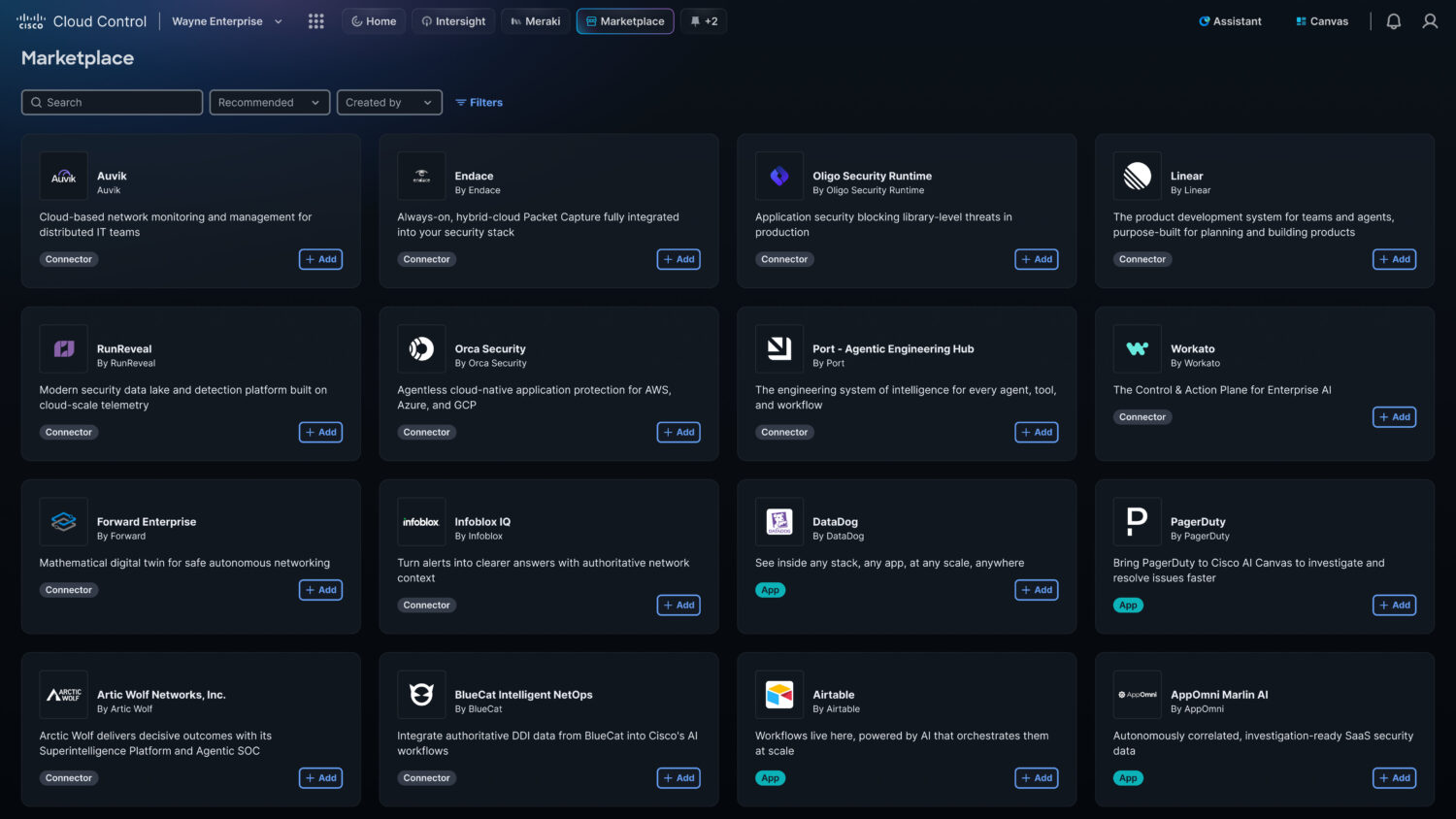
The fact that there is a marketplace for these integrations and that Cisco doesn’t just enable communication with other sources via MCP agents means that this goes beyond mere ad-hoc connections. From a security and governance perspective, this is good news, as these types of integrations are fundamentally easier to manage.
Add your own agents…
Cisco Cloud Control uses its own AI agents to bring the company’s AgenticOps vision to end users. These will undoubtedly be quite powerful, but they will never cover all the use cases that organizations have. That is why, in addition to its own AI agents and AI Canvas, Cisco also makes the so-called Cloud Control Studio available. In this environment, customers, as well as partners and integrators, can build their own agents and apps that can be deployed within Cisco Cloud Control.
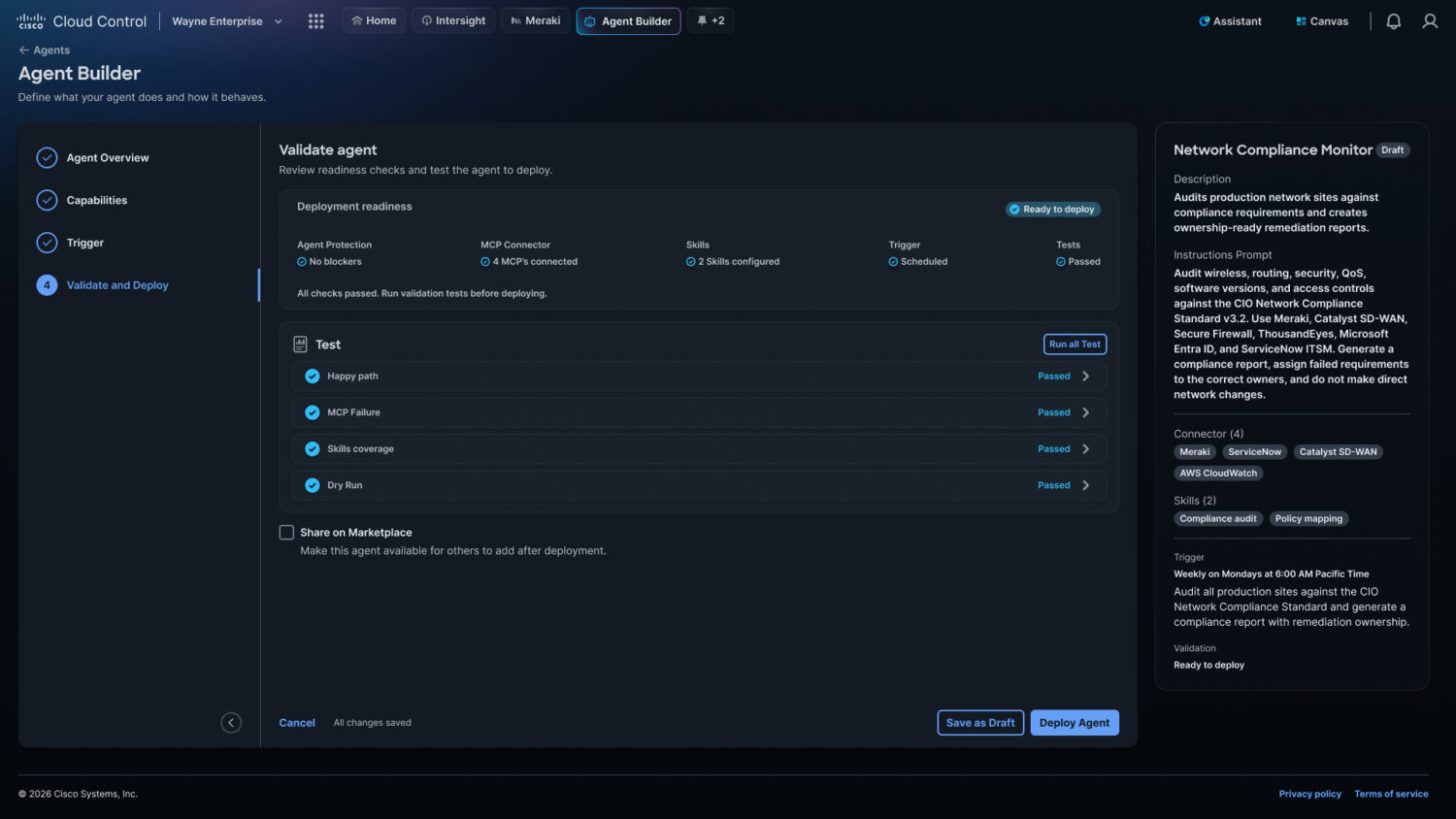
The ability to build further on the Cisco Cloud Control foundation is, in our view, truly crucial. Especially when you consider that there are already more than 50 integrations with external sources, Cisco can never provide the best AI agents for all those integrations that do exactly what organizations want and need. These agents can not only communicate with external sources via the 50 native integrations, but it’s also possible to add even more sources via MCP.
…and custom applications
In our view, the ability to build apps via Cloud Control Studio is even more important than adding more AI agents. This means that partners and customers can develop highly specific apps based on their own requirements. This makes the previously mentioned somewhat esoteric ambition—such as linking networking and security—a reality. In other words, you can use this approach to have Cisco Cloud Control perform tasks that cannot be configured in any of the individual UIs.
Through Cloud Control Studio, you can therefore configure Cisco Cloud Control entirely to your own taste and insight. Partners and organizations build the applications via a no-code/low-code environment that runs on OpenAI Codex. Sampath indicates that other similar coding platforms will certainly follow.
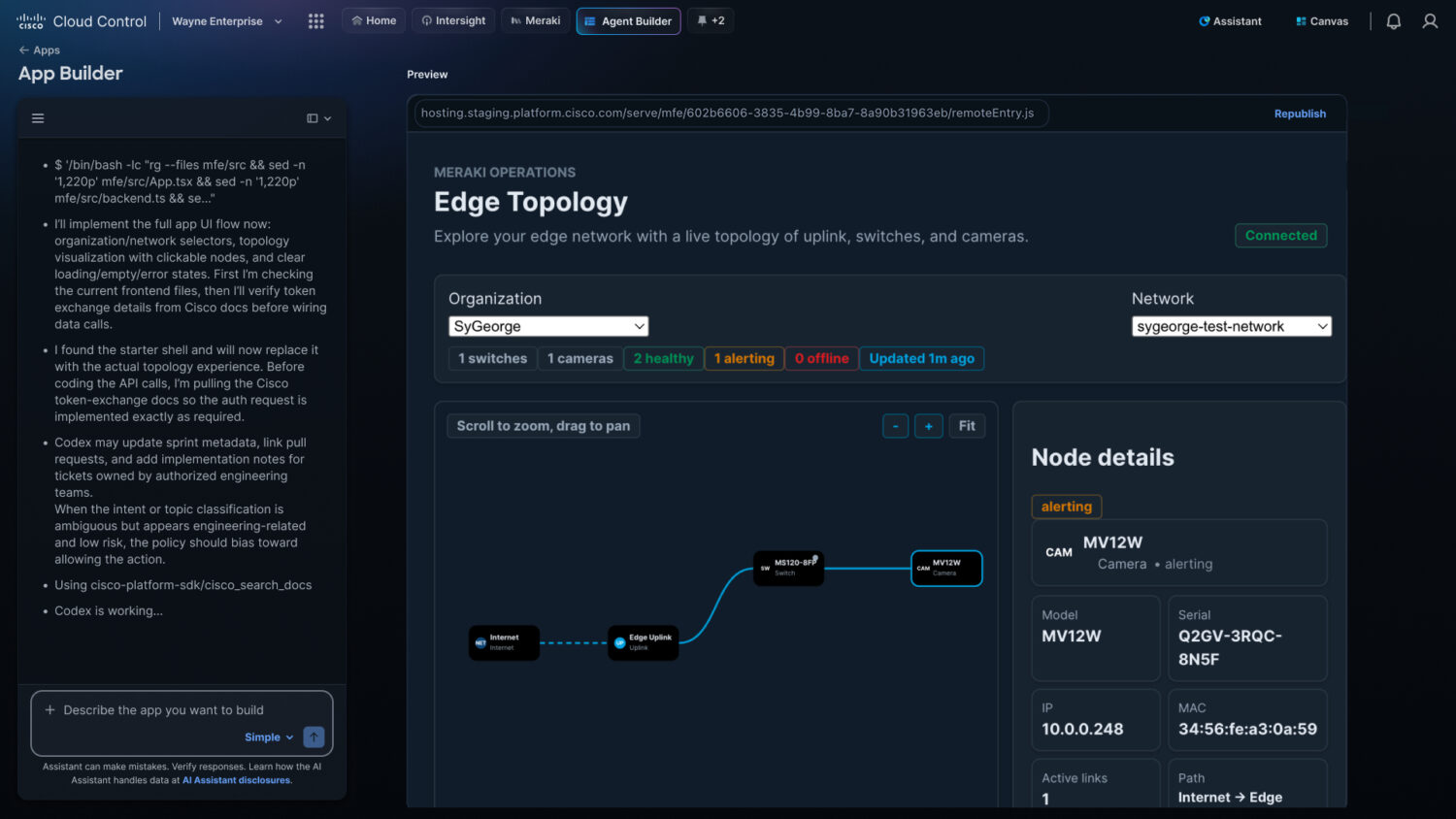
Finally, the applications built in Cloud Control Studio can also be published on the Marketplace. This can be valuable for partners serving a specific market sector where many of the same challenges arise. Consider, for example, specific laws and regulations that require necessary adjustments across the entire stack to achieve compliance. A partner can build an application once and then make it widely available through the Marketplace. This approach also gives partners an additional opportunity to make Cisco Cloud Control commercially attractive. An initial reaction from partners might be that consolidating all UIs into a single UI will result in lost revenue. This could then serve as an alternative source of income.
Software as the biggest innovation for a hardware player?
During the session we had with Sampath, he gave us a brief demo of the platform. Based on that and after giving it some further thought, we’d go so far as to say that Cisco Cloud Control is one of the biggest innovations Cisco has brought to market in the forty years it has existed. Whether it’s actually the biggest, however, we wouldn’t dare to say. However, Cisco Cloud Control does fundamentally transform Cisco as a provider.
Both Cisco President and CPO Jeetu Patel during the Cisco Live keynote, as wel as Chief Strategy Officer Ammar Maraqa and Sampath in conversation with us were also very clear about the purpose of Cisco Cloud Control: over time, it will replace the UIs of all the individual components it merges into one platform. That is, as they put it, the North Star for this new platform, which is actually not really new, but rather a provisional culmination of what Cisco has gradually brought to market over the past few years.
Hardware remains the foundation
Incidentally, the announcement of Cisco Cloud Control certainly doesn’t suddenly turn Cisco into a software company. The underlying infrastructure also continues to play a crucial role. This is already evident in various ways. For example, Nick Kucharewski, SVP & GM for Silicon One at Cisco, points out in our conversation that the latest Silicon One Series 9350 Smart Switches offer added value for Cloud Control through the specific telemetry that this programmable switching platform can provide.
Anurag Dhingra, SVP & GM for Enterprise Connectivity and Collaboration, describes today’s introduction of the Cisco Multicloud Fabric as something that is rolled out from Cisco Cloud Control as a NaaS service and, of course, depends on the hardware that operates in this way as a sort of equivalent to a global namespace (which we know from the compute world) across the entire network. Changes made to a part of the Multicloud Fabric (within the Cisco Cloud Control UI) are immediately applied across the entire fabric.
Can Cisco deliver on its promises with Cisco Cloud Control?
Cisco Cloud Control’s promise is grand. That also puts pressure on Cisco to deliver on this promise. That is not a given and often goes wrong in the IT industry. Cisco Cloud Control must not simply be a new UI to dump data, and turn it into a quagmire of insights and alerts. A bit like what Splunk was in the SIEM market, before Cisco (and Splunk before that) cleaned house there.
Based on what we’ve seen and heard so far, the risk of Cisco Cloud Control failing completely doesn’t seem very realistic to us. We feel confident in saying this because we’ve been following Cisco very closely over the past five to ten years. Based on that, we conclude that Cisco Cloud Control isn’t just a spur-of-the-moment announcement. It is the result of a vision that Cisco has been meticulously working on for years. Many of the announcements made over the past five years have led to this preliminary milestone.
Cisco Cloud Control has a major impact
Cisco Cloud Control is already a very complete platform, not just a first step. Its potential impact on Cisco—and by extension on the broader infrastructure market—is significant, very significant. That is certainly not to say that Cisco has won the battle with, among others, HPE. They are not sitting idle either and are steadily working on their own version of an infrastructure that allows agents and people to collaborate optimally. However, Cisco Cloud Control does mean that the lead HPE Networking undoubtedly had has shrunk significantly, if not disappeared entirely.
Maraqa, Cisco’s Chief Strategy Officer, acknowledges in conversation with us that HPE is a formidable competitor that deserves respect. He also states that the integration between security and networking at Cisco is deeper and more powerful. In our view, he certainly has a valid point there—at least on paper.
Will everyone use it?
Ultimately, the success of Cisco Cloud Control will, as always, depend on adoption by the market and partners. It is up to Cisco to drive this adoption. It can only do so by making its use so compelling that it becomes impossible to ignore. Maraqa, Cisco’s Chief Strategy Officer, is well aware of this, among other things. Cisco must not force it on users, something the company has done regularly in the past with previous products and platforms, given its massive installed base.
If Cisco resists the temptation to force Cloud Control on users, the potential of Cisco Cloud Control is so great that both end customers and partners will come to recognize its added value, even if certainly not everyone will switch immediately. It also helps that both the security and hardware portfolios are well up to date. The lights are definitely green for Cisco Cloud Control.