
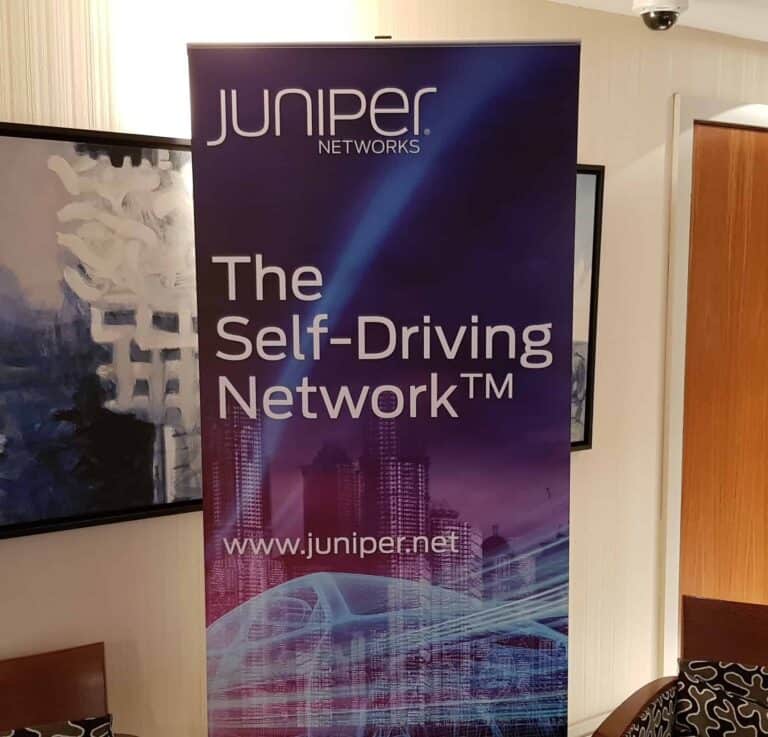
HPE Networking, and specifically the division formerly known as Juniper Networks, has been talking about plans to build a self-driving network for about a decade now (the image above is from 2017). While it sometimes sounds like a mantra, real progress is definitely being made. This week, HPE Networking is showcasing its latest innovations and updates. We spoke with the company to get a sense of where things stand now.
Recently, we’ve had several conversations with people from HPE Networking. During HPE Networking Day in Amsterdam, we interviewed Dobias van Ingen, HPE Networking EMEA CTO, and Sudheer Matta, SVP of Products (Aruba and Mist) at HPE Networking. Not long after that, we spoke with Rami Rahim, the former CEO of Juniper and now EVP, GM, and President of HPE Networking. Finally, just before this week’s announcements, we also had the opportunity to speak with Jeff Aaron, VP of Solutions Marketing, and Mittal Parekh, Senior Director of Product and Solutions Marketing at HPE Networking. Since there are many parallels in those conversations, we’re now bringing them all together to clearly explain HPE Networking’s strategy and perspectives.
Consistency is key
We’ve been following the HPE Networking divisions discussed in this article since the days when they were called Aruba and Mist. What struck us is that Aruba has sent all sorts of messages to the market, but Juniper (with and without Mist) has actually been saying the same thing for nearly a decade. It is focused on building a self-driving network, including analogies to self-driving cars and mapping the current state of networks to that development in four or five steps. We’re never big fans of analogies taken too far, so we’ll leave this aside for now (except in the title of this article).
If a company keeps repeating the same thing for a very long time, it can mean two things: either they just can’t seem to pull it off, or they can but it’s simply a long road. When we put this proposition to Matta and Rahim, they say independently of each other that it’s mainly the latter and that it’s precisely that consistency that’s so important. “In the age of AI, where networks are the on-ramp, you have to control the end-to-end experience,” adds Rahim.
Matta explicitly compares this consistency to the lack thereof at Cisco regarding Meraki, while Rahim notes that this consistency is “more important now than ever,” because he believes that creating a self-driving network is an absolute prerequisite for its performance and user experience. Finally, Aaron is quite emphatic, perhaps because of the marketing hat he’s wearing: “The self-driving network is here, at least in the world of HPE. Where others have only just begun by deploying agentic, for us that’s merely the most recent piece of the puzzle.”
A lot has already been achieved
Furthermore, it is certainly not the case that in the nearly ten years that Juniper and Mist (and now HPE Networking as well) have been talking about a self-driving network, absolutely nothing has been achieved. Everyone we spoke with made that point as well. According to Rahim: “We’ve already improved it immensely. About 70 to 80 percent of all tickets are proactively addressed by robots.” Matta has some additional data showing that there has indeed been (significant) progress overall. “We’ve seen efficacy climb to 80 percent, drop back down to 60 percent, and then climb again to 70 percent,” he notes. With this, he wants to make clear that today’s autonomous network is a completely different beast than the one from a decade ago.
The bottom line is that, according to the people we spoke with, the results of all the effort put into the self-driving network are clearly visible and measurable. Potential customers also seem relatively easy to convince of how well it works once they see it in practice, Matta tells us. “If we compete with Cisco based solely on a PowerPoint presentation, we lose 50 percent of the deals; if we’re allowed to run a production pilot, we win 90 percent of the deals,” he says.
Integrating Aruba and Mist, while maintaining platforms
Since the merger of HPE Aruba Networking and Juniper Networks into HPE Networking, the further development of the autonomous network has shifted into even higher gear. That’s a good thing, because “the process surrounding the acquisition didn’t help either party,” according to Van Ingen. As a representative of the Aruba side of the merger, he immediately adds that while HPE didn’t explicitly state it, they have indeed put a significant amount of work into making the network self-driving. According to him, the necessary recent acquisitions were aimed at this, as was certainly the introduction of GreenLake Intelligence last year.
The consensus is that integrating the two stacks is, in principle, quite feasible. Matta and Van Ingen emphasize the similarities in the underlying architecture of the Aruba and Mist stacks. While Mist has been based on microservices since its inception, Aruba completed the transition from the old architecture to a new one, including a new look, a few years ago.
Both architectures are inherently portable. This means not only that Aruba Central can be exactly the same in the cloud and on-premises, but also that transferring features from one environment to the other is not a major problem. For example, since the deal between HPE and Juniper Networks, many features have already been transferred. We wrote about that some time ago. The concept of the Large Experience Model, one of the fundamental components of Mist, was therefore one of the first things that could be ported to Aruba Central. In slightly more technical terms, the transport buses for both platforms are very similar.
Integration Accelerates Roadmap
From Rahim’s perspective, who focuses more on the organizational integration of the two entities, Aruba and Juniper (Mist) also complement each other perfectly. “The global reach that HPE brings to Juniper makes it possible to roll out AI-native operations on a global scale,” he cites as an example.
Rahim sees absolutely no negative impact on the innovation coming from the combined company, which now has revenue of around $11 billion (still nowhere near the revenue Cisco generates from its networking business, by the way, but that’s beside the point). “The innovation roadmap has been exceptional so far,” he notes. According to him, this demonstrates that the integration has not caused any distraction at HPE Networking.
What roadmap is HPE Networking rolling out?
In our conversation with Aaron and Parekh, we note that it’s already difficult to distinguish which innovations stem from the Juniper and Mist roadmap and which come from Aruba. HPE Networking also deliberately avoids making that distinction, we learn from Parekh and Aaron. “We’ve stopped distinguishing between the two,” the former admits.
When we then point out that this could be quite difficult for existing customers, who undoubtedly want to know whether their Mist or Aruba equipment will also receive a certain feature, Aaron immediately acknowledges this. “The best thing we can do is move forward as quickly as possible, with common hardware, and be explicit in our promise that we won’t leave any customer behind,” he says. “We’ve accomplished more in seven months than Cisco and Meraki have in seven years,” he adds to illustrate just how rapidly developments are progressing, in his view.
Shared hardware platform
The most important part of Aaron’s response to our questions above is that HPE Networking is fully committed to a shared hardware platform. That means, starting now, all new products delivered by HPE Networking will be compatible with both Aruba and Juniper/Mist. This begins with the access points but will also be implemented in switches and other product lines shared by the two divisions. The first access point was announced some time ago and is now generally available.
Note, however, that while this involves a common hardware platform, it does not mean you can choose which OS to run on it after purchase, as we learn when we ask Aaron how we should understand this. You buy a Juniper/Mist SKU or an Aruba SKU. So it doesn’t work like in some HPE storage lines, specifically Alletra, where after purchasing the hardware, the desired version (which file system) of the software is installed on the hardware.
Note, however, that a shared hardware platform does not mean that network hardware becomes a commodity. Several of the interviewees want to make that point very clear. “We can still achieve a lot of differentiation,” Rahim notes. Think of things like BLE, in-line security solutions in the hardware, but also certainly innovations in ASIC design, transistors, cooling, and so on. Ultimately, of course, there will be fewer truly distinct SKUs. That goes without saying and should provide economies of scale for HPE Networking.
Distinctions will disappear
In our conversation with Rahim, we ask him if he envisions a future in which the distinction between the two environments will disappear entirely. As far as we’re concerned, that is the logical (temporary) end state of the developments HPE Networking has set in motion. He confirms this to us as well. “Over time, the user experience will become the same; the only distinction will be where the hardware is deployed,” he says. “The experience for the end user will be identical,” he emphasizes once again.
Ultimately, what HPE Networking is doing with the self-driving network is part of a broader trend toward full-stack that is visible right now. Especially when it comes to AI, it’s important for organizations not to have too many variables and uncertainties. “We want to offer a single experience on the infrastructure,” Rahim expands on his earlier statement. Additionally, it’s much easier to combine this end-to-end approach with the self-driving nature of networks that HPE Networking is striving for.
Once HPE Networking has established the link between the shared hardware platform and the AIOps that the self-driving network uses, there will be a massive acceleration in the hardware sector. HPE Networking isn’t there yet, though. Rahim: “That’s going to take us some time, but we’re getting very good at it.” We think we can read between the lines here that HPE Networking doesn’t think this will take an enormous amount of time.
Latest autonomous updates
To bring the concept of a self-driving network a bit more to life, we’ll highlight a few new features that became available this week. Parekh wants to make it very clear that this isn’t just another set of actions that can be performed autonomously. He sees this as a “clear step forward in how networks operate, respond, and solve major problems.” “Our competitors are still doodling with agents; we’ve already solved all that,” he says, taking another jab at Cisco, which launched AI Canvas last year.
An important new capability announced by HPE Networking this week focuses on better channel selection, particularly in DFS (Dedicated Frequency Service) areas. Access points are allowed to use those channels but must stop immediately if a government satellite or, for example, a weather station comes onto that frequency. This can certainly cause some interference in certain areas. HPE Networking is now making this much more proactive, according to Parekh. Specifically, this means it identifies channels that are frequently in use and takes measures to prevent problems.
Additionally, improvements have been made to Dynamic Capacity Optimization. A network’s available capacity isn’t always the same. This has a major impact on the performance of wireless networks. You can do all sorts of things, such as adjusting the bandwidth, but also adjusting the transmission power and the roaming method. From now on, this is done autonomously by the self-driving network.
A final autonomous update addresses issues with VLANs. If the VLANs do not match, traffic must be rerouted, or in some cases, packets may even be lost. The new functionality detects mismatches and resolves them in a matter of seconds.
Marvis Minis for zero trust, but with a twist
The new functionality HPE announced this week for the self-driving network isn’t just focused on what you might call traditional AIOps. There’s also something noteworthy to report in the area of security. HPE Networking is getting a NAC sandbox. It delivers this via HPE Mist Access Assurance.
HPE Mist Access Assurance has been available for quite some time, but it requires a device to connect first. By then, however, the damage may already have been done. To solve this, there is now the NAC sandbox. It does exactly what the name suggests. It first places all devices that connect into a sandbox. You can compare it to Safe Mode on a PC. Only once it is clear which permissions can be granted is the device allowed to leave the sandbox.
The NAC sandbox is reminiscent of what HPE Networking can already do with Marvis Minis. These simulate network traffic on the access points themselves, after which adjustments can be made autonomously. The NAC sandbox, however, goes a step further. It operates in real time within a production environment. This feature therefore makes actual adjustments to configurations in real live environments. That takes it just a step further, but it combines excellently with Marvis Minis to make the network a bit safer and keep it that way.
Self-driving is the core of the platform
Based on our discussions with HPE Networking, it’s very clear what they aim to achieve with the autonomous network. “Self-driving isn’t a feature; it’s an architecture. We’re making self-driving the central focus of the platform,” Aaron sums it up well. It’s so fundamental that it takes time, but it should ultimately deliver significant value. A combination of smart AIOps features along with new capabilities for better network security makes this a very compelling solution as a whole.
Whether, and if so, when, HPE Networking can deliver a 100 percent self-driving network remains to be seen. After all, the network and its usage are constantly changing, so it must continuously adapt to and integrate those changes. But even if it never reaches 100 percent (if that is even desirable), it will automate many tasks that still have to be done manually today. That will undoubtedly lead to a better user experience. And ultimately, that is what it is all about.