Atlassian wouldn’t amount to much without the Teamwork Graph. That’s obviously a somewhat exaggerated position to take. Still, it’s hard to overestimate the importance of the Teamwork Graph for Atlassian. Especially when it comes to developing the various Collections and, of course, AI, the company really can’t do without this foundation.
It’s not difficult for a vendor to call something a platform. Whether a specific offering is actually a platform, however, remains to be seen. The term “platform” has now firmly entered the category of terms subject to inflation. What’s important for a platform is cohesion—it can’t just be a collection of loosely connected applications that customers can purchase. A common foundation is crucial for something to be called a platform. Atlassian understood this early on and is increasingly making the Teamwork Graph this common foundation. During the annual Atlassian Team conference, the company is highlighting the Teamwork Graph even more.
Teamwork Graph is more than a knowledge graph
If you want to get on Atlassian’s bad side, all you have to do is dismiss the Teamwork Graph as just another knowledge graph. That term has certainly taken off in recent years with the advent of AI and the cohesion organizations seek to leverage it. In that context, insights into how different data silos and parts of an organization are interconnected are extremely important to have. Especially as the use of AI agents (which will perform their tasks partially autonomously) increases, the demand for and need for these kinds of insights will also grow.
Atlassian makes a point of positioning the Teamwork Graph as more than just a knowledge graph. Of course, it is also a knowledge graph. That is to say, the Teamwork Graph establishes connections between different types of data, systems, people, and so on within organizations, and derives insights from them that organizations can use to align their strategies and processes and that AI tools can work with.
According to Atlassian, the Teamwork Graph provides much greater clarity than a standard knowledge graph. This is partly due to the continuous input it receives from the more than twenty apps Atlassian now offers. The idea is that this input improves the Teamwork Graph in real time. As Sherif Mansour, Atlassian’s Head of AI, puts it: “350,000 customers use Atlassian—and thus the Teamwork Graph—every day; they improve the Teamwork Graph as they go about their work.” The Teamwork Graph is therefore not static, but explicitly a ‘living’ entity.
Teamwork Graph is only becoming more important
It should be clear that the Teamwork Graph is of fundamental importance to Atlassian. After all, it provides the context that organizations need. According to Mike Cannon-Brookes, co-founder and CEO of Atlassian, the Teamwork Graph is only becoming more important. This is due in no small part to AI. Its success depends entirely on the quality of the input it receives. According to him, the Teamwork Graph and the context it provides are among the main reasons why Atlassian’s own Rovo AI outperforms offerings from other players in the market.
However, Atlassian says it is far from finished with the development of the Teamwork Graph. It wants to amplify its impact even further—not only for its own applications and Rovo AI, but also for environments outside of Atlassian. This strategy will naturally ensure that Atlassian as a whole plays a greater role within and for organizations. This, in turn, should drive further growth for the company, which recently reported quarterly revenue of roughly $1.8 billion.
Teamwork Graph CLI
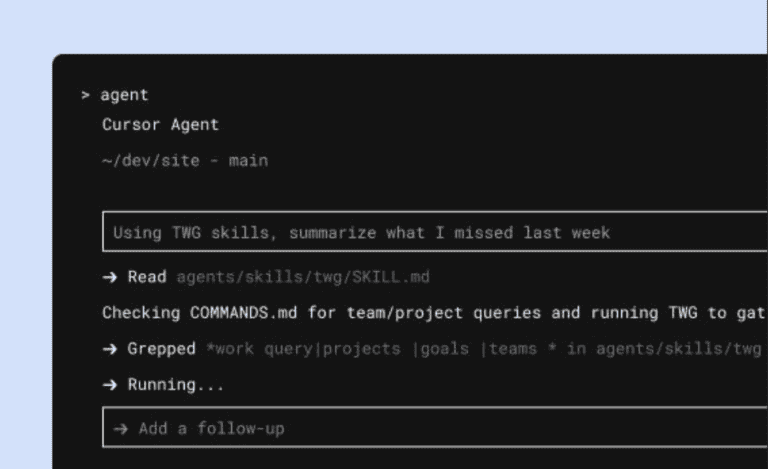
To increase Teamwork Graph’s impact, Atlassian first wants to bring it closer to application developers. That’s why it’s announcing the Teamwork Graph CLI (in beta) today. This should make it possible to bring context from the Teamwork Graph directly into any AI tool, AI agent, or workflow. Cannon-Brookes has high hopes for this, partly because the integration itself is free. That always helps, of course. It should give development environments like Claude Code and Cursor easy access to data related to workflows and dependencies that become clear through the Teamwork Graph.
Cannon-Brookes also promises that the Teamwork Graph CLI can work with some 380 tools via more than 300 commands. It’s also worth noting that this isn’t just a read-only integration. Developers can also update the Teamwork Graph via the CLI.
Rovo MCP Server provides access to Teamwork Graph
Teamwork Graph CLI is interesting for developers, but is likely a bridge too far for the average knowledge worker (an important target audience for Atlassian). That is why Atlassian is also making its own Teamwork Graph more widely available in another way. Through the Rovo MCP Server, AI assistants and agents that support the Model Context Protocol (MCP) can now also “talk” to the Teamwork Graph.
The Rovo MCP Server does what you’d expect from an MCP server. It makes the underlying data available to any platform. Think, for example, of Claude Cowork, which also specifically targets knowledge workers, but also ChatGPT, which is widely used in those environments.
Both the CLI and MCP integrations mentioned here are examples of what we might call the rise of headless apps. We recently wrote more about this based on input we received at a Salesforce event.
Building custom connectors for Teamwork Graph
With a CLI and an MCP offering, Atlassian already covers quite a few scenarios when it comes to opening up the Teamwork Graph. However, there will undoubtedly be customers who prefer to integrate a specific connector into their own environment. Or who need to do so because the tool they want to connect to the Teamwork Graph simply isn’t modern enough to do it any other way. That’s now also possible in Forge. Forge is Atlassian’s development platform, where customers and partners can get started building integrations themselves.
Atlassian designed the capabilities around Teamwork Graph in Forge to ensure that the foundation of everything Atlassian does is available to anyone who wants to use it. If what Atlassian claims about how good Teamwork Graph is holds true (we’ve spoken to quite a few customers who confirm this, though there will undoubtedly be differing opinions as well), this should enable a massive leap in relevance for the company itself. That is, of course, Atlassian’s ultimate goal with these expansions.
Teamwork Graph for Secure AI
One of the questions that undoubtedly comes to mind when reading about the above expansions is whether it’s really such a good idea to give all sorts of third-party tools access to important data about how organizations operate, what strategies and goals they have, and so on.
To provide as much transparency as possible, Atlassian states that it is also making it clearer what and where the Teamwork Graph contributes to AI output. This should instill sufficient confidence in people that they are working with the same data as the AI they are using. These insights also provide organizations with context across platforms. This, in turn, should ensure that they derive value from AI investments more quickly. Users manage permissions and access rights centrally for the entire system. This makes it clear who can view and use what.
Teamwork Graph should not only be a driving force for Atlassian
With the Teamwork Graph extensions announced by Atlassian, the company is delivering a much more fundamental update to its offering than the updates to the various Collections do.
Putting together these Collections—such as Teamwork Collection, Strategy Collection, Service Collection, and, as of this week, Product Collection—is a good way to demonstrate the interconnectivity of the applications they contain. It is also, of course, an absolute necessity to maintain a clear overview of the ever-expanding range of apps surrounding what Atlassian itself calls the System of Work.
Underlying all these apps and Collections, however, is the Teamwork Graph. Now more than ever, it has become the foundation for everything Atlassian does and aims to achieve—not only with its own offerings but now also through third-party applications and platforms. The insights the Teamwork Graph can offer are undoubtedly valuable for such applications and platforms. Conversely, these only serve to enrich and strengthen the Teamwork Graph in the end, which should ultimately benefit Atlassian. Thus, all parties should benefit from the Teamwork Graph, and it quickly becomes clear whether it is truly much more than a knowledge graph when used outside of Atlassian’s own ecosystem.