
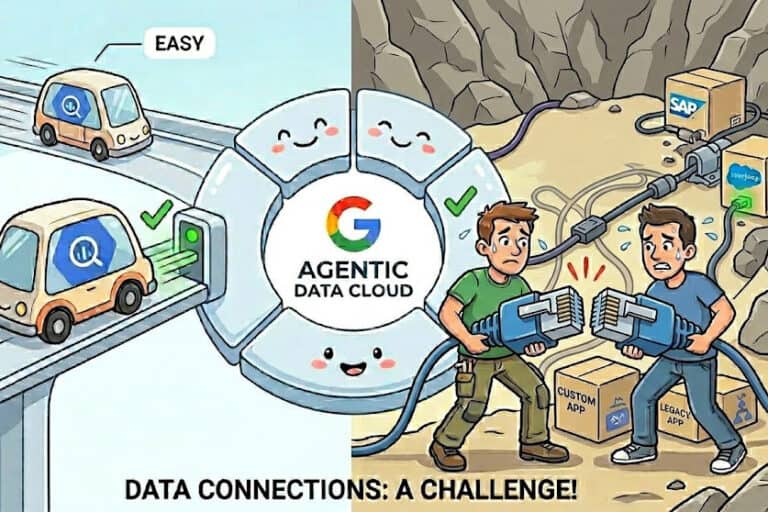
Google presents the Agentic Data Cloud as the connective tissue of the enterprise AI stack. A nice promise, but during a conversation with Andi Gutmans, VP and GM of Data Cloud at Google, it quickly became clear that this connecting layer has a major gap. A gap that Google is deliberately leaving open for now.
At Google Cloud Next 2026 in Las Vegas, Google introduced the Agentic Data Cloud. The message is clear: data is the foundation of AI, and Google wants to provide the infrastructure that brings all enterprise data together, makes it available to agents, and prevents hallucinations via a Universal Context Engine. It sounds like a complete solution. But is it?
The connective tissue only works if everything is connected
Google uses the term “connective tissue” for the Agentic Data Cloud, as the connecting factor between all data. The problem is that this only holds true if something is actually connected to that tissue. The Agentic Data Cloud can connect to all Google solutions such as BigQuery, Spanner, and services like Google Workspace and Microsoft 365. It also has built-in integrations with other enterprise players like Salesforce, SAP, ServiceNow, and a few others. Those are the big names Google neatly lists on its slides. But what if you didn’t choose those solutions, but one of the other thousands of SaaS solutions? The average enterprise runs about 900 to 1,000 applications.
Gutmans’ answer is honest, but uncomfortable: Google has a solution for first-party systems. For third-party applications, it’s a combination of partners, MCP, and the hope that the ecosystem develops quickly enough. By which he means that applications will soon hopefully support MCP.
We also spoke briefly with Thomas Kurian, the CEO of Google Cloud, about this. He stated that Google is now building more than 100 connectors itself, including NetSuite, Workday, Salesforce, Databricks, and Atlassian. But if you check the official Gemini Enterprise connector page, you’ll see far fewer than ten native third-party connectors. Some of which are still in public preview. Kurian is likely referring in part to Google Cloud Integration Connectors, a separate developer platform that does offer more connectors. But these aren’t out-of-the-box integrations that an administrator can enable in Gemini Enterprise with a single click; they require development capabilities. No matter how you count them, it doesn’t come close to the thousands of connectors offered by the average iPaaS platforms.
That’s not connective tissue, but a limited network with many loose ends. Too little for a platform that calls itself connective tissue.
MCP is just an API
Google positions MCP (Model Context Protocol) as the answer to the integration problem. Agents can use MCP to retrieve data from any application, as long as that application has an MCP server. That is also the problem, because those MCP servers do not yet exist for most enterprise applications.
Gutmans put it most clearly during our conversation: “MCP is just an API.” And he’s right. MCP is a slightly more agent-friendly version of what we already had with APIs. However, it doesn’t solve the fundamental problem: someone has to build that integration. Whether that’s done via MCP, via a REST API, or via a partner, that connective tissue has to be created.
The promise that agents will soon be able to navigate their way through undocumented APIs, he cited his own light switches as an example, is interesting, but it’s not an enterprise-level argument for a CIO who wants to go live this quarter. Besides, a light switch is a lot simpler than an enterprise application.
Workday saw the bigger picture and acquired PipeDream
In November 2025, Workday acquired the iPaaS platform PipeDream; they apparently understood that 3,000 ready-made connectors to enterprise applications are a strategic asset. Whoever owns the integrations drastically lowers the barrier to entry for their platform. The acquisition price was never disclosed, suggesting it wasn’t a massive deal.
Salesforce acquired MuleSoft years ago and recently added Informatica to its portfolio. Workday now has PipeDream. Google has a partner ecosystem and believes that Fivetran and dbt together will bring more data to BigQuery than what Salesforce and Workday have internally. The latter may well be true. But it misses the point.
It’s not just about the amount of data already in BigQuery. It’s about how quickly a new enterprise customer can connect their data to the Agentic Data Cloud. An iPaaS platform provides immediate acceleration and lowers the adoption barrier, that’s what’s currently missing at Google.
Not everything needs to be connected, but the foundation must be solid
Where Gutmans was right, however, is that not all data needs to be connected to already get enormous value. He used a demo example in which an analyst analyzed the impact of the Strait of Hormuz blockade on the supply chain by combining BigQuery customer data with news signals. It took the AI 15 minutes to do this analysis. Impressive, because a human would need days, if not weeks, to do that. It also doesn’t require 3,000 connectors, but it does require good data in the right place.
Google also has tools to help organizations with a more complex legacy landscape: the Agentic Data Cloud can analyze unstructured data and search through outdated databases, including the structure and relationships between tables based on query logs. That’s useful, and it deserves recognition. But it’s not the same as live integrations with the hundreds of applications that actually contain the daily business data.
Ultimately, the Hormuz demo is a strong argument for an early adopter with a well-established data foundation. Not for the majority of European companies that still use an ERP from 2009, a CRM whose name is barely known, and some 50 SaaS tools with just as many data silos.
The learning curve remains steep
Gemini Enterprise is presented as a simple AI platform for business users. No technical knowledge required, just flip a switch and get started. But that simplicity is built on the assumption of a solid data layer. For most organizations, that assumption simply isn’t true yet.
Gutmans argues that Google offers an independent AI solution, while Salesforce and Workday are already locked into a specific framework. That may be true. But as long as Google doesn’t have an answer to the integration challenge that’s as direct and concrete as “3,000 connectors, available immediately,” Gemini Enterprise’s learning curve will remain steep. Not because the interface is too complicated, but because the foundation for connecting all the data is missing.
The question isn’t whether Google will solve the integration problem, but whether they’ll do so quickly enough before customers decide that another platform with the right connectors is a better choice.