
HPE is reshaping its entire private cloud portfolio around a single operating model. At HPE Discover in Las Vegas the company revealed exactly how SimpliVity, Morpheus Central, VM Essentials, and Private Cloud AI fit together into one coherent stack. With 256 GPUs in a single private cloud, HPE brings AI infrastructure on-premises at a scale previously unthinkable a year ago.
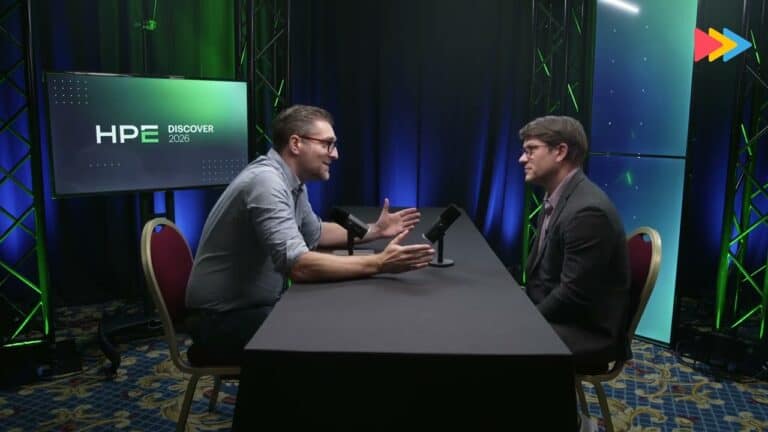
Techzine spoke with John Shirley, Vice President Product Management for HPE Private Cloud and GreenLake Flex, to get a detailed breakdown of every layer of that stack, from entry-level edge nodes all the way to 256-GPU AI clusters. Here is what every infrastructure decision-maker needs to know.
Shirley walks through the full stack; including how small you can actually start, in the video above.
A new tier structure for private cloud
HPE has reorganized its private cloud hardware into three clearly named tiers: PC-1000, PC-3000, and PC-7000. The PC-1000 maps to what was formerly known as SimpliVity, the PC-3000 covers the disaggregated hyperconverged environment, and the PC-7000 represents the fully managed private cloud for enterprise. According to Shirley, the renaming is more than cosmetic, it signals a common operating model that spans all three tiers. All these private cloud tiers share the same unified framework, HPE’s cloud suite. This suite includes Morpheus for orchestration, OpsRamp for observability, and Zerto for data protection and recovery. Together with the Private Cloud AI (PCAI) solution, this stack puts HPE in a strong position because it owns both the hardware and software stack, according to Shirley.
SimpliVity (PC-1000) is back, and bigger than expected
After several years of relative quiet, SimpliVity is experiencing what Shirley describes as a tremendous resurgence. The product is well-suited for two specific scenarios: edge deployments, where a retail chain might run virtualization or container workloads at remote locations, and smaller IT shops that need a compact, self-contained hyperconverged node. These can also be combined with a PC-7000 in a central data center. The arrival of Morpheus as the orchestration layer above SimpliVity is a significant factor in that revival. Customers can now manage edge SimpliVity nodes and central private cloud environments from a single pane of glass. This makes the overall architecture far more coherent.
Also read: HPE’s private cloud AI strategy for enterprises
Morpheus Central: one view across every deployment
Morpheus Central is the newest addition to the Morpheus family and is designed for enterprise customers who have scaled their footprint to multiple instances. Shirley describes it as a manager of managers. It provides a top-level view of all environments, it shows their health, flags upgrade opportunities across the fleet, and lets operators drill down into individual Morpheus instances. These can be environments on-premises and in public clouds. But more important, it is not limited to HPE infrastructure, because Morpheus can also manage AWS, Azure, and Google Cloud. These public cloud environments were already available in Morpheus. For large enterprises running hybrid estates, this means a genuinely unified operational view.
VM Essentials: beyond VMware migration
HPE’s VM Essentials (VME) hypervisor, built on KVM, has passed 2,000 customers. The most obvious demand driver is the Broadcom acquisition of VMware, which prompted many organizations to evaluate alternatives. Shirley is careful to position Morpheus as the orchestration layer above the hypervisor, not as a VMware replacement in itself. The hypervisor is VME, while Morpheus handles the higher-level orchestration that makes it enterprise-ready.
What makes VME genuinely differentiated in Shirley’s view is the PC-3000’s ability to run VMware workloads and VME workloads simultaneously on the same infrastructure. This means customers do not face a hard cutover. Instead, they can migrate workloads to VME at their own pace while mission-critical VMware applications continue running untouched. OpsRamp provides the observability layer throughout, and the entire stack: hardware, hypervisor, orchestration, observability, and support, it all comes from a single vendor. Demand is not purely migration-driven. Shirley notes that greenfield workloads spun up natively on VME represent a meaningful share of the customer base, though he declines to give an exact split.
Private Cloud AI: from pilots to production
A year ago, most HPE Private Cloud AI customers were still in evaluation mode. Today, Shirley says, those same customers are in production, and not just running inference workloads with retrieval-augmented generation (RAG), chatbots, and large language models (LLMs). Agentic AI frameworks are already adopted in enterprise environments. A development that surprised even some industry observers who expected it to take longer.
The hardware side has kept pace. HPE announced 256 GPU support at HPE Discover, a scale that would have seemed implausible twelve months ago. This scale is necessary because agentic workloads consume significantly more GPU resources than pure inference. At the same time, HPE has been careful to offer flexibility at the low end. The PCAI lineup uses a t-shirt sizing model that starts with a developer kit, a small environment using software-defined storage, designed to help data scientists learn models and scale incrementally from there.
Who is adopting PCAI?
Adoption spans industries. Shirley points to the Ryder Cup as a high-profile partner visible at the show. Other examples are healthcare organizations and financial services firms. The common thread is data privacy: customers who cannot or will not send sensitive data to a public cloud. That means legal firms, healthcare providers, and regulated financial institutions are the most motivated buyers of on-premises AI infrastructure.
AI Essentials: the software layer that ties it together
HPE’s key differentiator in the crowded AI factory market is the AI Essentials software suite. This suite is always included with every PCAI deployment. AI Essentials integrates HPE’s NVIDIA software capabilities, open-source model support, and a data fabric layer that enables data scientists to discover, connect to, and consume data within AI workloads without manual plumbing.
OpsRamp is also built into the PCAI stack, providing observability that goes beyond standard infrastructure metrics. It also includes token consumption, GPU utilization monitoring, and visibility that is essential for managing the economics of large-scale inference and agentic deployments.
With adoption accelerating and the product footprint expected to be significantly larger by HPE Discover 2026, the private cloud and PCAI portfolio is clearly at the center of HPE’s enterprise strategy.