
Sometimes it’s remarkable how things turn out. Everpure (then known as Pure Storage) originally developed Cloud Block Store simply to be able to check a box when offering cloud storage. Through a series of twists and turns, it has since become a full-fledged business unit within the company. We spoke with Dan Kogan, VP of Cloud at Everpure, about this development.
Everpure projects the image that it has been working toward its current position since its founding, and that it’s therefore no surprise that things are going so well. The decision to produce only arrays with onboard NAND flash from the start, first SSDs and later its own DFMs, along with the ease of operating and managing the hardware and the low power consumption, was all part of the plan from the beginning.
Still, even a company with Everpure’s unmistakable focus needs a little luck now and then when developing something new. That was certainly the case with Cloud Block Store, which became available in 2019. To put it bluntly, Everpure didn’t really have any plans for it at the time. “It started out as a safety net for on-premises sales,” Kogan explains. In other words, it was meant to ensure that the sales team could tell potential customers that (at the time) Pure Storage also offered cloud storage. “We didn’t expect it to take off”, Kogan stresses once more.
From virtual array to native service
So, when it was introduced, Pure Storage Cloud Block Store wasn’t actually all that interesting. It was nothing more than a virtual array that drew little interest, just a checkmark on a list of features. “It wasn’t used that muchl,” according to Kogan.
When Kogan took charge of Everpure’s cloud business, he wanted to see if there wasn’t more to be gained from it. To do that, the way customers worked with it had to change completely. Cloud Block Store was initially a virtual SAN that connected to applications but also had to be managed as a SAN. That didn’t immediately make it very attractive for customers to adopt. After all, in the cloud, organizations expect the necessary services.
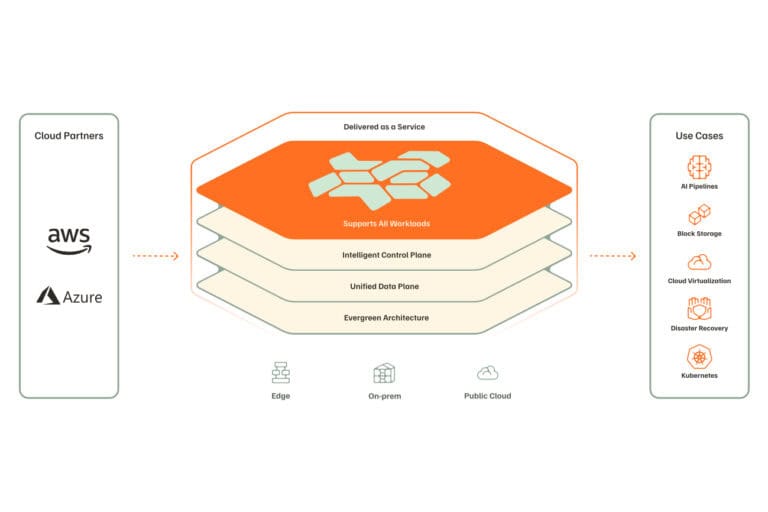
That service aspect eventually came into play. What we now call Everpure Cloud consists of services fully managed by Everpure, which customers can deploy directly from the Azure console. This made Everpure Cloud much easier to adopt and use.
Broadcom lends a hand
Modernizing Cloud Block Store (later also known as Pure Storage Cloud Dedicated) certainly made the service more attractive. However, this was still no guarantee of adoption. Sometimes other factors have to fall into place as well. Broadcom’s acquisition of VMware was clearly one such stroke of luck, Kogan tells us.
We’re all familiar with the stories. After the acquisition, Broadcom didn’t take half-measures and rigorously cut back on VMware’s product offerings. In addition, it essentially wanted only customers on VMware Cloud Foundation, where everything from VMware converges into a single platform. As a result, prices for customers who, for example, purchased only vSphere skyrocketed.
The impact of Broadcom’s aggressive actions is still being felt. Some customers acted quickly and looked for alternatives, decided to stay with VMware, or settled for a middle ground. However, there are still quite a few who are right in the middle of the process.
FinOps is a major driver
Everpure Cloud can help customers with their VMware challenges in various ways, Kogan explains. They can perform a lift-and-shift from on-premises to Everpure Cloud, but Everpure can also assist with a transition to other platforms, such as AWS, Azure, Nutanix, and Red Hat OpenShift.
Of course, simply moving things around doesn’t solve much on its own. However, Everpure has extensive experience in storing data as efficiently as possible. That’s where Everpure Cloud can offer significant value, Kogan explains. In other words, it can make public cloud storage much more affordable for customers.
These can be truly significant savings, he notes. He cites a customer in Europe who reduced annual storage costs from $35 million to about $11 million thanks to Everpure Cloud. While it’s certainly not a cheap service, the costs are, of course, always relative. At the end of the day, the customer benefits greatly, so it’s worth the investment. The customer can then reinvest the savings into other cloud services, such as AI.
Customers are coming in through the cloud
We’ve noticed that Everpure Cloud is, for now, quite separate from the rest of Everpure’s offerings, which are still fundamentally focused on on-premises solutions. This has both advantages and disadvantages.
One advantage is that Everpure isn’t dependent on the presence of on-premises hardware and services. In other words, it can sign up customers for Everpure Cloud who, so to speak, only have NetApp in their own data center. Kogan assures us that this definitely happens.
A disadvantage is that, for now, there aren’t really many opportunities to naturally extend Everpure’s footprint from the cloud toward on-premises environments. “We have many business conversations with customers to build trust and, in that way, also do on-prem business with them; we’re not really expanding [Everpure Cloud, ed.] toward on-prem from a technical perspective,” says Kogan.
There’s still a lot of work to be done
Everpure’s cloud business is still quite young, that much is clear. So there’s still a great deal to do to really build it out properly. For example, there’s a clear difference in the maturity of the Everpure Cloud offering on Azure and AWS. Everpure is much further along with Azure. AWS/Amazon itself doesn’t seem to have a huge interest in moving forward with it, Kogan tells us. Google Cloud is taking the initiative, though, so we can expect something in that area in the future. Kogan also sees offerings on Oracle Cloud Infrastructure (OCI) looming on the horizon.
It’s also worth noting that while the name has changed from Cloud Block Store to Everpure Cloud, the platform still only supports block storage. According to Kogan, work is underway to expand support to file and object storage.
Given the major announcements Everpure has made in recent years during Everpure Accelerate (Everpure’s own conference), this expansion will certainly be necessary. These announcements focus on setting up an Enterprise Data Cloud (EDC). Initially, this primarily concerned the arrays that customers had on-premises. To ensure that cloud storage can also be part of the EDC, it is important that all protocols are supported there as well.
Everpure Cloud gains a foothold
The story of Everpure Cloud is one of how a new service, which started as a mere checkmark on a checklist that received little attention, has evolved into a standalone business unit that’s gaining momentum. It has now become a foot in the door for Everpure to gain access to customers where it isn’t yet present. That’s quite a good outcome for something that seemed to have little future. In any case, it shows that not everything can be planned, not even for a company with the clear vision and strategy that Everpure had and still has.
For now, the main priority for Kogan and Everpure is to continue developing Everpure Cloud. Only then can the company truly compete with the public cloud offerings of other players, such as NetApp. We’re also writing an article about how Everpure Cloud and the services NetApp offers in the public cloud compare. You’ll be able to read that soon.
See also: From app-centric to open and data center-centric: can Everpure deliver on its promise?