
An entire workforce leaving your company every year would normally be cause for concern. Not so for the student-led Forze Hydrogen Racing. Sustainably fueled racecars competing at an international level are prepared, maintained and improved by an ever-shifting team of students. This extreme level of institutional knowledge loss means Forze Hydrogen Racing along with their partner Randstad Digital are finding a unique use case for an AI assistant.
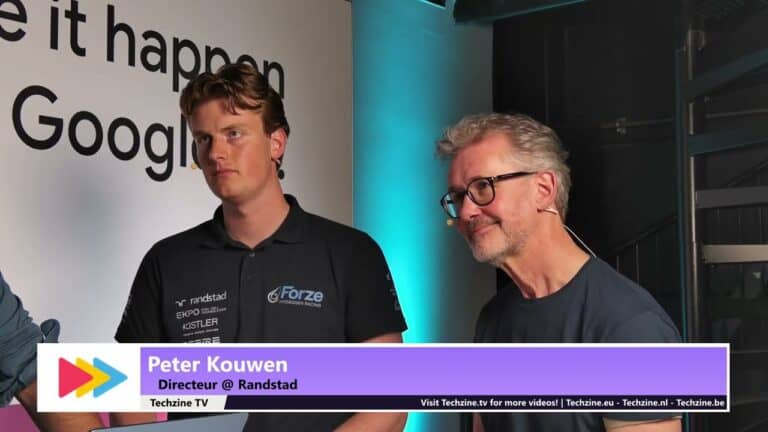
At Google Cloud AI Live in Amsterdam, Olivier de Boer, team manager at Forze Hydrogen Racing, and Peter Kouwen, director at Randstad Digital, shared how they created Forze Mirate, an AI mentor that preserves 18 years of engineering knowledge and doubles onboarding speed for new team members.
The unique challenge of student racing teams
Forze Hydrogen Racing operates with 50 to 60 students who volunteer for a full year to build a Le Mans prototype car powered by hydrogen. The team’s mission extends beyond racing, as they aim to promote hydrogen as a sustainable energy carrier while educating future engineers, marketers, and leaders.
“Each year a new team starts and the entire team leaves Forze,” De Boer explains. “And then a new team is onboarded in parallel to the last part of the current team. And the current team becomes alumni.” This annual complete turnover creates one of the organization’s biggest challenges: how to transfer knowledge accumulated over 18 years by 500 students.
The team doesn’t just handle engineering, as they also manage governance, business operations, and all aspects of running an organization. New teams must take over everything from the previous cohort, making comprehensive knowledge transfer critical.
Partnering with Randstad Digital for AI implementation
Randstad serves as a sponsor of the Forze project through its Randstad Digital specialization, which focuses on digital talents, digital projects, and getting digital work done in cybersecurity, data and AI, and digital delivery.
“There should also be in today’s world of engineering a digital component as part of that,” Kouwen notes. “And that’s where we joined forces. We combined the capabilities of the Google platform and support from Google with Randstad’s ability to create applications and integrate the data that is needed for that to support the challenges that Forze is dealing with.”
Building Forze Mirate: The AI mentor solution
Forze Mirate serves as a digital mentor to help new students access all the knowledge acquired over the organization’s history. However, the data landscape presented significant challenges.
“Imagine here that the knowledge that was acquired looked like if you would look at the data, you would see a student room. It’s a mess. It’s all over the place,” Kouwen describes. “It is not categorized or standardized or structured. So how do you get all of that information that has been built up over the last 18 years by 500 students? How do you get that combined in a trusted way?”
The solution involved creating an AI agent that could scan unstructured documentation and provide reliable answers without requiring a massive data cleanup project first.
Preventing hallucinations and ensuring accuracy
One of the critical requirements for the AI system was preventing hallucinations—instances where AI generates false or unsupported information. The team implemented specific safeguards to maintain data integrity.
“Together with Randstad, we determined some requirements, which was referrals to each document it takes knowledge from,” De Boer explains. “And this prevents hallucinations. And if it wants to give a hallucination, it just has to, is forced to tell it doesn’t have any information available.”
The system prioritizes the newest data available and requires source citations for all information provided. It’s also connected to Slack, where team members can chat and receive responses based solely on documented information rather than interpretation.
Adoption results and productivity gains
The AI agent has achieved significant adoption across the organization with measurable impact on team performance.
“Already a very large part of our organization has adopted to the technology, to the AI agent Forze Mirate,” De Boer reports. “We see that, for example, with the onboardings, it goes now twice as fast as before because our engineers in the new team can independently onboard themselves.”
Team members can ask questions, generate learning modules, and start quizzes to test their knowledge comprehension. Current team members also use the system extensively, eliminating the need to search through multiple documents manually. “Before you had to search for a document and read the entire document, and then you needed to go on to the next document, etc. And now you just get the overview of everything you need.”
Eliminating bias through objective AI
Before implementing the AI system, teams relied heavily on alumni to answer difficult questions about past design choices, wiring decisions, and engineering approaches. However, human memory introduces bias and subjective perspectives.
“We see that the AI is very objective,” De Boer observes. “So it only scans the data without any perspective or any subjective opinion, and then just shares the information that it reads. And that takes away the bias.”
This objectivity extends to Slack conversations, where the AI reads and processes only the information in messages without adding interpretation or personal opinion.
Future applications in racing and real-time data
The current implementation focuses on organizational processes, standard operating procedures, and engineering designs. However, the team has ambitious plans for expansion.
“The next part’s of course racing and real life, live data and troubleshooting help,” De Boer shares. “And that’s what we wanna develop in the future. So while troubleshooting, testing, and eventually racing, having an extra teammate that’s doing everything faster than we can do as humans.”
Enterprise applications for institutional knowledge
While Forze Hydrogen Racing represents an extreme case of knowledge turnover, Kouwen emphasizes that corporations face similar challenges at different scales.
“We are working with clients that have a, of course, at a different scale, but have a similar challenge as to what Oliver described for Forze,” Kouwen explains. “How do you make all of the engineering data that you have in your company accessible, easily accessible? How do you avoid that there’s a bias of a certain strong personality and stick to the facts? How do you onboard new talent? And at the same time, how do you safeguard those people that are going to retire? That they leave the knowledge behind instead of taking it with them.”
These challenges, found at an elevated and accelerated level in Forze, mirror issues in corporations dealing with legacy systems, retiring workforces, and the need to preserve expertise.
Rapid implementation: Four weeks from concept to production
Perhaps the most striking aspect of the project is its speed. The team didn’t spend years planning and preparing data before launching the AI agent.
“The interesting thing is that this is not a project that has taken us years to build. Actually, the real work to build this is probably 4 weeks,” Kouwen reveals. “So you can quickly start with today’s technology to get something off the ground, get your projects live, and then iterate and further develop the application.”
The implementation approach involved several key principles. First, they didn’t reorganize all the data before starting. “The data continues to live where it lives and we make this accessible through an app with integrations, with zero copy integrations into the app,” Kouwen explains.
Second, they used short iterations with constant feedback. “Every time we brought the technical person from Russell Digital together with the Forze Hydrogen engineer. They would look at, what do you think of this? Does that work? Does it avoid some of the design criteria like avoiding hallucinations? And is this what you would like?”
Think big, start small, iterate fast
The project philosophy follows a clear principle that Kouwen believes many organizations, including Randstad itself, sometimes forget: “Think big, but smart, start small and iterate fast. That’s exactly what we did here.”
He emphasizes that technology only becomes valuable when it’s working in someone’s hands, not when it’s being endlessly refined in development. “If I look at our own organization at Randstad, we sometimes forget that as well. We think big and we start big. Oh, there’s probably a better way of doing this and show, not tell how you iterate on the basis of that.”
Improved documentation culture
An unexpected benefit of implementing the AI system has been increased awareness of documentation quality. “The fun thing is that you see now that we started using AI and you see the limitations of our own documentation,” De Boer notes. “So this is also a trigger for the new team that’s coming along to document well, because it will only improve their own processes.”
The organization has responded by creating new positions within the team, including AI engineer roles and positions focused on information and communication to improve standardization and documentation practices.
Implications for hiring and workforce development
When AI can preserve and transfer institutional knowledge this effectively, it changes the calculus for hiring decisions. Organizations may find they can hire more junior talent when an AI mentor can accelerate their ramp-up to productivity.
“If you onboard people and you want them to quickly learn how we do stuff around here in terms of content, but also we included also HR policies, right? They’re also part of the system,” Kouwen explains. “If you have this at your disposal, if also we embedded in the application a testing mechanism, so you get the information that you need to learn in modules, the AI does that. The AI presents you with checking questions and then validates whether you are good to go to the next module.”
This approach to onboarding applies equally to student racing teams and large corporations seeking to reduce time-to-productivity for new hires.
Also read: From pilot to production: what it really takes to run AI for real