
During SAS Innovate in Grapevine, which coincides with the company’s 50th anniversary this year, the company announced major expansions to the Viya platform. At its core, they mean less data needs to be moved, code generation is accelerated, and models can be more easily linked to external agents. What new features would benefit data scientists and data engineers?
SAS observes that many organizations are currently getting stuck when scaling up AI projects. This is not so much due to a lack of AI tools or ambition. Fragmented data environments and insufficient data governance are more likely to be the root causes. Fragmented cloud environments can hinder AI progress. SAS aims to change this with a rock-solid data foundation and the tools to extract maximum value from it using generative and agentic AI.
For data engineers, the constant movement of data is often a pain point. Scaling analytics often requires duplicating sensitive data. Moreover, embracing AI agents and AI assistants makes ensuring data quality and governance even more crucial. Many assistants operate only after data preparation, creating gaps in trust, lineage, and visibility. SAS Viya chooses to apply AI-driven assistance directly to the data lifecycle. According to the company, “foundation-level decisions” determine whether AI can be trusted at scale.
Tip: SAS gives data scientists the steering wheel for the AI (agents) era
In-place analytics
A central component here is SAS SpeedyStore. This is a high-performance, cloud-native analytical data platform, tightly integrated with Viya, designed to run directly alongside existing distributed data. As a result, heavy analytics and AI workloads are executed where the data is physically located, without unnecessary or risky data movement. This reduces costs and latency and, most importantly, ensures that the lineage organizations need for reliable compliance remains intact.
This philosophy extends beyond the platform itself. With the introduction of the SAS Data Accelerator, the company enables its SAS analytics to run directly and seamlessly within third-party cloud data environments, including modern data warehouses and lakehouse architectures. We have not yet been able to determine whether this is possible with a select group of providers or with all major platforms.
Another addition for data professionals is native support for DuckDB as an embedded analytics engine within SAS Viya. This enables fast local analysis of open file formats, including Parquet, CSV, and JSON. This occurs securely within a managed workflow.
The fundamental idea behind these innovations is that governance is no longer a cumbersome layer on top of data workflows, but is intrinsically woven into them. According to Alyssa Farrell, Senior Director of Data and AI Strategy at SAS, a modern data platform is now an absolute mission-critical requirement as organizations move ever faster toward agentic AI workflows where human oversight is diminishing. “SAS is redefining data management for the AI era by helping organizations optimize modernize data estates, reduce complexity and unlock AI value, with governance and trust engineered directly into the foundation,” said Farrell.
Copilot directly in the workflow
Once a solid data foundation is in place, the data scientist interacts with the SAS Viya Copilot. This generative AI assistant distinguishes itself by operating deep within production analytics workflows. It possesses extensive domain-specific knowledge, the correct terminology, and ingrained best practices. Thanks to tight integration with Microsoft Foundry, the assistant truly operates from within the analytics environment itself and does not function as a separate chat interface alongside it.
Users can ask complex questions of their Viya applications using natural language. An interesting feature for developers is Copilot for Code Assistance, which brings AI-powered development directly to SAS Studio. This allows data scientists and engineers to write, refine, and obtain explanations for both SAS and Python code via spoken or typed instructions, without leaving their managed development environment. The assistant also provides guidance on setting up complex model pipelines and creating clear dashboards.
For the pre-modeling phase, there is Copilot for Data Discovery, a tool that enables natural language exploration of managed data and analytics assets. With this, a user can determine in seconds which data is actually available and usable within the organization. Another update is available for SAS Data Maker. When access to data is restricted by strict privacy laws, Data Maker generates synthetic data that flawlessly mirrors the statistical, relational, and temporal characteristics of the real production data. This is done without exposing sensitive information or personal data, allowing teams to continue developing, testing, and collaborating uninterrupted while strictly adhering to all regulatory requirements.
In addition to these generic tools, SAS has also made two industry-specific versions of the assistant available. These are the ALM Copilot for financial risk management and the Health Clinical Data Discovery Copilot for complex clinical data analysis in the healthcare sector. The company is also looking ahead and plans further expansions into critical domains by 2026, including fraud prevention in banking and supply chain optimization in manufacturing.
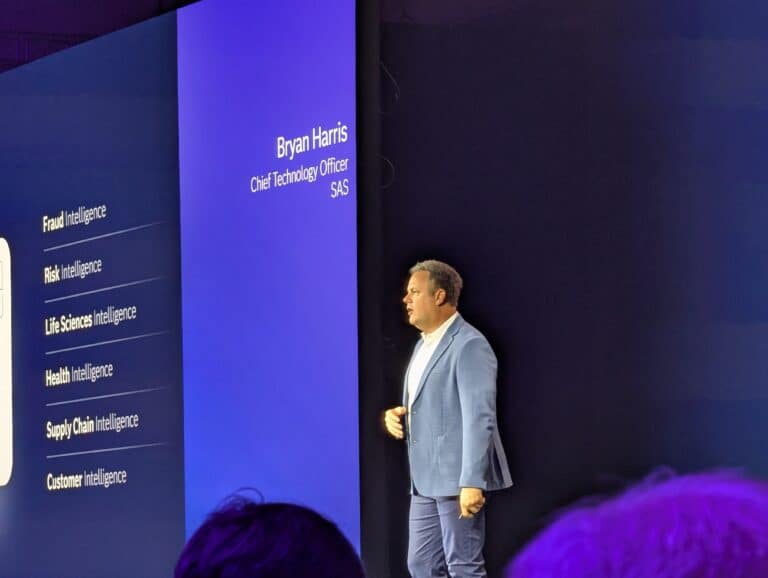
Tip: SAS CTO Bryan Harris: AI requires pragmatism, not hype
Leap from assistant to autonomous agent
In addition to innovations for Copilot and improvements in data management, SAS is taking the next step from reactive AI assistants to proactive, independently operating agents with two brand-new components. The first of these is the SAS Viya Model Context Protocol Server. By leveraging the open MCP standard, external AI agents can securely utilize deep SAS analytics, business models, and complex decision logic. In practice, this means organizations can invoke SAS’s trusted analytics capabilities from their preferred LLM interface, such as Anthropic Claude. The advantage of this is that valuable business logic does not need to be duplicated, and strict enterprise governance is not circumvented by shadow IT practices.
The second addition is the SAS Agentic AI Accelerator. This platform offers a highly structured and comprehensive framework for teams of all skill levels, from business users working with no-code solutions to seasoned developers. In principle, everyone should be equipped with the tools to design agents, manage them effectively, and deploy them securely into production. The Accelerator contains a wealth of reusable code, predefined components, and standardized interfaces that effectively help organizations bridge the notorious gap between local experiments and repeatable, managed enterprise implementations. To accelerate adoption, SAS has decided to make both components immediately available to all current Viya users via GitHub.
As the icing on the cake, SAS is introducing the Retrieval Agent Manager, or RAM. This is a no-code solution fully based on the retrieval-augmented generation principle. RAM is designed to convert the massive amounts of unstructured business data into highly accurate and context-aware responses for the deployed AI agents. Although this specific tool is currently being marketed as a standalone product, SAS plans to deeply integrate these capabilities into the Viya platform. Eventually, agents and assistants should be able to seamlessly and flawlessly anchor all their responses in the very latest enterprise context.
The indispensable role of human expertise
A recurring theme in all announcements is the undiminished importance of human judgment alongside AI automation. As technology becomes more autonomous, the safety net provided by human expertise and governance becomes increasingly critical. According to SAS, the role of human expertise in operationalizing agentic AI will be elevated.
With the new capabilities within SAS Viya, organizations can safely link their copilots and autonomous agents to human judgment, validated and trusted data, and enterprise governance. As a result, the AI actually drives responsible and impactful decisions in the real world. For data professionals, the new Viya means that endless data management is slowly giving way to the era of reliable, scalable, and automated decision-making