
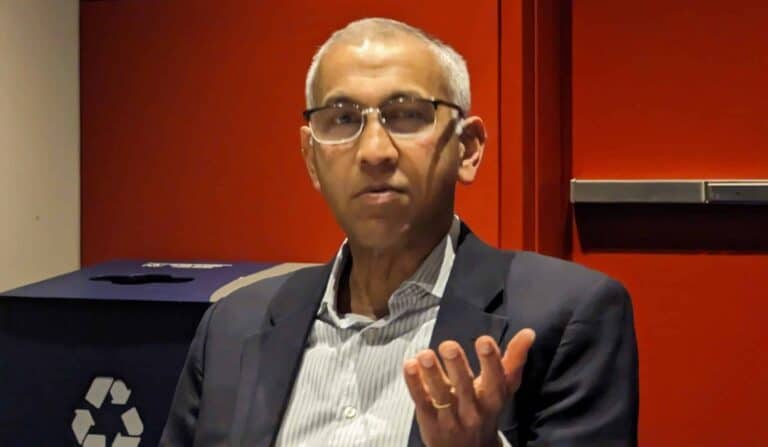
Sometimes, leadership succession at the top of a company is planned. A successor for Nutanix CEO Rajiv Ramaswami has not yet been named, but he will step down as soon as one is found. Now that “chapter 2” is complete, a new leader will take the helm, just as a new leader did after the conclusion of the previous phase of Nutanix’s growth. It appears to be a smart move in the race to integrate AI, a race that seems increasingly likely to be a marathon rather than a sprint.
Dheeraj Pandey, co-founder and CEO of Nutanix until the end of 2020, led the first chapter of this journey. Under Ramaswami, it didn’t quite turn out to be the “next decade of growth” that Pandey had suggested upon his departure, but it was six eventful years that revolved just as much around Nutanix as they did around VMware.
Growth from two sides
Ramaswami was COO of Products and Cloud Services at VMware until he moved to Nutanix within a few days to lead that company. A lawsuit followed, which VMware dropped in late 2021. Two years later, Broadcom acquired VMware, triggering a massive restructuring of the partner network, the product line, and, consequently, the availability of virtualization, particularly for smaller customers. It immediately seemed like a godsend for the many potential alternatives, with Nutanix emerging as, and remaining, one of the largest and most feature-rich rivals.
That growth had already been well underway long before the Broadcom acquisition. After Ramaswami helped steer VMware toward a hybrid subscription model as COO, he completed the transition he had begun under Pandey as CEO of Nutanix. The revenue the company generated in fiscal year 2020 has more than doubled by 2026 to $2.85 billion. Free cash flow is $841 million in the black, compared to a $249 million deficit. Growth has, however, slowed: ARR growth dropped from 18 to 15 percent within a year, and Nutanix expects renewals to grow at a slower pace in fiscal year 2027.
Those leaving VMware have undoubtedly contributed to the growth, but the Nutanix CEO already told us in 2024 that this influx would be slow. Replacing IT infrastructure solutions is, of course, no easy task. VMware/Broadcom is well aware of this and has taken some steps to accommodate customers in this regard. However, it is also hindering easy migrations by, for example, limiting the availability of VDDK, an SDK used by Nutanix and others in their own Move tool, to select partners since August.
Ramaswami, incidentally, fully understood Broadcom’s decision to drastically streamline its portfolio. In an interview with Techzine, he demonstrated an awareness of the new VMware’s focus on the very largest customers and a unified offering. As a challenger, Nutanix still has the flexibility and the imperative to prioritize adoption over hefty costs. The test will first be whether the company is more than just a challenger to VMware among larger customers and whether it sticks to its principles of not behaving like Broadcom toward less fortunate parties.
A new Nutanix can’t just plow ahead
Anyone looking at what former CEO Pandey is doing these days will see DevRev, a platform shaped for and by the rise of AI. This stands in contrast to infrastructure players who, like Nutanix with its acquisition of Ryax, offer at most add-ons to capitalize on the new AI infrastructure, without fundamentally changing the day-to-day work of IT administrators.
That approach is explicit and deliberate. Nutanix is not meant to be a platform driven by agents at all, but one in which humans are more than just “in the loop,” with responsibility and consistent policies.
From that perspective, it makes sense that Ramaswami, when announcing his departure, spoke of a somewhat vague next chapter. He likely concluded himself that the next ten years will not revolve around further expansion based on the same principles as before. Consider the strain that AI workloads place on current infrastructure: all data must be immediately available, and costs rise rapidly if the environments aren’t aligned with the models. But also, sovereignty is a more important issue than ever, making a fully isolated AI rollout desirable, yet often unfeasible from a budgetary standpoint.
Conclusion: HCI is not an advantage and will no longer take center stage
Ironically, it is precisely the battle for VMware customers that has already set Nutanix on that path. Switching is cheaper than before because the platform now supports external storage from Dell, Pure Storage, and NetApp. It also runs via NC2 at the hyperscalers. HCI, the foundation of Nutanix, has thus effectively already been set aside, although not yet entirely in terms of product stack and corporate philosophy. And the success of the battle with VMware, which is neither a contest between equals nor a matter of fully compatible environments, depends on how you look at it. Nutanix brings in hundreds of VMware customers every quarter, but Broadcom claims to already have over 90 percent of the 10,000 largest VMware customers on VCF. Nutanix can therefore point to high adoption rates, but it is by no means always winning over the larger players, who may actually be quite satisfied with VMware’s approach under Broadcom.
The third chapter, which remains to be determined, is therefore less about HCI or an additional AI module and more about the management layer atop a complex, heterogeneous environment. Nutanix hopes to be the open platform that connects all of this without allowing other players to simplify it, for example, through AI tools, and to ensure that the idea prevails that it’s best to have a primary platform with a small, sovereign estate that you manage separately.