
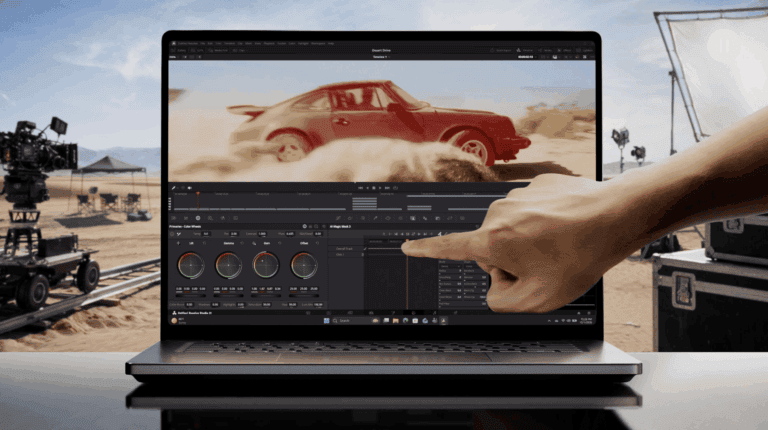
After months of speculation and leaks, the Microsoft Surface Laptop Ultra has been unveiled, equipped with the Nvidia RTX Spark chip. There is no European equivalent of the starting price yet, with the $2,599 price tag from the U.S. serving as the best indication. For that price, you’re not getting a workstation: 8 cores, 24GB of RAM, and 512GB of storage. However, the built-in magnetic USB-C charger is included as a premium-looking feature.
With 128GB of memory, which provides the AI workstation with a reasonable amount of RAM for sophisticated AI models, the Surface Laptop Ultra costs nearly $6,000. At that price point, another alternative has been announced: the Surface RTX Spark Dev Box, a mini-PC for developers that also features 128GB of RAM. Pre-orders have begun, and shipments are expected on October 16.
Nvidia as CPU and GPU
Following Qualcomm’s entry into the Windows market in 2024, the hype surrounding Windows on Arm has rapidly subsided. Although the systems are efficient and capable for many users, compatibility is still not perfect, and Intel and AMD have proven capable of significantly improving their battery life and performance.
Now Nvidia is following suit with its own RTX Spark chip, also known as a System-on-a-Chip (SoC) that combines a CPU and GPU. This means the hardware features “unified memory”: a single memory pool for all tasks. This is crucial for local AI workloads, as all parameters of a large language model (LLM) must be loaded into memory for fast performance.
RAM as a bottleneck
The problem facing the Surface Laptop Ultra, and many consumers, is the RAM crisis. Because memory is currently extremely expensive due to high demand, it isn’t necessarily appealing to purchase the hardware for AI on one’s own. The problem: since AI is then only available remotely, such as Claude, ChatGPT, or various models accessible via API, demand in that area grows, and the providers of these services purchase more memory. This is how the price spiral continues to spiral out of control.
As a result, the entry-level model of the Microsoft Surface Laptop Ultra is very limited. 24GB, although unified, is downright insufficient for AI. That’s the same amount offered by an RTX 4090 GPU; the difference is that, as a standalone graphics card, that chip operates much faster at the cost of significantly higher power consumption. But the rest of the PC still needs additional DRAM to run the system itself, so unified memory must strike a balance. Actually using 24GB for a single LLM is therefore unthinkable: the OS, other processes, and any applications also need memory space.
MacBook alternative
Ultimately, consumers have little say when it comes to pricing. However, there is a choice between Apple and Microsoft. The Surface Laptop Ultra is explicitly a counterpart to the MacBook Pro with the M5 Pro chip. The specifications for the entry-level model are actually very similar: an 18-core CPU, 24GB of RAM, and Wi-Fi 7. However, Bluetooth 6 is missing from the Microsoft model, which “only” supports version 5.4.
Ultimately, both ecosystems are practically equivalent once you’re running the same AI model with the necessary hardware. The advantage for Windows is greater compatibility with, among other things, Nvidia’s CUDA stack for AI development. Additionally, the RAM on the Surface Laptop Ultra is not soldered in place, unlike on the MacBook. So anyone who opts for the 24GB model could choose to upgrade it themselves (provided the RAM shortage doesn’t worsen).