
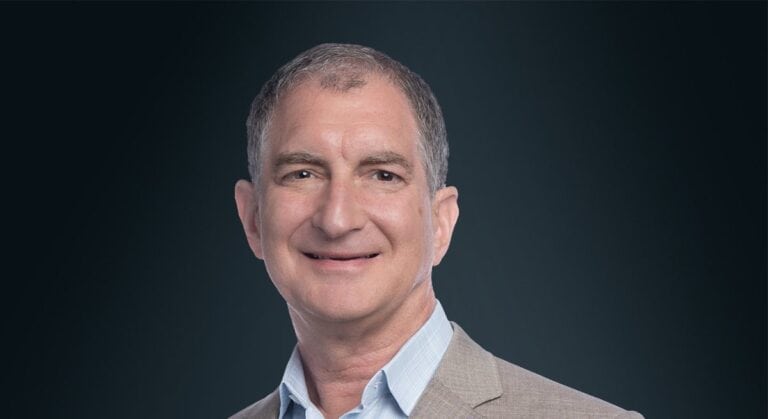
In a short period of time, AMD has evolved from a chip supplier to a provider of complete AI systems, and now aims to bring the layer above that in-house with a model builder. At the same time, the company is positioning itself in Europe as the open alternative that doesn’t lock customers into anything. CTO Mark Papermaster explains why he doesn’t seethis as a contradiction , and what sovereignty really means.
Anyone who looks at AMD’s moves over the past few years side by side sees a company that is increasingly filling in more layers on its own. With ZT Systems, the chip supplier acquired a server rack manufacturer; with Helios, it designed a complete rack for AI data centers; and with ROCm, it is establishing its own software stack as an alternative to Nvidia’s CUDA. Added to this is World Labs, the AI lab that AMD intends to acquire and which was founded by renowned AI researcher Fei-Fei Li. We spoke with AMD CTO Mark Papermaster at the World Summit AI in Amsterdam. “The major challenge for the coming years is making AI more efficient,” he says. “And that will only be possible if everything fits together seamlessly, from the compute layer through the software all the way to the model.”
Robot without a power cord
AMD announced in late September its intention to acquire World Labs. It will pay approximately $8.2 billion for the acquisition, entirely in its own stock. The acquisition is still pending regulatory approval, but AMD hopes to close the deal by the end of this year. World Labs develops so-called “world models,” AI models that understand, simulate, and generate three-dimensional environments based on text, images, and video. Such models form the basis for what Papermaster calls “physical AI,” AI that is built into robots and devices around us. These world models require quite a bit of computing power. Unlike ROCm, they are not open-source: the model weights are not publicly available. World Labs offers its models through its own product and an API, and its latest model, Atlas, is available only to select partners. It is not yet known what AMD will do with these models following the acquisition.
Papermaster explains why a chipmaker would want to bring a model developer in-house using the example of a humanoid robot. “Assume that such robots will make their debut in about five years and be commonplace in ten years,” he says. “A robot in your home isn’t tethered to a power cord. It has to be extremely energy-efficient, capable of doing a lot, and very safe, otherwise, you won’t let it in.” According to him, optimizing all these requirements simultaneously is only possible if chip designers and model builders work together on the entire chain. That modeling expertise must come from Li, who was one of the founders of the ImageNet image database. Following the acquisition, she will join AMD as executive vice president and chief scientist.
Tokens for more energy-efficient hardware
AMD also realized just how critical efficiency is within its own operations. When the company began deploying agents on a large scale, the cost of AI tokens skyrocketed. To keep costs under control, AMD implemented an open-source-based token router that determines, for each task, where it can run most efficiently. AMD not only makes chips for the cloud and data centers but also for embedded devices and PCs, and according to Papermaster, the router can therefore distribute the work across hardware that the company already has in-house.
“Tasks that require the newest and most expensive model are sent there,” he explains. “For everything else, an open-weight model or an older model will suffice, and that can run on-premises or even on a PC.” In a pilot project AMD detailed in July, the company directed workloads to its own MI350P GPUs instead of to Frontier models in the cloud. According to the company, this reduced token costs by 43 percent and made response times 2.9 times faster.
For Dutch organizations, this kind of distribution isn’t just about costs. Here, the overloaded power grid often poses a greater limitation on AI capacity than the availability of chips. Papermaster advises CIOs not to deploy more computing power than necessary. “For each task, determine what truly requires the latest, most power-hungry technology, and what can run just as well on a more energy-efficient platform on-premises or on a PC.” He believes significant energy savings can be achieved this way, and large consulting firms can help set up such a routing system.
Reference, not a competitor
With World Labs, AMD, if the acquisition goes through, will bring in-house a layer that it has so far left to others. This is striking, because the company explicitly positions itself around open standards and open software, so that customers can interchange parts of their infrastructure and remain un锁定 to any single vendor. A supplier that can provide everything itself, from racks to models, seems, at first glance, to be a less good fit for that approach. Papermaster sees it differently. “AMD optimizes everything from silicon to application,” he says, “but we do that through an ecosystem, not by selling everything ourselves.”
According to him, Helios is a prime example of this. ZT Systems designed the rack, which will be shipped this quarter, but AMD isn’t marketing it as a competitor to server manufacturers. It’s a reference design on which other manufacturers build their own systems. AMD doesn’t build the racks itself: ZT Systems’ manufacturing division was sold to Sanmina last year, leaving only the designers and customer teams. According to Papermaster, the same applies to networking: AMD has its own networking solutions, but other networking vendors and additional accelerators can easily integrate via open standards.
The same applies to the software. ROCm is open: customers can customize the stack, improve it, and propose code changes themselves. “Being a true partner in an open ecosystem really sets us apart,” says Papermaster. “This is catching on very well, especially in Europe.”
AMD wants to bridge the gap
That openness strategy is, of course, primarily aimed at customers of Nvidia, which has long dominated the market for AI chips. Much AI software was written for CUDA, Nvidia’s proprietary programming platform, and switching meant rewriting and re-optimizing the code. That required so much work that the industry called it the “moat” around Nvidia. When Helios was introduced in July, AMD already noted that customers hardly ever mention CUDA anymore.
Papermaster echoes that view. According to him, AI has more or less drained the moat: software written to run AI models on Nvidia GPUs can now largely be converted by AI itself. He points to ROCm.ai, a platform AMD unveiled in July that teaches AI coding assistants like Claude, Codex, and Cursor how to adapt existing code for ROCm and optimize it for AMD chips. “Any developer can use this to quickly port their code to AMD,” says Papermaster. “What used to take weeks or days of optimization work is now a simple and fast process carried out by AI.” He did not provide a customer example or an indication of the time and cost involved in such a transition.
The key lies with the customer
Papermaster also approaches sovereignty from the perspective of this interchangeability, rather than from the question of where chips come from. “If you define sovereignty as manufacturing all components domestically, that’s a virtually impossible task,” he says. In that case, Europe would need not only the most advanced chip factories but also the production capacity for the countless other electronic components in an AI system.
For AMD, sovereignty is primarily about data protection, and to that end, the company is focusing on confidential computing. At the heart of this is the Platform Security Processor (PSP), a separate security processor within the chip that, according to Papermaster, is audited by third parties. It ensures that data remains encrypted during processing and while in memory, and, according to Papermaster, this allows the customer to determine for themselves where and when their data is used. This has been in production for years on AMD processors, used by virtually every major cloud provider, and he says it will soon be available for GPUs as well.
Critics refer to the PSP, just like the comparable Management Engine in Intel processors, as a “black box”: a computer within a computer, the inner workings of which users cannot see. Papermaster does not directly address this criticism. Instead, he points to Caliptra, an open-source project for identity verification and authentication starting from the moment a computer boots up, which he says runs on that same security processor. “Open is the safest solution,” he says, “because everyone can see exactly what you’re doing.”
When asked whether a European customer would ever know if an American judge were to request data from AMD, his answer is brief. “We do not manage customer data, nor do we have access to it,” he says. “We provide the computing infrastructure for AI; we do not operate clouds or data centers.” For him, sovereignty is therefore not a matter of where a supplier comes from, but of what the customer retains control over. “We want to give customers sovereign control over the elements that matter,” says Papermaster. “Those are the protection of their data and the freedom to swap in and out components of their infrastructure via open standards, so they’re not tied to anything.”