
Delft is approaching quantum chip production in various ways. QuTech spin-off QuantWare is building its own factory for quantum processors, startup Groove Quantum aims to use existing chip factories, and TU Delft is collaborating with four other universities to build a fabrication line for quantum materials that must be kept in an airtight environment.
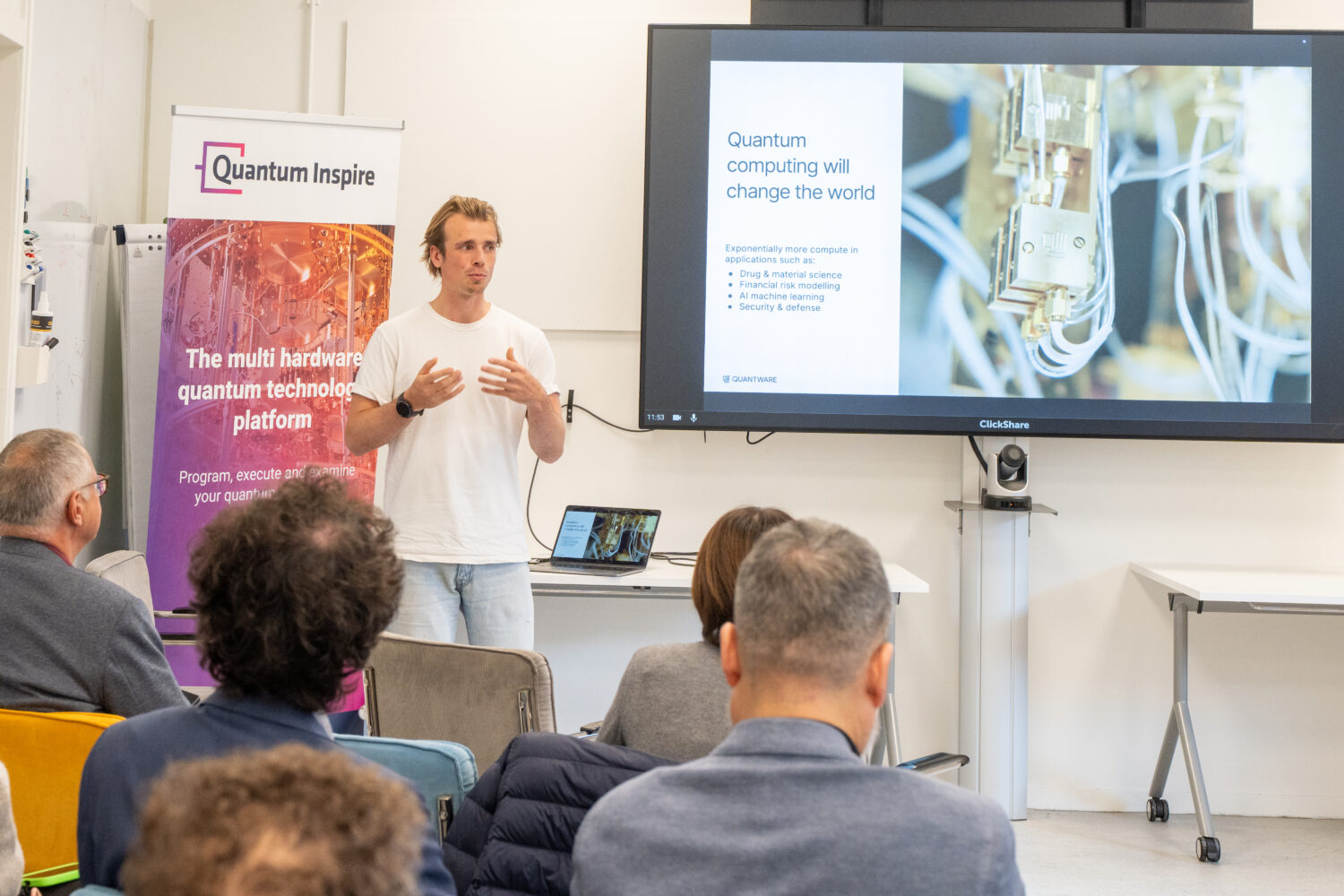
One kilometer south of the TU Delft campus, QuantWare is building KiloFab, a factory with its own cleanroom where the company plans to manufacture its quantum processors on an industrial scale. “Our processors consist of hundreds of chips,” says Wouter Wesselink, VP of Product at QuantWare, “and if you want to turn those into large modules, you really just need a lot of production volume. That’s why we’re building that factory.” According to QuantWare, this will increase the company’s production capacity twentyfold. Wesselink shared this during the International Quantum Press Tour through the province of South Holland, where the cities of Rotterdam, The Hague, Delft, and Leiden showcased the region’s quantum technology initiatives. In Delft, much of the discussion centered on how to transition from a working prototype to mass production.
From lab to business
Maarten Huppertz, external relations manager at QuTech, the quantum institute at TU Delft, calculated just how large the Delft quantum cluster has become. QuTech itself employs about 350 people, with another 150 at the rest of the university. Startups and companies together account for about 500 jobs, and that group grew by about 45 percent annually between 2019 and 2025. If you include TNO and other tech companies, the total exceeds 1,100. Twelve companies were founded in Delft and fifteen came from elsewhere, and together they raised 350 million euros. “This creates an ecosystem with a kind of gravitational pull,” says Huppertz. “Companies from outside are drawn to it.”
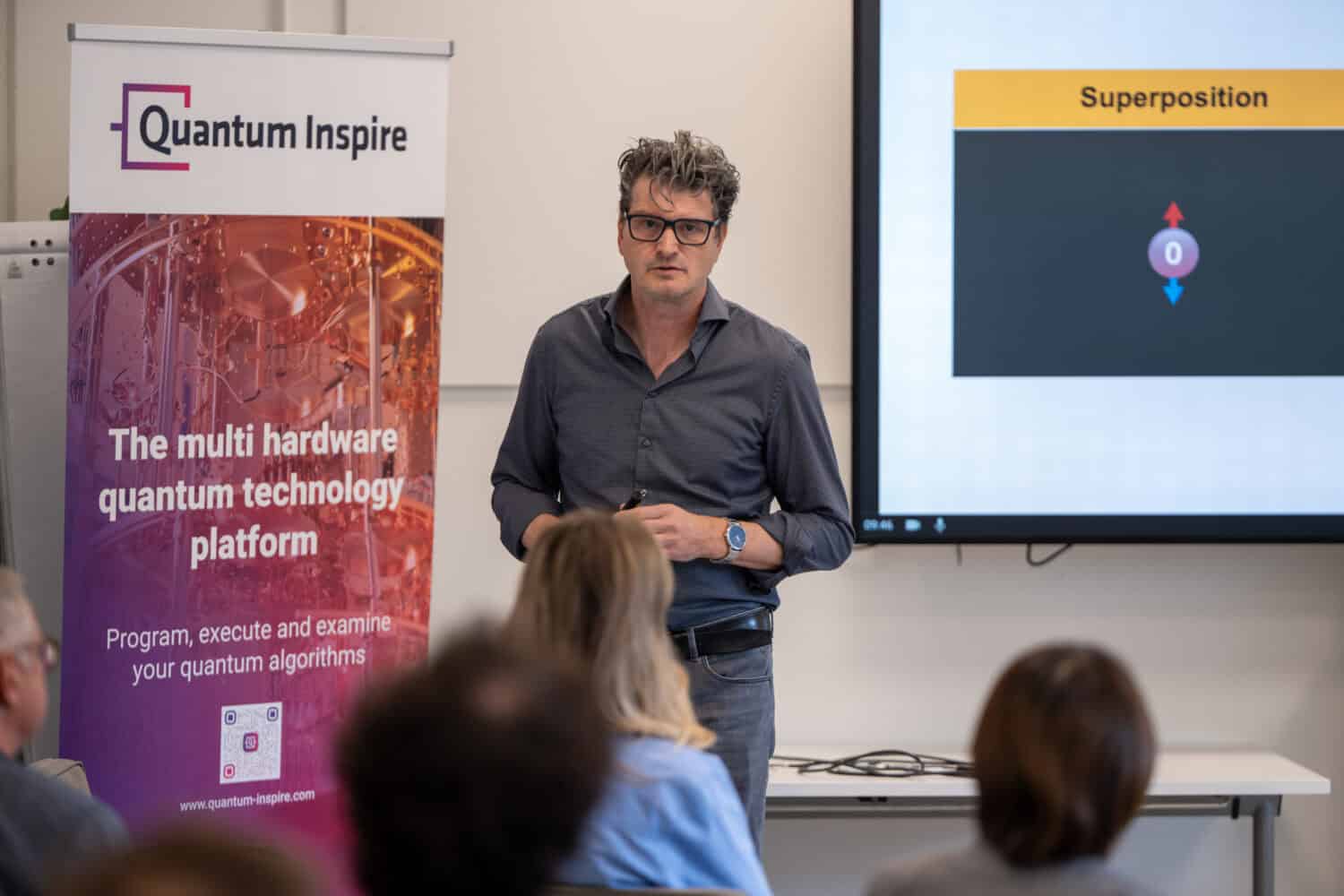
The American company Qunnect, which builds quantum networks, opened a branch in Delft. Anne Hofmann, general director of TU Delft’s Quantum Policy Lab, sees the same thing happening with companies from Finland, Germany, and France, which are setting up shop in Delft to be close to the research. In addition, spin-offs are emerging on the campus itself, such as Single Quantum, which manufactures detectors capable of detecting individual photons. Part of the funding for this growth comes from the government. The national Quantum Delta NL program, with hubs in Delft, Amsterdam, Leiden, Eindhoven, and Twente, among other locations, received a total of 615 million euros from the National Growth Fund between 2021 and 2024. QuTech was one of the major recipients in the early stages, according to Huppertz.
QuantWare is one of the companies that emerged from QuTech. It manufactures quantum processors, the chips that contain the qubits. QuantWare does not build complete computers. “We’re a bit like the early Intel of quantum computers,” says Wesselink. Other parties build the machine around the processor, which means that even countries without their own quantum computer manufacturer can build one. Quantum computers do already exist, but they are still small. They are useful for research and for experimenting with algorithms, but not yet capable of outperforming a conventional computer in practice or cracking existing encryption. Israel and Spain built their first quantum computers using a QuantWare processor, and Italy’s largest quantum computer runs on a chip from the company. In 2021, QuantWare released Soprano, which the company claims is the first superconducting quantum processor available as a standalone chip, without requiring the purchase of a complete quantum computer.
The size of twenty parking spaces
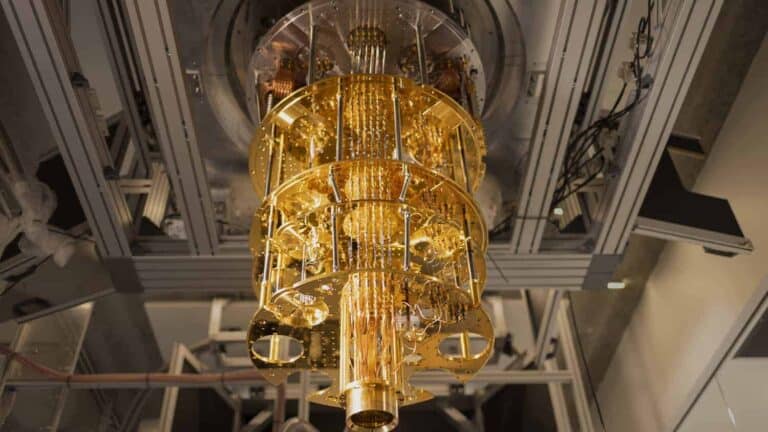
QuantWare works with superconducting qubits: tiny metal circuits that conduct electricity without any resistance, but only when cooled to just above absolute zero. According to Wesselink, an IBM processor, the 120-qubit Nighthawk, is now about the size of an A4 sheet of paper, and most of it does not consist of qubits. “In the center is a small chip containing the actual qubits,” he explains. “Everything around it is wiring to send signals to the qubits and retrieve the results.” That wiring lies in the same plane as the qubits, so the more qubits you add, the more crowded that plane becomes. According to QuantWare, a quantum processor can only do something a regular computer can’t once it reaches about 10,000 qubits. If you continue with the current design approach, such a processor would be about the size of twenty parking spaces. “And if you want to reach the million qubits we’ll ultimately need, you’re talking about Central Park,” says Wesselink. “That’s not going to work.”
On top of that, the processor is housed in a cryostat, a cooling system that keeps the chip at that extremely low temperature. All signals travel in and out via cables, passing through filters and amplifiers, each housed in its own small copper box and connected by hand. “No one can do that for a million qubits,” says Wesselink. “It just doesn’t scale.” He compares it to the vacuum tubes from the early days of computing, which were also wired together by hand. It wasn’t until all the components were integrated onto a single chip that computers could truly grow, and he believes quantum computing must now take the same step.
In-house factory for volume production
The solution QuantWare has developed for this is called VIO. All signals enter vertically and never have to pass through the plane of the qubits again. To achieve this, the company stacks thirty to one hundred silicon chips on top of each other, rotates the stack a quarter turn, and connects it to the processor. The signal lines are laid out on those chips just like in your phone’s chip, and because everything is superconducting, they are well shielded from one another. Because the edges of the qubit chip are freed up, you can arrange processors side by side like tiles, thereby scaling up the system modularly. According to Wesselink, a 10,000-qubit processor can fit on a single sheet of A4 paper this way. The VIO-40K version stands for 40,000 input and output lines, intended for 10,000-qubit systems. This is an announced architecture; there is not yet a functioning processor of that scale. QuantWare has, however, built smaller modules and described them in white papers. Because a processor consists of hundreds of chips, Wesselink says a high production volume is required, and QuantWare is building KiloFab for that purpose.
At that factory, QuantWare aims to develop the industrial processes for the next generations of VIO, produce enough volume for the global market, and reduce the cost per unit. That market isn’t limited to QuantWare’s own processors. According to Wesselink, the architecture works with any type of superconducting qubit chip, including those from other manufacturers. “They could be our own qubit chips, but also qubit chips manufactured in the U.S. or Finland,” he says. QuantWare is already integrating chips from partners worldwide, and Wesselink expects the first 10,000-qubit systems to be operational by the end of this decade. On May 5, QuantWare raised $178 million to build KiloFab. Investors include Intel Capital, IQT, ETF Partners, Invest-NL Deep Tech Fund, and InnovationQuarter Capital.
Cleanrooms are already in place
Groove Quantum, a startup that also originated at TU Delft, aims to manufacture its quantum chips on a large scale. The company is developing chips in which the qubits themselves are embedded in a semiconductor. This is a different type of qubit than QuantWare’s, and it also enables a different approach to production. CEO and co-founder Anne-Marije Zwerver was a Ph.D. candidate and postdoc in Delft, where she worked with silicon qubits. Her co-founder, Nico Hendrickx, was conducting research on germanium qubits at the same time, and those results were so promising that the idea for a company was born, she told Pioneering Tech, TU Delft’s magazine, earlier this year. In 2024, they founded Groove Quantum. Zwerver begins her story with the ENIAC, one of the first programmable computers, which, she explains, took up two entire rooms, with 18,000 vacuum tubes and 800 kilometers of wire. “If we were still building our phones that way, every phone would be as big as a stadium,” she says. The transistor put an end to that.
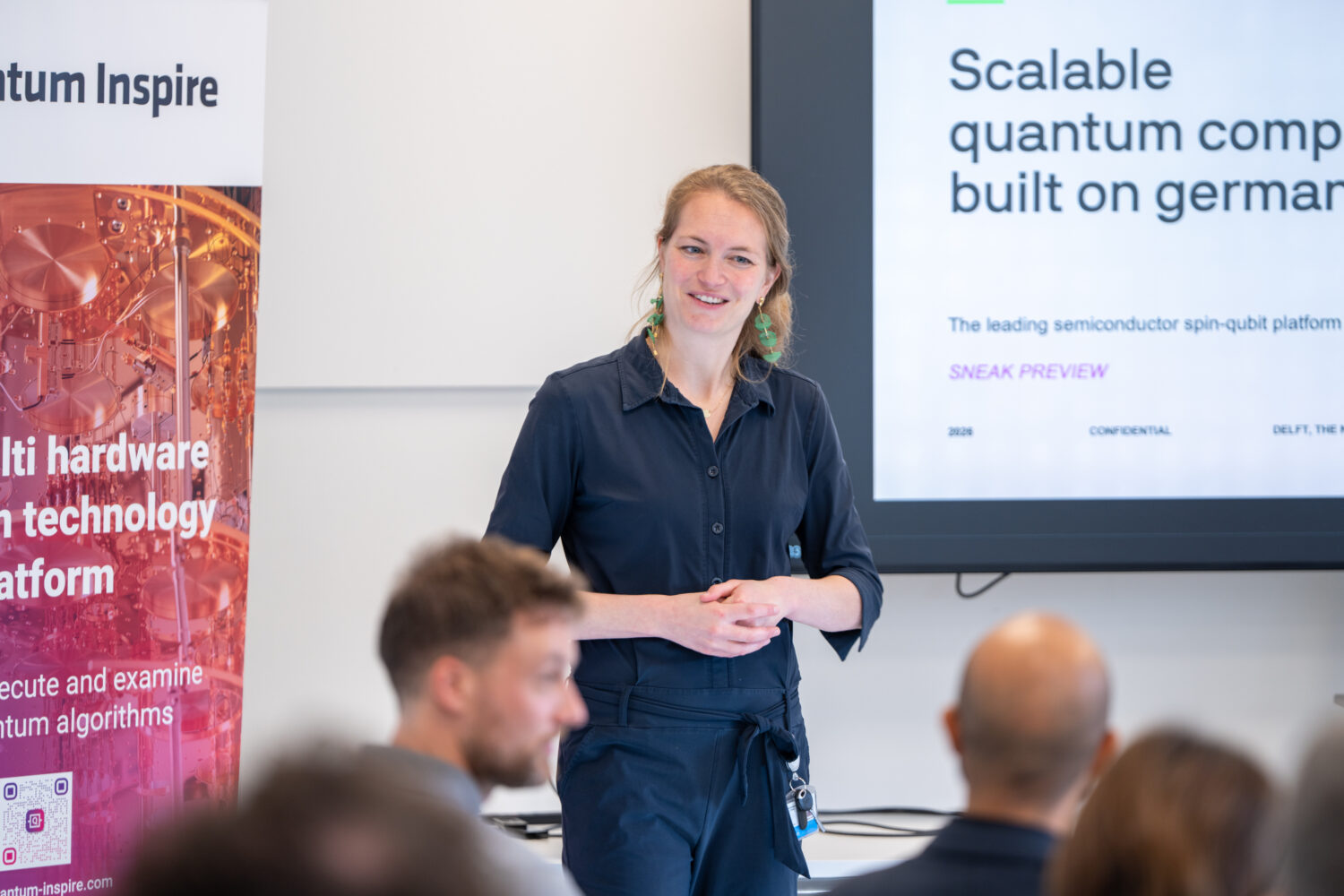
Groove works with spin qubits, in which the information is stored in the spin of an electron, a magnetic property that can be thought of as a direction of rotation. Such a qubit is manufactured like a transistor, and in her doctoral research, Zwerver herself demonstrated that this means they can be produced in the same factories. “We can use exactly the same pilot lines and chip factories as for computer chips,” she says. “We don’t need to build new cleanrooms. Those billion-dollar cleanrooms are already there, all over Europe.” She also notes that cooling requirements do not increase proportionally with the number of qubits. While other techniques sometimes require additional coolers when the number of qubits doubles, Groove can accommodate everything in a single cooling system.
Groove uses germanium, the element located directly below silicon in the periodic table. According to Zwerver, silicon is optimized for conventional electronics and introduces a fair amount of noise into qubits. Germanium better shields the qubit from its environment. It results in slightly larger structures, which makes the production process a bit more forgiving. Groove is currently running eighteen qubits simultaneously. “That’s fewer than the hundred qubits achieved with other techniques, I know that,” she says. “But we’re getting there.” According to the company, 99.99 percent of operations on a single qubit succeed, and for operations involving two qubits working together, the success rate is over 99.95 percent, which Zwerver says is a world record. The more nines, the fewer computational errors. According to Quantum Computing Report, Groove raised 16 million euros in April, including 10 million in seed capital and 6 million in grants. “Today, we’re at the ENIAC stage of quantum computing,” says Zwerver. “Soon, we’ll be at the iPhone stage.”
Production without air
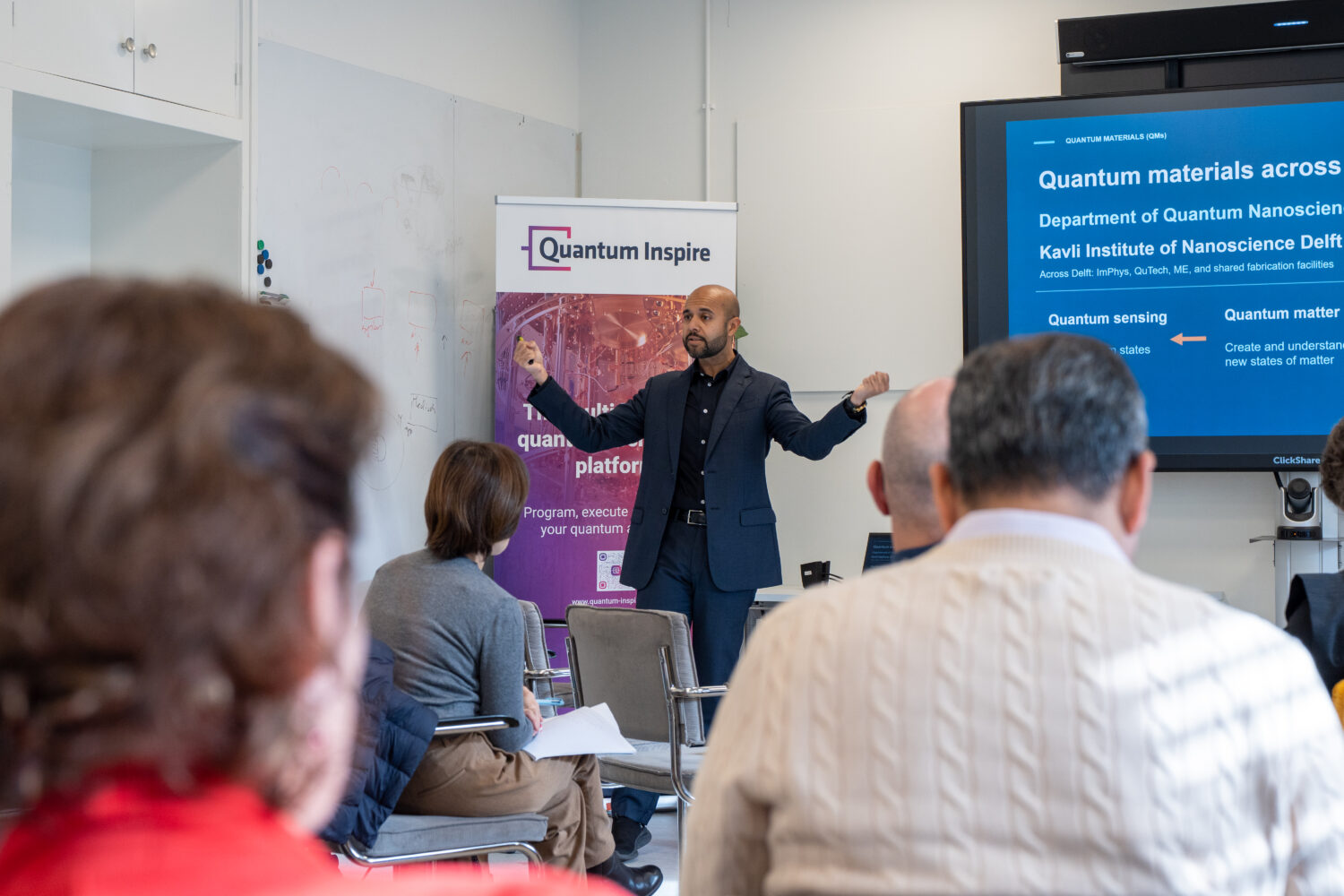
It’s not just companies working on production. TU Delft itself is also helping to build a fabrication line, but one step earlier in the chain: at the materials level. Mazhar Ali, associate professor of quantum nanoscience at TU Delft and one of the two directors of the Kavli Institute of Nanoscience Delft, is one of the researchers behind that project. “If you want to create quantum technology, you’ll probably start with a quantum material,” he says. Superconductors, such as those in QuantWare’s qubits, are an example of this. Researchers can now build materials from layers just a few atoms thick, which they stack or twist relative to one another to achieve new properties. This poses a practical problem. “Many of these materials must not come into contact with air during fabrication,” Ali explains. “That really required new infrastructure.”
That infrastructure is taking shape in the form of SAP-NL, a national fabrication line for atomically thin materials. The technology must be designed in such a way that it can later be scaled up for industrial production. The project is led by Sten Vollebregt of the Faculty of Electrical Engineering, Mathematics, and Computer Science at TU Delft, and five universities are participating. NWO is funding the line with 4.8 million euros for the period from 2025 to 2030. The facility will be built in Delft and will then be made available as an open facility within NanoLabNL, the national network of cleanrooms for nanotechnology. The goal is to demonstrate that the technology works on wafers up to six inches in diameter, the thin discs on which chips are manufactured.
With SAP-NL, the universities are tackling the scaling issue, but according to Ali, that is not the only challenge. Temperature also remains an open question. Much quantum technology only works at 10 kelvin or colder, well over 260 degrees below zero. “And 10 kelvin is still a generous estimate,” he says. “Cooling requires a lot of energy.” Ali also sees strategic importance in quantum materials: in his view, they can offer alternatives to magnets and semiconductors, the supply of which is under pressure. This could potentially make supply chains less vulnerable.
Money, space, and cleanrooms
Governments worldwide have announced some $55 billion (approximately 47 billion euros) in investments in quantum technology through 2025, of which about $15 billion (about 13 billion euros) is in Europe. This is according to the Quantum Technology Monitor published by McKinsey in April. According to Anne Hofmann, director of the Quantum Policy Lab, the major difference with the U.S. lies in private funding, which is not included in those figures. “In the U.S., private investments are very high,” she says. “In Europe, they are very small.” Arthur Dallau, co-founder of the Quantum Communication Fieldlab Rotterdam, made a similar point. In his view, the region cannot compete with the U.S. when it comes to investments. However, he does believe that significant progress can be made if stakeholders collaborate effectively.
The municipality and the province also play a role in that collaboration. According to Rotterdam Alderman Tim Versnel, quantum companies need more than just an office: they need cleanrooms and specialized power capacity. The region is working to maintain existing cleanrooms and bring deep-tech companies together on shared campuses. “We want quantum companies to start here,” says Versnel, “and for them to stay here, grow, and find their customers.”
The province of South Holland is also working with InnovationQuarter to identify locations and facilities for quantum companies. In early 2027, the province will present an action plan developed in collaboration with TU Delft, the City of Delft, InnovationQuarter, and 25 companies. The goal is for South Holland to become Europe’s leading quantum hub by 2030. “Developing good technology is one thing,” says Provincial Executive Member Meindert Stolk. “We also need to ensure that companies can manufacture, scale up, and apply that technology here in Europe.” According to him, now is the time to do so. “Decisions are currently being made about where companies will expand, where production facilities will be located, and where talent and investments will converge.”