

The question is no longer how we connect AI agents to enterprise systems, but how we maintain control once they start acting independently within those systems. Hans Bot, enterprise architect at Yenlo, warns that IT governance needs a fundamental overhaul. He advocates for a unique identity and wallet for each agent: “In addition to a workforce, you’re also getting an agent force.”
AI agents are increasingly being granted direct access to enterprise applications, APIs, and business data. Previously, an agent was a smart layer within a chat window, but now it’s an independent user of business services. Who actually determines what such an AI agent is allowed to do on the network? And how do you prevent an agent from gaining more access than necessary? Most organizations still don’t have a good answer to these fundamental governance questions, Bot argues.
The speed at which agents can independently perform actions within enterprise systems is further accelerated by the Model Context Protocol (MCP). This protocol serves as a standardized bridge that connects AI models directly to local enterprise applications and data. Vendors are responding to this with MCP management and agent governance.
Change management as a blind spot
Precisely because of this low barrier to entry, the question remains whether enterprise API environments are actually ready for agents. That varies, Bot admits. SAP faces criticism for moving too slowly, while Salesforce is adopting the technology more aggressively. He believes the organization itself is more important than the systems. The strict separation between IT, which develops, and the business, which uses, is blurring. For example, business departments are building their own agents and updating them weekly with new case law. In doing so, they’re taking on traditional development tasks without the peer reviews and tests that IT has implemented through trial and error.
As a result, AI adoption is outpacing governance in many organizations. This creates a new phenomenon: “shadow AI agents.” The risk is significant: invisible, unmanaged agents can emerge in the network and gain excessive access. Traditional IT oversight is lost in this scenario.
An agent in production can also suddenly behave differently because of a new language model version or changed default settings. That model is often managed externally. According to Bot, there hasn’t yet been sufficient thought given to how to keep this continuous change under control.
He refers to Gartner’s classification into systems of record, systems of differentiation, and systems of innovation. In the innovation layer, AI can be adopted quickly. Overhauling business processes creates more friction, as tasks shift from people to agents. And letting an agent handle the accounting? According to Bot, that’s still three steps away.
Still, he also warns against the opposite: organizations that are too hesitant. Bot expects companies to fail because competitors are embracing AI. He envisions a scenario in which mainly very large players will remain. His advice, therefore, is to find something that others cannot easily copy. A business model that relies entirely on someone else’s language model is vulnerable, because whatever you can do with that model, so can its owner.
Your own salary, yes; your colleague’s, no
To solve the resulting governance problem, Bot says we need to look directly at the foundation: identity and access management (IAM). The classic IAM model is straightforward: a person or application must authenticate and be authorized to access a digital object. With agents, however, a complex third party is introduced that always acts on behalf of someone else. This adds an extra dimension to access control. What is the agent allowed to do on its own? What is it allowed to do on behalf of its client?
Bot gives an example from HR. An agent with access to personnel data can tell an employee how many days of leave they have remaining. But that employee is not allowed to request a colleague’s salary, while that colleague must be able to view their own salary. In practice, this often goes wrong, Bot notes. He refers to a recent incident at Meta, in which an agent posted incorrect advice on an internal forum without authorization. As a result, sensitive data was visible for two hours to employees who had absolutely no rights to access it.
Delegation isn’t entirely new. When someone goes on vacation, they grant a colleague access to their email. In hospitals, a doctor on duty can view a colleague’s medical records, and in the military, the highest-ranking officer on duty rotates. These kinds of arrangements have never been properly standardized. Organizations come up with ad hoc solutions and often place the responsibility on the employee who authorizes another person. According to Bot, this lack of accountability is no longer tenable for agents. In such cases, a third party must exercise control.
An important part of this is conditional authorization. For example, an agent may independently carry out small financial transactions but must request permission for amounts above a certain threshold. That permission itself is also an authorization step. This lets an agent process transactions rather than just provide advice, while the user retains a point of control. This aligns with the “human-in-the-loop” concept.
Bot is pleased that standards are now being developed for this. If such a standard is built into the browser, for example, an agent can display a pop-up to request permission. That functionality never existed before. Much of this work revolves around OpenID Connect.
Lifecycle management for the digital colleague
Will every agent then have its own identity? For Bot, that’s a prerequisite. Without an identity, you can’t authenticate an agent, and therefore can’t authorize it either. Then you can only hope that the agent does what it’s supposed to do. “Just like with people: trust is good, but verification is better,” Bot explains.
With an identity comes lifecycle management. Agents are deployed into production and then phased out. When an agent is taken out of production, its authorizations must be revoked so that no one can misuse them. Just like with employees who join and leave the company. “In addition to a workforce, you also get an agent force,” says Bot. You have to manage that agent force the same way you manage your staff in terms of IT resources.
A wallet for the agent
Things get interesting when it comes to authentication. Applications traditionally authenticate using a secret key to generate a temporary token valid for, say, one hour. For humans, strong authentication is now commonplace, such as two-factor authentication, a fingerprint, or a passkey stored in a wallet or password vault. This is still lacking for agents, even though Bot expects agents to start imitating or spoofing other agents.
Yenlo’s enterprise architect expects agents, like people, to have their own wallets containing credentials. Yenlo is already working on this in practice with solutions such as ThunderID, where agents’ identities are securely recorded via verifiable credentials. From a network perspective, only that agent can access the wallet. It contains cryptographically secured statements such as “this agent is authorized to act on behalf of person X” or “is authorized to conduct transactions up to 100 euros at a time.” Just as the government certifies your date of birth, an authority must always grant such permissions. According to Bot, this system is quite watertight, and the agent does not need to return to the source every time to verify its rights.
However, we still have a few steps to take. Even for individuals, the European wallet is not yet available in practice. Although it already exists in legislation (eIDAS 2.0), its implementation in the Netherlands is running behind schedule, according to Bot, and will take some time.
Bot calls this meticulous approach a typically European way of thinking. An assistant who is only allowed access to your work calendar and is explicitly barred from accessing past appointments or your personal calendar. According to him, Americans seem to have much less of a problem with an officer simply being allowed to use everything stored on a computer.
Performance review with an agent
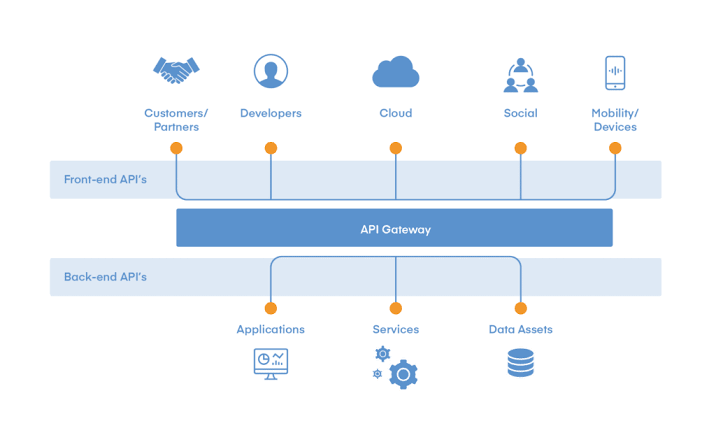
Does Bot expect agent management to eventually become its own discipline, separate from API management? Absolutely. The question is whether the current infrastructure can handle this shift and whether organizations will soon need a specific agent gateway in addition to their existing API gateway.
To help organizations with this, technologies such as the WSO2 Agent Manager are being used alongside an AI Gateway. APIs are purely technical and simply send data back and forth. An agent, by contrast, exhibits behavior, consumes tokens, interacts directly with customers, and influences their satisfaction. To measure effectiveness, monitor token consumption, and audit actions, a standard API gateway is no longer sufficient. Agents can be evaluated, A/B tested, and compared based on effectiveness and token consumption. According to Bot, this is a business question, not an IT question. What is the value, and what does it deliver?
He can even imagine a department for both human and artificial resource management that conducts a performance review with an agent to discuss how often it has hallucinated. Part of that evaluation could be carried out by so-called “eval agents,” a concept that already exists. His concern extends beyond the individual agent: with swarms of thousands of collaborating agents, control becomes a practical issue. Bot fears things will have to go seriously wrong before authorities set limits, and by then, it will be too late.