
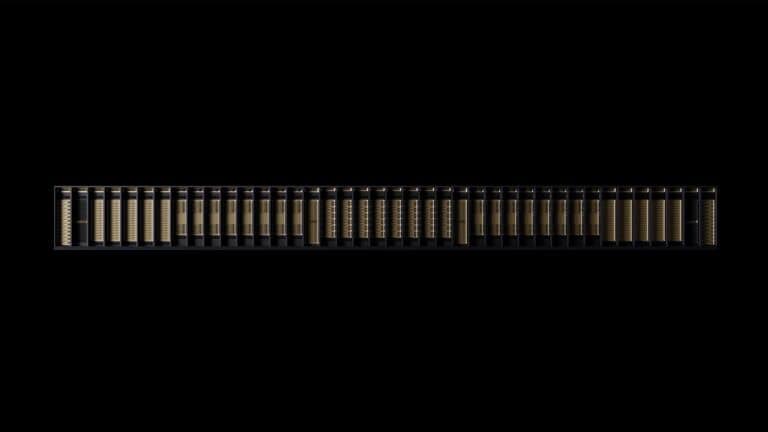
Alongside its proposed AI PCs for consumers, Nvidia shared its multifaceted AI plans for enterprise. The company reports that its flagship platform Vera Rubin is ramping into full production, superceding Blackwell. In addition, DGX Station ‘deskside’ PCs will power developers working on AI with trillion-parameter models, while a revamped Agent Toolkit will make said job easier. Nvidia is also continuing its push to further physical AI with the open Cosmos 3 model and a reference robot.
At GTC Taipei 2026, which is running concurrently with the Computex trade show, Nvidia laid out what it calls the infrastructure of the next industrial revolution. Jensen Huang’s keynote covered everything from rack-scale AI factories to a desktop-sized supercomputer for Windows, a developer toolkit for autonomous agents, a new world model for physical AI, and an open humanoid robot reference design for academic researchers.
While RTX Spark in both slim laptops and small desktops is charming consumers, marking Nvidia’s Apple M1-style entry into fully-equipped PC systems with OEMs, its enterprise news reaches beyond this anticipated release. As ever, the company is scaling up AI once more.
Vera Rubin enters production
The centerpiece of Nvidia’s enterprise announcements is Vera Rubin, the successor to its Grace Blackwell platform. First detailed earlier this year, Vera Rubin is now entering volume production with more than 350 supply chain partners across 30 countries. Partners including Dell, HPE, Lenovo, and SuperMicro are manufacturing systems destined for cloud and enterprise customers in the fall. OpenAI and Anthropic are already busy with the new architecture.
At the heart of the platform sits the Vera Rubin NVL72, a liquid-cooled rack-scale system housing 72 Rubin GPUs and 36 Vera CPUs connected over NVLink 6. Nvidia says it can train large mixture-of-experts models using one-quarter of the GPUs compared to Blackwell, and deliver ten times the inference throughput at one-tenth the cost per token. A new Groq 3 language processing unit accompanies the platform, designed for the low-latency inference that trillion-parameter agentic models demand. This is a notable addition made possibly through its de facto acquisition of Groq.
The Vera CPU is notable in its own right. Based on a custom core called Olympus, it features 88 cores and 1.2 terabytes per second of memory bandwidth, built specifically for agentic workloads such as Python runtimes, orchestration logic, and database processing. Nvidia also introduced Spectrum-X Ethernet Photonics, the world’s first co-packaged optics-based network switches, promising five times greater power efficiency. BlueField-4 STX DPUs handle storage, networking, and security functions, enabling full-stack confidential computing at rack scale.
“One prompt can launch a thousand-step journey of reasoning, retrieval, tool use and response generation,” Huang said at the Computex keynote. “Vera Rubin was built for this moment — an AI factory engine that delivers intelligence at scale, with the performance, efficiency and security needed to power the next industrial revolution.”
DGX Station brings supercomputing to Windows
A more unexpected announcement is the DGX Station for Windows, described by Nvidia as the world’s first deskside AI supercomputer. Developed in collaboration with Microsoft, it is powered by the GB300 Grace Blackwell Ultra Desktop Superchip, delivering 20 petaflops of FP4 performance and up to 748 gigabytes of memory. It’s enough to run frontier models with up to one trillion parameters locally.
The goal is to eliminate the need for enterprise developers to route early-stage AI workloads to cloud infrastructure. The system supports Nvidia’s OpenShell secure runtime, which enforces security and privacy policies at the operating system level using Windows’ native security primitives rather than behavioral prompts. Nvidia has been working toward local AI supercomputing since announcing Project Digits (now DGX Spark) at CES 2025, which targeted 200-billion-parameter models. The DGX Station extends that ambition considerably to a more familiar format.
Systems will ship from manufacturing partners including Dell, HP, ASUS, MSI, and Super Micro, with availability planned before the end of 2026. An optional RTX Pro 6000 Blackwell Workstation GPU can be added for physical AI workflows involving ray-tracing and simulation, while multiple units can be linked over ConnectX-8 SuperNIC to form desktop compute clusters.
Agent Toolkit, Cosmos 3, and a humanoid robot
For developers building agents, Nvidia released an updated Agent Toolkit centered on NemoClaw, an open framework for constructing agentic orchestration layers. It includes Nemotron 3 Ultra, a 550-billion-parameter mixture-of-experts model designed for long-running autonomous agents, claiming five times faster inference and 30 percent lower costs than comparable models, launching June 4. The OpenShell Secure Runtime, co-developed with Microsoft, Canonical, and Red Hat, gives agents sandboxed environments with system-level policy enforcement. Early adopters include CrowdStrike, Palantir, Cadence, and Siemens.
Nvidia also launched Cosmos 3, an open world foundation model for physical AI built on a mixture-of-transformers architecture. It combines vision reasoning, world generation, and action prediction in a single system. Cosmos 3 Super and Nano are available today via Hugging Face and Nvidia’s NIM microservices; an Edge variant for real-time inference is coming soon. Partners across robotics, autonomous vehicles, and industrial AI are already building on the platform.
Finally, Nvidia announced the Isaac GR00T Reference Humanoid Robot, an open reference design combining a Unitree H2 Plus chassis with Sharpa Wave five-finger hands and Jetson AGX Thor onboard compute. Standing nearly two metres tall with 75 degrees of freedom, the robot gives academic research institutions, including ETH Zurich, Stanford Robotics Center, and UC San Diego. It’s a unified platform for humanoid development without reliance on proprietary stacks. Availability is planned for late 2026 through Unitree.