
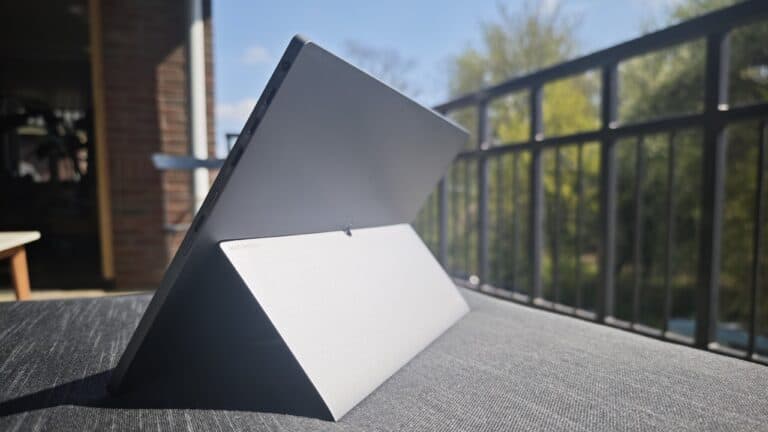
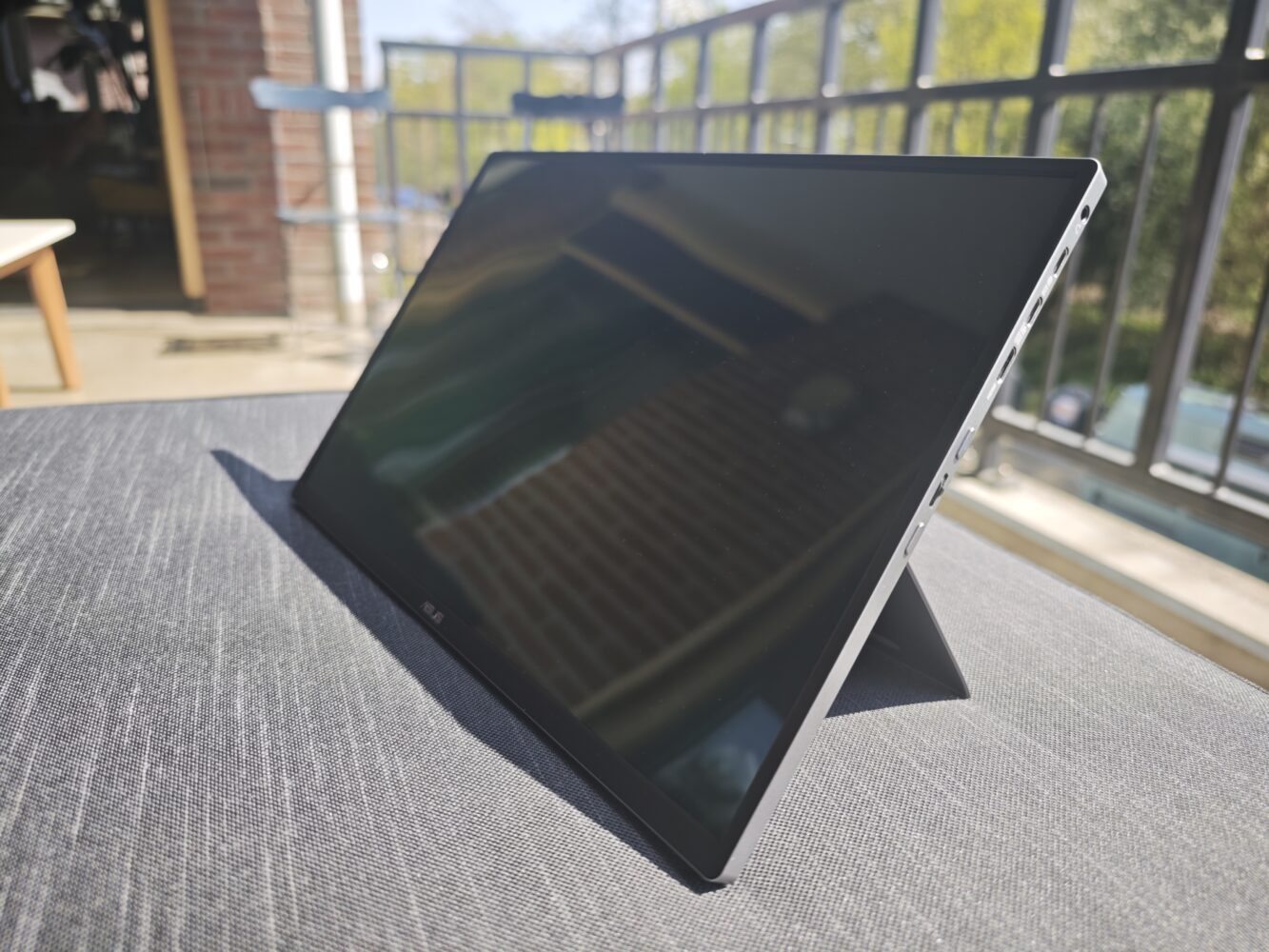
The ASUS ZenScreen OLED MQ16FC is geared towards professionals on the move. As an expansion of the versatile ZenScreen lineup, ASUS’ latest addition delivers on the qualities OLED generally brings. In addition, the 16:10 aspect ratio, two-way power pass-through and thin bezels make the display a worthy rival to all but the most high-end laptop screens.
Not all ZenScreens fit the same mold. In fact, the collection can’t even be summarized as an entirely mobile one owing to the fact the MS27UC and MS32UC exist as stationary Smart Monitors. Apart from those, though, every ZenScreen can carry over to new physical workspaces relatively easily.
The MQ16FC slots in as the ZenScreen OLED equivalent of the MB16FC, which similarly has the highly desirable two-way power pass-through. The other 16:10, 16-inch option is the MB16NCG, a higher resolution, higher-refresh display with a 65W pass-through, which lacks OLED. For those dealing with deep blacks in productivity work or a need for an equivalent display look compared to an OLED main monitor, the MQ16FC fills a gap in the ASUS lineup. There’s even more choice in the 16:9 space, including the battery-equipped MB16AMTR, but we will spare you the rundown of every other ZenScreen imaginable – there are many.
Modern needs
Being a new inclusion in the ZenScreen portfolio, the MQ16FC is really all about a shift towards modern tendencies. It is 16:10 (WUXGA, 1920×1200), 16 inch and can transfer power from its connected devices to and from one another. With two-way power delivery, charging a laptop in use won’t be an issue using a single port on it. As ubiquitous as 16:9 is, productivity-focused displays tend to provide slightly more vertical real estate because enterprise apps and content creation can make use of it.
16:9 is mainly the standard because most media use it. Applications and websites tend to provide more information density at 16:10.16 inches, to be sure, is vast for an external display. The high screen-to-body ratio (89 percent) and thin frame with an integrated stand does mean most users can safely tuck the ZenScreen MQ16FC away in the same bag as their laptop or tablet.
In addition, the OLED screen is high quality enough that the ZenScreen could perform as a tertiary screen in a desktop setting with the laptop in use as the second display.
A mature setup
The ZenScreen MQ16FC performed well throughout our testing period. It was never getting all that warm and provided a consistent bright image even in somewhat challenging lighting. One element that used to strike fears into the hearts of those using OLED for work, was burn-in. Built-in tools should prevent this from becoming a problem. The industry as a whole has become much better at stopping the burn-in issue. Time will tell if ASUS has done a good job here, too.
ASUS also benefits from the OLED choice with a 1ms response time (albeit at 60Hz, meaning a refresh does take 16.7 Ms), seemingly infinite blacks and good color reproduction.The maturity of the ZenScreen proposition also appears when using it in various modes. The DisplayWidget Center notices if the orientation is vertical or horizontal, communicating this to Windows. Most users will stick to one or the other in a session. The initial handshake will do the heavy lifting for most.
Conclusion: no major compromises
At 279 euros, the ZenScreen OLED MQ16FC is cheaper than most OLED displays at desktop sizes. While the smaller stature would be a major limiting factor as a true desktop screen, most laptop users would desire this ZenScreen option when space is constrained or travel bags are a necessity. This means the 16 inch format is really the best halfway point between compactness and usable size.
No major concerns in use means the features on offer translate to an easily usable and more than serviceable display. In most instances, OLED and 16 inches will even strike some as overkill. The effective 1080p fidelity (stretched to 1200 pixels due to the 16:10 ratio) is the only element that keeps the ZenScreen OLED MQ16FC from being indistinguishable from high-end laptop screens. At 60Hz, it isn’t going to be outperforming the refresh rates of said screens either.
At any rate, that isn’t what users would buy a ZenScreen OLED MQ16FC for. ASUS positions it as a temporary second screen while on the go, and for that purpose, it is an excellent choice at a fairly reasonable asking price.
Also read: Review ASUS NUC 15 Pro: brings computing power to impossible places