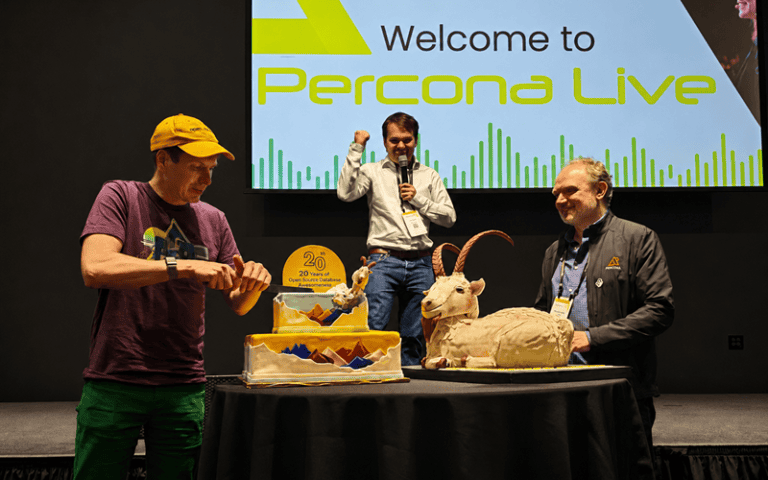
Attending Percona Live 2026 this month in Mountain View, California, gave Techzine Global the chance to sit down with Peter Farkas, CEO of Percona, who says he is excited to lead Percona through the company’s latest chapter, all while keeping innovation, service excellence and a commitment to the open source community at the heart of everything the company does, for many more years to come.
We spoke to him at length, but first… the keynote.
In a snappy 10-minute keynote held at the Computer History Museum in Mountain View, Farkas said that the company chose the venue because he thinks, “The work that is being carried out by the open source database community is as important as the artefacts on show at the museum itself.”
Navigating open data
Talking about the history of Percona (the company is now 20 years old), Farkas said the team has seen database technologies come and go over those years. What sums up these two decades for him is the fact that he feels Percona has helped so many different users “navigate the open data landscape” over this period.
“This event is all about you [the users, the community] and Percona Live is not about the fluff; this is an event with workshops and hands-on learning experiences,” said Farkas. “When we think about the fact that AI is supposed to eat us all alive, it kind of does i.e. if you’re a DBA today, you’re going to see that usage patterns now can be extremely different to anything experienced beforehand. The themes for this year will include AI-driven data management and users will ned to understand that there are new tools and methods that they will now need to embrace.”
Farkas also noted open source licensing, metrics and overall adoption as key themes this year.
If you smell bullshit, call it out
“You did not really come here for the talks I think, the power of Percona Live is the networking and the opportunity to connect with likeminded peers who will all help ask the questions that need asking, If you see a talk presented this year that you think is bullshit and presents things that are not feasible, then you need to say this out loud, because this is the ethos that we need to uphold in the open source community,” said Farkas.
Guest keynote speaker Andy Pavlov took the stage to present a talk that focused on how automated tuning agents have to make changes to systems without getting them wrong… and, secondly, the action of agents themselves.
A deeply techie speaker and laureate of Carnegie Mellon University, Pavlo’s session is a story in and of itself. He usually provides an annual “year in open source databases” presentation, which last surmised that, every decade or so, the database industry seems to experience a collective bout of amnesia.
The relational model obsolete, or not?
Pavlo says that a new generation of engineers arrives, declares the relational model obsolete, proclaims SQL too slow or too awkward or too “not web‑scale,” and sets out to reinvent the foundations of data management. And then—almost inevitably—they rediscover why those foundations existed in the first place. He reminds us that there is a pattern that has shaped the last half‑century of database innovation: the industry’s recurring urge to abandon the relational model, only to return to it once the shiny new alternatives reveal their limitations.
Other keynote sessions included “What Percona delivers for MySQL, and what’s coming next”, presented by Michal Nosek, Percona; “One Platform, Three Engines: Open Source DBaaS Patterns on Kubernetes”, presented by Kate Obiidykhata, Percona and George Kechagias, Percona; “From Our Customers to the Community: How AWS Contributes Upstream”, presented by Madelyn Olson, AWS… and then finally (as always) the big picture from Percona founder, Peter Zaitsev, who presented his “The State of Open Source Database Ecosystem in 2026” session.
Talking about how developers use databases today, Zaitsev pointed to how the MySQL ecosystem has been developing.
“There are so many MySQL workloads out there, but Oracle’s stewardship has moved over ebbs and flows. We think that MariaDB has regained its mojo after a near-death experience… and (looking again at MySQL) there are now so many forks and alternatives out there, plus a whole lot of community action going on,” said Zaitsev.
NOTE: For those that missed it, MariaDB faced problems after losing major enterprise support, funding pressures, and market relevance, but survived through community backing, innovation, and strategic restructuring
The five levels of self-driving databases
“We also see the increasing role of the Linux Foundation hosting more projects, including Valkey, as an important move. There’s lots happening in sovereign cloud and portability issues. Cloud-native is also so important to keep things in a controlled and unified space… so when it comes to databases on Kubernetes, it’s no longer a case of IF, but HOW. Then of course to AI, we need to think about self-driving databases,” said Zaitsev, which he defines in five tiers as follows.
Level 1:Manual
Level 2- Assisted
Level 3- Partially Automated
Level 4 – Highly Automated
Level 5 – Full Automation Autonomy
The OurSQL Foundation
A new community initiative aims to support MySQL users around best practices, future developments and knowledge sharing. The OurSQL Foundation is a vendor-neutral MySQL community initiative aimed at supporting all the companies, partners and users around MySQL.The OurSQLFoundation supports users as they collaborate on MySQL as a database technology.
The foundation will provide a place for those involved in the MySQL community building and deploying applications that use MySQL (or the compatible software that works with it) to share with their colleagues, to gain knowledge, and provide feedback on onward development in a transparent and stable way. It has been developed to support the broader community and ecosystem. Newly created, the Foundation’s community will look into how to support and collaborate around potential member needs in the future.
“This Foundation will provide a platform to promote and support MySQL as a database, fostering collaboration across everyone looking to contribute to the broad MySQL ecosystem,” said Vadim Tkachenko, co-founder at Percona. “By bringing the community together under the banner of an independent Foundation, we can demonstrate that MySQL has a valid and vibrant future ahead of it. The OurSQL Foundation will be a neutral organization that will support MySQL as a technology, helping the community as a whole to grow and succeed in parallel with Oracle’s renewed focus on MySQL community development,” added Tkachenko.
Valkey reaches 9.1.0
Percona Live 2026 also saw the Valkey team supporting the launch of 9.1.0. As all good DBAs and developers will know, Valkey is an open-source, high-performance, in-memory data store used as a database, cache and message broker. The technology itself was created as an alternative to Redis, the open source, in-memory data structure store used as a database, cache and broker.
This current release of Valkey ships with new functionality and advancements for security, observability, performance, efficiency and tooling. Over eighty contributors have worked to enable stronger multi-tenant solution isolation and more granular security policies by allowing DBAs and wider data administrators to restrict which commands a user may execute with per-database granularity.
Valkey 9.1 moves the Lua scripting engine into its own module, decoupling it from the core server. For those not up to speed with Lua, this is a scripting engine that works as a lightweight, embeddable interpreter that executes Lua code within a host application to provide high-performance customisation and automated logic. By extracting Lua into a module, Valkey reduces its security surface area and gives operators the option to disable Lua entirely if it is not required.
Valkey now displays a TLS certificate. TLS certificates use digital certificates and public key cryptography to authenticate servers or clients, encrypt network communications, verify identity through trusted certificate authorities. They also prevent interception or tampering during secure data exchange between services. Valkey displays a TLS certificate expiration date via its INFO command, which makes it simpler to detect and avoid outages caused by expired TLS certificates.
Deep dive with Percona CEO Peter Farkas
Techzine Global: For Percona Live this year, what have you been looking forward in general?
Farkas: I think this event is the first to bring together multiple communities around databases for a few years – you have events run by single vendors around their own technologies, or others that put databases as a topic into the corner and chase after the latest trends. This event is different because it focuses so much on the practical side of databases, without being linked into one company’s view of the world.
Having multiple open source database groups come together in one place is an effective way to share that knowledge, see what is interesting and learn more about what people have trouble with. Some of the speakers are dealing with the biggest database deployments in the world, so we are all going to learn a lot.
Techzine Global: Why did you decide to bring this event back now? Why is it necessary?
Farkas: We have been at multiple open source and data events over the past couple of years and they have been great, but they have only touched on surface-level problems or issues in passing. Just when you heard a speaker start to go down a path that was valuable, it would cut off. We found that others had that same feeling, so we thought how best to bring people together.
Hallway track
The other element here will be the “hallway track”, where you meet people or get into conversations that would otherwise not take place. That kind of knowledge sharing or getting introductions is why a physical event is valuable. Databases are often taken for granted, but they can make the difference between success or failure based on the decisions that you make. For many developers, taking the default option or trusting in a cloud provider’s opinionated stack is a valid choice, but there is so much more in terms of performance or cost saving that can be achieved if you understand all the variables.
I think we are headed for a time where issues like control and sovereignty will force those kinds of discussions to take place in an open forum. This event is a necessary one for that reason too.
Unshittification & enshittification
Techzine Global: In your recent rebrand, you discuss how open source needs to be refreshed and that the tech industry needs (as you put it) “unshittification” today. What are the key problems right now and does the community know that those issues exist?
Farkas: The element that has changed over the past few years is that we have seen a lot more open source projects moving to shared source or closed source licenses. We have seen IT companies hinder their open source versions in an effort to increase their revenues. That kind of “enshittification” process is not helpful to users, it hinders collaboration and it ultimately does not work for companies either.
This conference is an antidote to that. We want to celebrate the open source projects that we and others are part of. That means understanding where people have problems, how to solve them and where we can all benefit. At the same time, we need to build more sustainable business models around open source and around the value that companies provide based on their expertise. We want to call out the problems as a way to start fixing them, rather than pretending they don’t exist.
Techzine Global: What are the highlights to look out for on the schedule?
Farkas: It’s no surprise that we had plenty of submissions around AI this year – we have some strong stories around using AI for DBA tasks, like Pinterest sharing their story around setting up an AI DBA. But there are also some sessions on the real world impact and what you have to look out for – Fernando Ipar from Life360 and Andrew Morgan of Sixta will cover lessons from a year of building and running an AI-assisted database incident investigation in production. They will share where AI works and what still breaks. There will be architecture decisions that people can steal for themselves.
Valkey value
In terms of the stories around databases being run at scale, I am looking forward to the stories around migrating 155 MySQL instances to PostgreSQL in a healthcare provider, as well as some of the lessons that the Valkey community can share around in-memory data and caching at scale. Valkey has been up and running for just over two years and it has grown a huge amount in that time based on collaboration in the community.
I’m also looking forward to Corey Quinn’s presentation, RDS is Crap. I expect him to be forthright around that topic!
Techzine Global: What do you think the community will bring to this event compared to others? Why is it unique?
Farkas: I’m looking forward to getting the MySQL community together at the event – we have been working on how to support MySQL as a group of professionals, as a collection of companies that are involved around the database and as a community of users as well.
Community spirit
After the open letter to Oracle that we shared earlier in the year, we have seen a ton of activity from Oracle around MySQL Community Edition that has been hugely important. As an example, MySQL 9.7 launched with new features in MySQL Community Edition that had previously only been available in the subscription version – Oracle committed to that change and they have been following up to make those changes take place. We’ll have Heather VanCura of Oracle sharing more on that work and the MySQL community members like Percona, PlanetScale and VillageSQL will share more on their work too.