
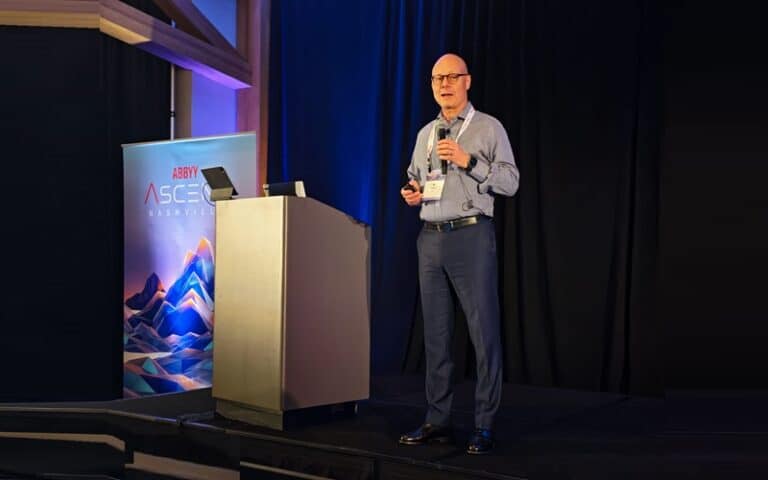
ABBYY CEO Ulf Persson has led the Document AI platform company for almost a decade now. He delivered his keynote at ABBYY Ascend (hereafter written as Abbyy) 2026 in Nashville this year to an audience of customers, partners and practitioners at all levels. Techzine attended on a mission to understand where the company has come from (with its roots in optical character recognition OCR)… and gain a first-hand grasp on where the organisation’s Document AI platform goes next in the era of AI.
Persson and team say that document-heavy workflows still power many businesses at the backend. To address the reality of modern documentation data, Abbyy spans purpose-built Document AI models and domain-specific vision language models (VLMs) that enable agents to read, interpret and act on business-critical documents with accuracy and confidence.
The company says that high-quality document intelligence is transforming workflows across finance, operations, compliance and customer experience. Talking about how Document AI fits into the wider world of intelligence, Persson says that Abbyy has “really transformed from the bottom up” and that evolution has happened in order to prepare for operations in today’s cloud-native enterprise stack.
“We have in our DNA a solid reputation for profitable growth, but why does that matter? It means that we don’t need anyone else to support our development (although yes, we are private equity owned, we are masters of our own destiny)… so today we spend about 25% of all our revenues on R&D to evolve our platform,” said Persson. “So, looking at how we leverage AI today, it means that we can do more and do better, and that progression translates directly to our customers also being able to do more and work in a more agile way, whatever their industry vertical.”
Code is not the moat
Persson says that code alone is no longer the competitive differentiator that it used to be. His favoured term is that code is not the moat i.e. some surrounding blocking factor that draws a perimeter of limitations around any given software project. What matters is how an enterprise software company actually delivers and how securely it does so on the road ahead, all while keeping open to the optionality of the next AI services, which are surely around the corner.
“From a market perspective, the concept of intelligent document processing (IDP) came at the back of the robotic process automation (RPA) revolution, when the technology itself became popular. What happens now is a question of how AI-powered IDP will take on a deeper meaning and perhaps evolve (or even disappear and be subsumed into an abstracted service) to take a new role in enterprise software,” said Persson.
Agentic HITL
He notes that as customer expectations now increasingly spiral upwards, we can agree that AI becomes the framework for all IDP services, including agentic human-in-the-loop (HITL) deployments.
“Just because Abbyy has been doing what we have been doing for 30-35 years (and just because AI has come along today), that track record of document technology knowledge stands us in the best possible ground in terms of being able to roll out AI with a purpose, which means trusted intelligence services with governance and support,” said Persson.
He thinks that the core capabilities of his firm’s technology include a lot of “connective tissue” today – some of which comes from Abbyy and some of which comes from partners – and this helps create a total platform technology proposition that champions flexibility from ground zero. These, for the Swedish-born CEO, are the factors that help customers move forward in their chosen markets without the fear of vendor lock-in.
Document bread and butter
Handing over to one of his core team lynchpins, Persson introduced Bruce Orcutt, Abbyy chief marketing officer. Technically competent and affably engaging, the ebullient Orcutt described today’s marketplace for the company and how the firm still focuses on documents as its bread and butter.
“Documents have so many different values in different parts of any business, but whatever form they manifest themselves as, they still need management to make them more effective and enable the straight through processing (STP) that they need to be more successful,” said Orcutt. “Our core competency is transforming any piece of content into actionable data – and much of that happens in real-time.”
Talking about how new technologies are now plugging into the Abbyy platform, the CMO says that trust has been engineered to be baked in from the start. The organistion’s key markets are financial services, healthcare and government… and with that exacting customer base to serve, the team is focused on evolving core competencies that include:
- Computer vision
- Image enhancement
- Layout analysis
- OCR / ICR
- Natural Language Processing (NLP)
- Segmentation
“No organisation has seen more documents in more languages in more business scenarios than Abbyy, that’s just a statement of fact,” said Orcutt. “This means we have a huge span in terms of the compliance stipulations that we know how to work with,” he noted, before inviting users to visit the company’s Trust Portal to understand where it meets global compliance standards.
DocLang, a reliable abstraction layer
Abbyy Ascend convention saw Abbyy announce news with partners IBM and Red Hat. The organisations have announced the formation of the DocLang working group under the Linux Foundation’s LF AI & Data Foundation. Abbyy says that global industries need a standard document structure for AI in order to address the maelstrom of digital document formats that enterprises operate on, such as PDFs and JPEGs.
The companies say that DocLang addresses these critical gaps by creating a reliable abstraction layer between unstructured documents and intelligent AI systems. The standard explicitly preserves both semantic meaning and geometric layout in a single AI-native format and encodes structural elements like headings, paragraphs and tables alongside their exact position on the page.
“DocLang is specifically engineered to address industry challenges with a minimal, standardised, and AI-native method for representing document structure, meaning, layout, and governance,” commented Maxime Vermeir, vice president, AI strategy at Abbyy. “Being designed for efficient machine processing provides a predictable structure optimised for modern AI tokenisation and modelling techniques. Organisations will see a significant difference with more reliable interpretation, reduced hallucinations, and lower computational costs.”
Klososky: Birth of a new ‘synthetic species’
This event featured an event speaker session from Scott Klososky in his role as technology advocate, author, consultant and founder of Future Point of View.
Klososky highlighted the huge level of mistrust in AI that exists across North America. Compared to nations like India and China that are positively placing large amounts of trust in the potential for AI to create new job openings, he thinks the trend (at a high level at least) is strange, not least because the USA has control and ownership of so much of the front-line AI services and indeed the data backbone infrastructures that support it.
“What if AI ends up being the most powerful thing we have ever invented,” said Klososky. “We often talk in terms of synthetic intelligence (AI that is built into software systems) and physical intelligence (AI built into physical devices) and that creates a whole new intelligence layer… and this might allow us to talk about the birth of a new ‘synthetic species’, especially with agents now moving us so far along the evolution curve.”
Talking about our next stage in the AI era (and referencing a Sam Altman quote), Klososky thinks that soon enough we’ll see intelligence become subsumed into enterprise software and data services, as a utility, rather like an electricity or water supply.
The question for users now, perhaps, is how much intelligence humans want to take on board. Klososky says that (for example) a pretty smart person might have an IQ of 130, but that person with Claude, Gemeni, ChatGPT, Grok or other on board, becomes a person that might have an IQ of 160. That elevation is something that people have to consider and so do companies i.e. from HR all the way up through an organisation’s departments.
A DocLang deep dive
The following editorial section is drawn from an interview with CEO Persson himself.
Techzine Global: You say that PDFs and JPEGs are “fundamentally misaligned with AI consumption” and are really tools for human eyes, not machine reasoning. Can we quantify how much this misalignment costs business today i.e. do we count the cost of hallucinations, computational overhead, failed automations or some other aspect?
Ulf Persson: In our benchmarks, we see a clear picture. For example, an LLM processing a PDF for a complex document such as a clinical study packet shows higher compute usage, higher latency and less precisions and accuracy. To that extent, it misses a large part of the table outlining the results. If your submissions to the authorities for approval leverage these results, you can only imagine the cost implications of rectifying that after the fact.
Techzine Global: DocLang embeds “enforceable governance controls” directly into a document itself – and this spans privacy, extraction scope and model training permissions. That’s a big dinner plate of controls, is that all as functional and solid as it sounds?
Ulf Persson: The DocLang standard describes all these controls, so organisations have a clear template of how to establish compliance with GDPR, ISO 27701 and the EU AI Act (to name a few). By embedding rules directly into the document layer, it ensures privacy, extraction scope, and AI training permissions are upheld wherever the document goes, compared to zero controls in other document formats. This approach secures data at the source, offering enterprises confidence in scaling their document workflows.
Techzine Global: By open sourcing a format standard rather than keeping it proprietary, some might say that you are “gifting infrastructure” to a broader ecosystem that includes competitors, including AWS and Microsoft – what ‘s your rationale and stance on this point?
Ulf Persson: Standardising document infrastructure drives true interoperability, security, and transparency across the entire enterprise ecosystem. While this allows competitors to use the standard, establishing a universal language accelerates industry innovation and eliminates restrictive vendor lock-in. With the cost of switching quickly eroding to zero, we choose to compete on the measurable business value of our purpose-built AI solutions instead of relying on proprietary format constraints.
Key takeaways
The central theme for any Abbyy event is of course, documents and how we use them today. The new work with the Linux Foundation (and IBM + Red Hat) is arguably quite impressive i.e. no other body is likely to attempt to lay down a standard of this kind, so it may well become a de facto layer in the modern enterprise stack. Overall, the fact that the company can draw on more than three decades of data digitisation surely gives it a credible enough track record as we now talk about encoding every part of our world for the agentic engines currently being built.