
The use of AI in the enterprise is still in its infancy. There are several reasons for this. One of them is that most of the underlying AI infrastructure that is built and deployed now isn’t built for the enterprise, but for AI labs and training facilities. VAST Data claims it can play an important role in making the transition from one environment to the other.
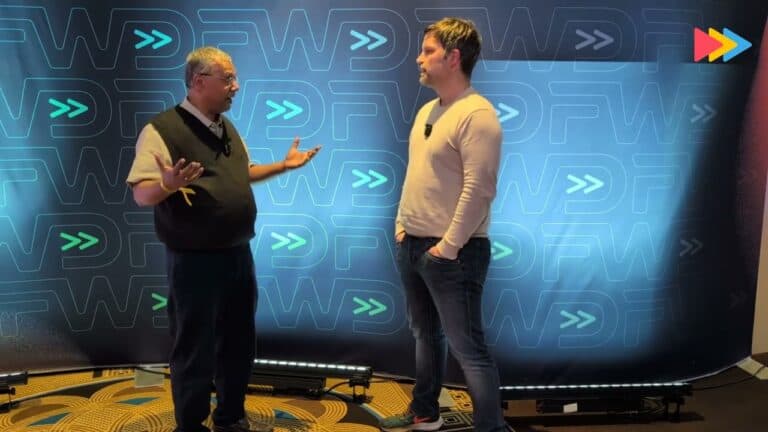
At VAST Data’s inaugural VAST Forward user conference, VP & Chief Scientist of Systems Engineering Subramanian Kartik (better known and henceforth referred to as Dr. Kartik) took the time to talk to us and gave is some insights into this transition. It represents the biggest opportunity and at the same time also the most significant challenge in enterprise technology today. The enterprise AI market could dwarf the training market by a factor of ten or more, but realizing that potential requires overcoming obstacles around data, infrastructure, governance, and complexity.
Evolution from training to inference
The AI landscape has evolved rapidly since ChatGPT’s launch. Each year has brought major innovations; retrieval-augmented generation (RAG), model context protocol (MCP), and breakthrough moments like DeepSeek’s cost-efficient approach. The transition we discuss in this Techzine TV episode is more fundamental, according to Dr. Kartik. It is the transition from training-focused AI to inference-focused deployment.
This shift means moving from approximately ten major model training players to thousands of enterprises, each seeking to leverage AI for competitive advantage. Within five years, Dr. Kartik predicts we won’t even discuss AI as a separate category because it will be embedded everywhere. But reaching that ubiquitous future requires solving today’s enterprise deployment challenges.
Stuck between promise and reality
Most large enterprises report they’re using generative AI, but Dr. Kartik’s experience working with numerous companies reveals a more nuanced reality. Typically, this means signing up for Microsoft Copilot or Google Gemini, followed by pilots and experimentation, much of which fails.
The challenges are multifaceted. Data privacy rules prevent enterprises from moving sensitive data to hyperscaler clouds. Even when data movement is possible, scaling costs become prohibitive. Technical complexity grows exponentially with scale, making execution extremely difficult in public cloud environments.
Many companies respond by creating new AI silos, separate environments disconnected from existing data and systems. This approach contradicts what VAST advocates: AI needs clean access to all enterprise data to deliver maximum benefit.
Also read: Who will develop the OS for AI? VAST Data is going for it
Simplicity as strategy
VAST Data positions itself as an “AI Operating System”. This means a platform providing the substrate for deploying AI applications without requiring enterprises to master complex underlying technologies.
“One thing I learned from the enterprise is they have no desire to master complex technologies. They don’t want to learn how to operate an InfiniBand network,” Dr. Kartik says to illustrate what he is talking about. “They want outcomes. They say here’s the data, I’d like these results from it. So the easy button is what they are looking for.”
This outcome-based approach differs fundamentally from the technical mindset of large-scale model trainers. Enterprise customers have businesses to run, they don’t want to become technicians or build tools. They need AI solutions that work across hybrid environments, federating data between private and public clouds seamlessly.
Neoclouds are bridges
Given infrastructure limitations, Dr. Kartik expects significant workload migration from hyperscaler clouds to neoclouds, specialized GPU cloud providers operating at different cost and scale points than AWS, Azure, or Google Cloud. The hybrid approach many enterprises have will likely connect neoclouds with on-premises environments.
“When it comes to AI, maybe the neoclouds and maybe also AI factories and all those kind of locations may be the next on-premises data center for enterprises,” Dr. Kartik suggests. Enterprises will rent capacity from these specialized providers for training and fine-tuning workloads impossible to run in their own facilities.
As it happens, many neoclouds have standardized on VAST Data infrastructure, creating advanced data federation opportunities. “Now I have VAST over there, I have VAST over here. VAST DataSpace can federate this. Now enterprises don’t even have to worry about data movement, they have location transparency and strong security controls around that data.”
The expanding VAST ecosystem
Many customers initially engage VAST for specific use cases, for example as a backup target. After that, they discover broader capabilities, especially when it comes to high-performance workloads.
This expansion includes virtualized environments, GPU-based workloads, and increasingly, AI-specific capabilities like vector stores for newer data structures. VAST’s control plane, Polaris, provides a management interface and operates across cloud and on-premises environments, even though it starts out in the cloud before expanding to other deployment models.
Building for the future
An important question for any platform claiming comprehensive capabilities is if it can guarantee that it can also deliver new ones as they emerge. In other words, can development continue without creating technical debt and legacy constraints? VAST’s answer to this question lies in its modular architecture.
In order to illustrate modularity, Dr. Kartik uses protocol support: “We support NFS3, NFS4, SMB2, SMB3, S3, we support block. None of the introduction of these new protocols that we did had any disruptive effect on any of the protocols we already supported because the way we developed these is completely modular and completely independent of each other.”
This design philosophy extends to database components, Kafka-compatible brokers, triggers, serverless functions, and data pipelines. Each can be developed, modified, or enhanced without interfering with existing functionality. In our opinion, this is a very important part of the VAST Data story. If everything works as the company claims, the platform as a whole is very flexible and dynamic. That is always a big plus towards the future.
Watch and listen to the entire conversation we had with Dr. Kartik to hear a lot more about enterprise AI and the role VAST Data wants to play in it.
Also read: VAST Data leverages unique market position to develop full-stack AI infrastructure