
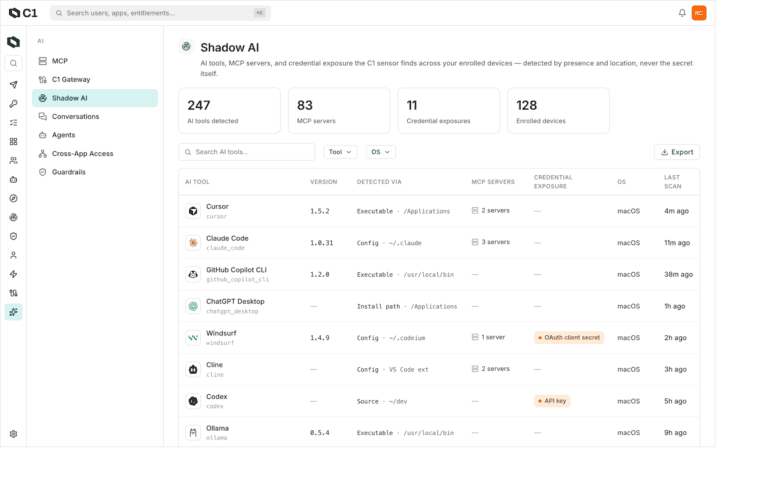
C1 introduces shadow AI discovery, a feature that helps security teams detect unapproved AI tools, AI agents, MCP servers, and exposed credentials. The solution scans endpoints as well as cloud and identity environments, assigns ownership, and integrates everything into existing governance processes.
C1 presents the building blocks organizations need to adopt and secure AI agents. Discovery is the first step. In the days that follow, organizations secure credentials, set up runtime guardrails, and respond to risks.
The underlying problem is that AI adoption among many teams outpaced governance capabilities. According to C1, it’s not about a handful of additional agents, but rather a sharp increase in non-human identities (NHIs) within the environment. And what you can’t see, you can’t manage.
Much of AI remains invisible to the tools organizations are already running. PAM monitors human sessions, EDR tracks processes, and CASB and DLP monitor approved SaaS. These tools assume that an identity is either a person or an approved app. But the fastest-growing identities are actually non-human, and the least managed of these is the AI agent that authenticates itself and collects credentials.
Two areas: endpoint and cloud
C1 tackles shadow AI on two fronts. On endpoints, the tool scans developers’ laptops for self-installed coding assistants and locally running MCP servers via stdio. That MCP traffic never passes through the network, so cloud scanners and proxies don’t detect it. The report shows the installed AI tools, the specified MCP servers, and the credential files left behind.
In the second area, the connectors inventory AI agents in platforms such as Salesforce Agentforce and AWS Bedrock AgentCore, in addition to the broader NHI population. This includes service principals, managed identities, app registrations, and service accounts within Entra, Okta, GCP, GitHub, Snowflake, and Active Directory. Each item is linked to an owner, with high-risk accounts being flagged.
Within C1, a detected agent, MCP server, or credential becomes an access item on the same agentic control plane as employees. Governance thus becomes a lifecycle rather than a toggle, according to the company.