
ServiceNow is seeing a fundamental shift in how companies implement AI. The discussion is no longer exclusively about task augmentation, but often about transforming roles. We spoke with Chief Transformation Officer Hartmut Mueller about this shift, the challenges of platform adoption, and why speed is the most important success factor.
Mueller’s role at ServiceNow is twofold. On the one hand, he guides customers through their transformation journeys. On the other hand, he works internally with product teams to align roadmaps with specific industries. This dual role gives him insight into what is really going on at companies that want to implement AI.
Mueller has seen a fundamental change over the past two and a half years. “We used to talk about task augmentation,” the ServiceNow executive explains about the discussions surrounding AI. “But now the focus has shifted to how AI or agentic models can drive role transformation.” That may sound like a subtle distinction, but the implications are enormous.
From end-to-end processes to role-based architecture
Task augmentation was about improving individual tasks within an existing process. Think of a source-to-pay process in which specific steps are automated. That is relatively easy to visualize and implement in a classic process landscape.
Role transformation, however, requires a completely different approach. You have to turn your entire end-to-end business process architecture into a role-based architecture, explains Mueller. “You now look at the roles in your company,” says ServiceNow’s Chief Transformation Officer. One of Mueller’s customers in Asia illustrated this with a striking example. That company started with an entirely human workforce. Through automation and support, they reduced the number of tasks by 40 to 60 percent. They then supplemented this with AI agents, so that ultimately 40 percent of the work was done by agents. The organization counted AI agents in the same way as FTEs and external employees in their organizational structure.
The change formula: narrative, measurement, movement, and UX
Over the years, ServiceNow has developed a change formula that is also relevant for other platforms. It starts with a clear narrative. Only if you know why you are buying a platform and what benefits it will provide can you be successful.
Secondly, you need to measure what you are doing. This prevents decisions based on gut feeling, especially with new technology. “When you introduce new things, you have to measure,” Mueller emphasizes. Otherwise, you won’t know what works.
The third factor is creating momentum around the product. It is essential to avoid translating thousands of applications across thousands of platforms. You want to converge on a single platform, which requires companies to build capabilities. Mueller noticed that ServiceNow sometimes underemphasizes this aspect at events. “AI agents were in the corner, as was ServiceNow University. No, that should be central. That’s the movement, that’s capability building.”
The fourth and perhaps most important factor: user experience. For decades, new IT applications were pushed onto users. They had to work with them, regardless of the UX. With a good UX, you turn that push into a pull. “Why is the iPhone successful? Great UX. Amazon? Great UX,” says Mueller. “AI could be the new UI/UX.” Mueller points out that young people type little to nothing on their phones. They almost exclusively use voice. That interface evolution will determine future success.
So which AI agents currently have the most traction with customers? Customer service is by far the most mature area. Many companies still have catch-and-dispatch teams or first-call resolution with knowledge bases. “Why should that be done by a human?” Mueller wonders. ServiceNow itself has completely replaced first-line support with AI agents.
In terms of industries, telecom, manufacturing, and financial services are leading the way. These sectors have the maturity to deploy AI agents effectively.
Business value, low complexity, and frequent use
During a customer presentation, the ServiceNow executive outlined the sweet spot for agentic AI using a Venn diagram: business value, low-complexity tasks, and common use. That’s where you need to start.
Think of an agent that links past incidents to existing problems. Or an agent that automatically checks licenses and certifications for all running systems. “I wonder why everyone isn’t already doing this,” says Mueller. In the event of an incident with a known problem, the agent can intervene immediately without human intervention. That’s an autonomous circle. For more complex tasks, you can start in supervised mode and later transition to autonomous mode.
The formula: the more experience humans have, the more experience the AI agent can gain. Experienced professionals can offload complex tasks. Combine experienced employees with a virtual agent, a domain-specific large language model, and an AI agent, and that person becomes more effective.
Three fundamental decisions for AI-driven organizations
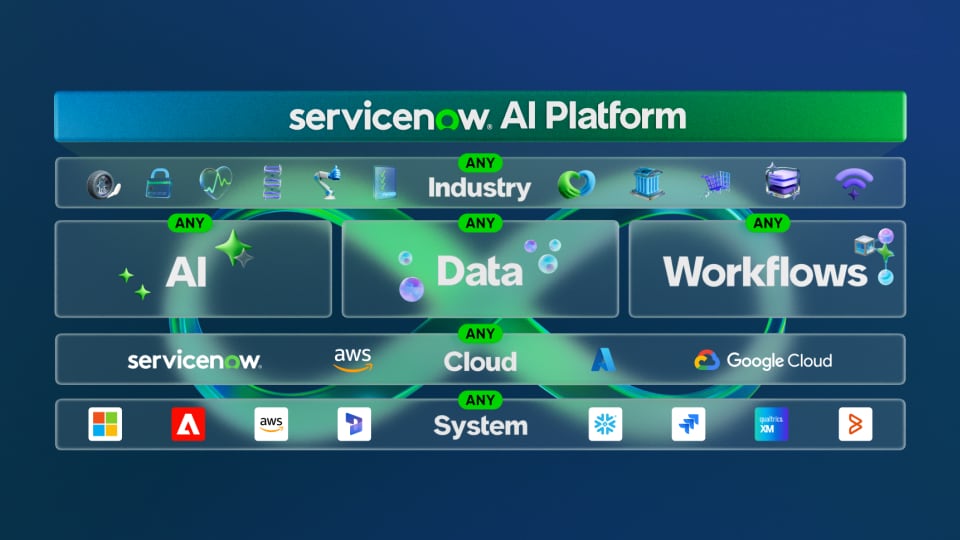
According to Mueller, companies must make three critical choices in the fast-moving world of AI. First: what will your data fabric be? How do you connect external and decentralized data pools? You have to decide which platform will organize that.
The second factor is your orchestration layer. How do you arrange governance for AI agents, Now Assist, and your own models? How do you manage the lifecycle? Here, too, you have to choose a platform.
Third, it’s about a unified experience. This not only reduces complexity and change for employees, but also allows you to grant or revoke access to underlying systems through that unified experience. “I already did this eight years ago at my previous company,” says Mueller. “I called it a firewall. Everything had to go through it, from the outside in or from the inside out.”
Some colleagues wanted to buy certain tools, but Mueller refused. “I’m not going to grant access via the unified experience for employees.” The logic of multiple layers with a data fabric, AI orchestration, and governance, topped by a single pane of glass for granting and revoking access, ensures a secure, compliant organization.
Best-of-breed versus platform strategy
Many tech vendors are trying to build a data fabric or lakehouse. Companies think that their SaaS workload runs best in party X’s fabric, the AI workload in party Y’s lakehouse, and so on. As a result, they buy everything.
But who can afford best-of-breed? And who can control the innovation roadmaps of all those companies? “You also have to limit the change for your people,” says Mueller. “And the capabilities you need to build for your people. If you don’t, you’re screwed.”
Standardization helps enormously in minimizing change for employees and limiting the capabilities required. “I wouldn’t say that best-of-breed is dead, but I see many CIOs in my network who swore by best-of-breed five years ago and have now switched to a platform.” That doesn’t mean one platform for everything; it means platforms for specific business domains. Then it’s just a matter of whether your company can keep up with the platform’s pace of innovation.
Speed as the ultimate success factor
The real challenge is that companies are so far behind in their capabilities to handle the latest technology. Many cannot even visualize what AI means. The executive has a simple recommendation: “If you had to build it from scratch on greenfield, would you do it the same way you do now?”
That question gets to the heart of the matter. “Everyone looks at the auto industry and sees that it is being disrupted by Chinese companies. This is because Chinese companies can do things much faster than old economies,” Mueller notes.
It’s all about speed. How can you gain speed? How can you manage technological innovation so the gap doesn’t widen? If that gap grows, technical debt piles up, and security debt increases. “That’s why I say: speed is important. How can you accelerate? What’s holding you back?”
Autonomous agents as the new reality
ServiceNow itself, for example, uses AI agents during its sales kickoff to do work for sales teams and other organizations. Something that used to take 3 to 4 hours of heavy lifting now takes two minutes. Mueller also regularly confronts colleagues about the possibilities. “Why are you still doing this this way? This can be done by AI.” The answer: “We’ve always done it this way.” But that’s no longer the point. “We’re not talking about support, we’re talking about role transformation.”
As far as Mueller is concerned, this shift from improving tasks to transforming roles is something that organizations need to understand. To achieve this, the right architecture, governance, and speed are needed.
Also read: Aston Martin Aramco F1 builds on ServiceNow for success on the track