
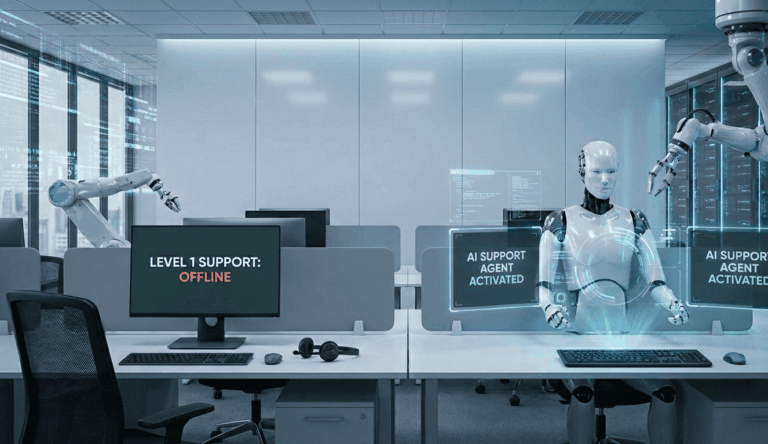
ServiceNow presents two important innovations: Autonomous Workforce and ServiceNow EmployeeWorks. The autonomous workforce aims to replace certain employees with AI agents. EmployeeWorks offers an AI assistant that is close to the human employee and always available. That sounds promising, but there are still some snags.
While many organizations are still experimenting with AI, major software vendors are already taking the next step. AI solutions that make work easier or take it off your hands completely. We have been hearing about this for a year now with the rise of Agentic AI. Not all solutions have proven to be equally reliable to date, but ServiceNow is now making an attempt, and it looks more promising.
Autonomous Workforce: AI specialists who perform work
The concept is simple yet radical. ServiceNow is introducing AI specialists who can take over specific tasks and roles. ServiceNow enables the deployment of autonomous AI employees that can replace a human worker, not just individual tasks. Replacing people with AI is a highly sensitive issue for both companies and technology providers. It is not very popular to say that people can be replaced by technology. The fact is, however, that past innovations have done exactly the same thing. It’s not bad in our opinion because AI innovations offer opportunities for organizations and human workers as well. Employees who are replaced can be redeployed elsewhere. Organizations can train them to a higher level or retrain them for other work within the organization. Many organizations struggle to fill all their job openings.
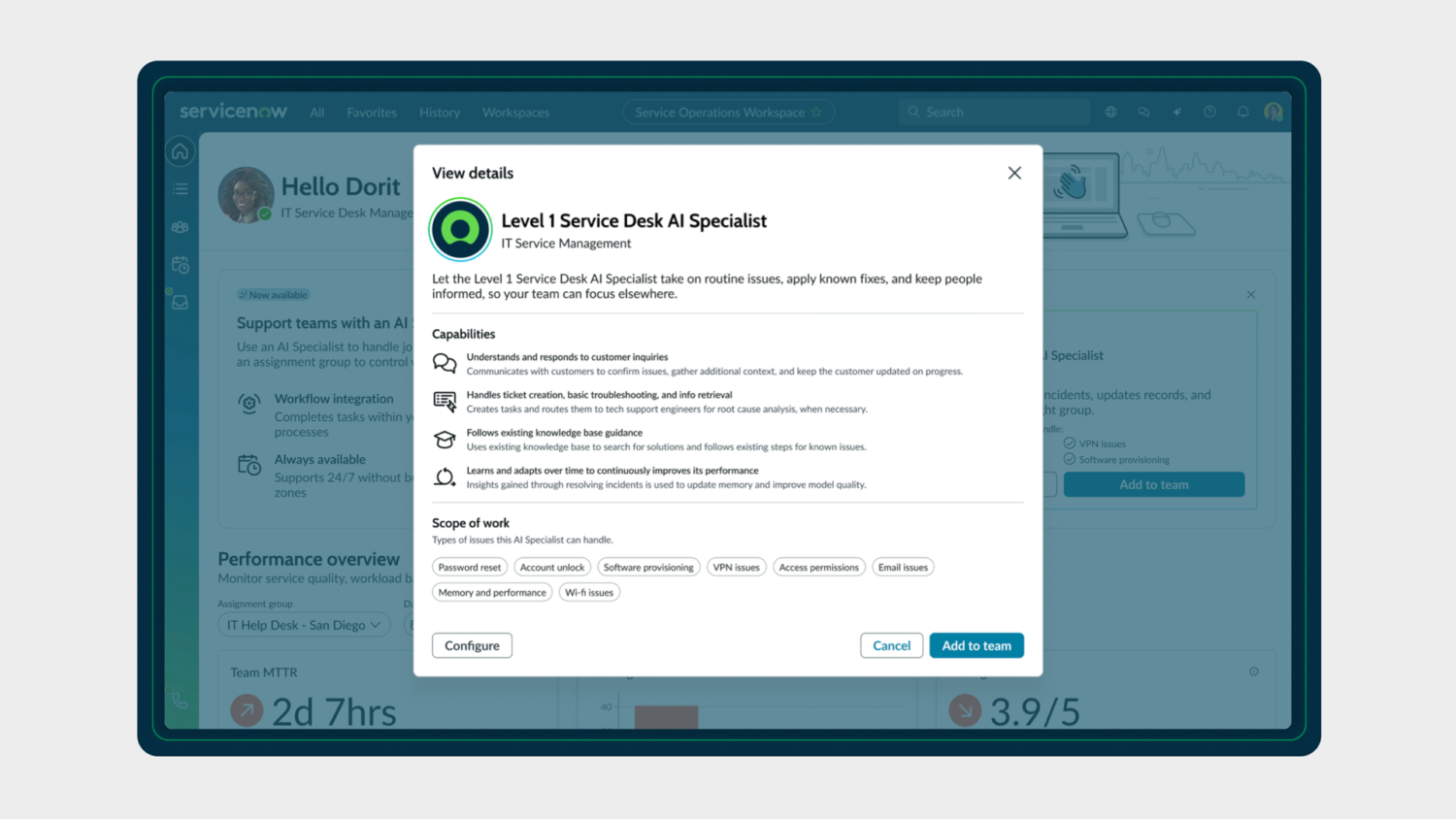
The AI employees or roles that ServiceNow is currently focusing on are Level 1 Service Desk AI Specialist, Employee Service Agent, and Security Operations Analyst. The AI specialists work within the existing governance framework, with the same access controls, policies, and audit trails as their human colleagues. In doing so, ServiceNow is taking the same approach as Workday.
The first specialist to become available is the Level 1 Service Desk AI Specialist, who is expected in Q2 2026. The Service Desk AI Specialist resolves simpler IT issues completely independently: from VPN failures and password resets to software installations. These are really first-level support tasks that are often very repetitive and have sometimes already been partially automated.
What is different from the past is that the AI specialist no longer follows scripts to perform the various tasks. The AI specialist has access to the systems just like a human employee and can therefore also detect, analyze, execute, document, and ultimately update the knowledge base. All without human intervention.
If the AI specialist is unable to resolve the issue, it can transfer the case to an L2 or L3 employee, who is still a human. They can then solve the problem and update the knowledge base, enabling the AI specialist to solve certain problems independently in the future.
Customer Zero
ServiceNow claims to be ‘customer zero’ and has shared its initial results. More than 90 percent of all internal IT requests are already handled by the Autonomous Workforce. The L1 Service Desk AI Specialist resolves cases 99 percent faster than human employees. According to ServiceNow, these are not roadmap promises, but actual production figures. Now, it is not surprising that AI is faster than a human, but the big question is how many requests it has forwarded to an L2 or L3 employee.
Of course, ServiceNow has been a major player in IT Service Management for many years and has the data and context to properly train AI for an L1 Service Desk AI specialist. If anyone can develop such an AI specialist, it is ServiceNow. Given that most IT requests can be handled by an L1 employee, this could result in significant savings for organizations. That is why this is certainly an interesting announcement.
Also read: ServiceNow makes Now platform AI-driven and adds thousands of AI agents
ServiceNow EmployeeWorks brings all AI tools to your favorite application
The second major announcement is the result of the acquisition of Moveworks in December 2025. ServiceNow EmployeeWorks combines Moveworks’ conversational AI and enterprise search with ServiceNow’s portal and autonomous workflows. EmployeeWorks is available to all customers immediately.
The problem that EmployeeWorks addresses is familiar for many organizations. The necessary AI tools have been rolled out internally, but this has led to several or even a dozen separate applications and tools. Employees have to switch between systems to get things done. Which agent do I need for what? Where is the information? EmployeeWorks tackles this fragmentation with a single central starting point.
The platform understands the intent behind a question and independently performs the necessary actions across multiple systems. In addition, you don’t necessarily have to go to the EmployeeWorks portal; you can also ask that question via Teams or Slack. EmployeeWorks is, of course, available via the browser on your PC or mobile device. This allows the AI interface to move to where the employee is located or where they feel comfortable. Moveworks already had more than 5.5 million users worldwide before the acquisition, which, according to ServiceNow, proves that this way of working also works.
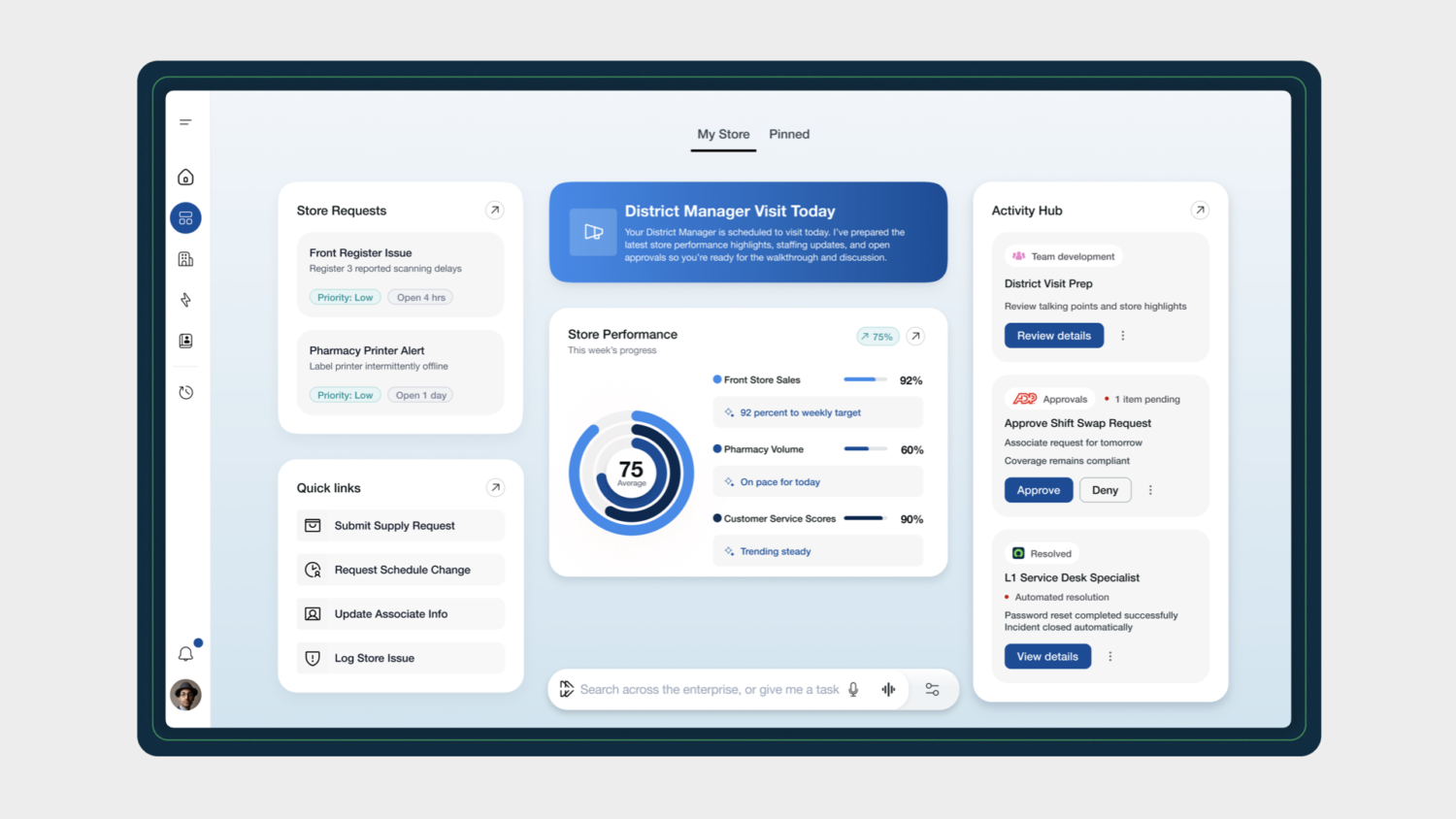
EmployeeWorks does not assist; it performs actions and provides an overview in complex environments
The difference with other AI assistants lies in how it is executed. EmployeeWorks does not index keywords or provide lists of links. It understands organizational structures, approval processes, and authorizations. It can retrieve a document from SharePoint, check a status in ServiceNow, and comb through a Slack thread, then convert the information into concrete actions.
Only decisions that require human judgment are forwarded. The rest is handled automatically. That is precisely what many AI tools do not yet do: they give you an answer, but the employee then has to carry out the action themselves.
Moveworks also remains available as a standalone product, separate from ServiceNow. Organizations can deploy it as an independent AI solution on any platform or as an integrated part of their ServiceNow environment.
AI Control Tower: governance is no longer an afterthought
Autonomous Workforce and EmployeeWorks are powerful, but without central governance, AI will create more chaos than it solves. This challenge is widely felt across organizations and the market. A recent Salesforce survey also highlighted this:
Also read: 86% of IT decision-makers believe that AI agents add more problems than value
You need to keep track of what all those agents are doing, what data they use, and whether they comply with the rules. Each platform has its own solution for this. ServiceNow introduced the AI Control Tower during Knowledge 2025 and is now expanding it into a central command center for all AI activity on the NOW platform. Every action taken by an AI specialist is traceable and managed by policies embedded deep in the workflow layer.
Also read: ServiceNow launches AI Control Tower for central management of AI agents
The AI Control Tower monitors all AI agents, models, and workflows in one place. It checks whether approved LLM suppliers and models are being used, detects prompt injection attacks, and monitors compliance. AI specialists are monitored for handle time, CSAT, and escalation rate, just like human employees. However, there is still a blind spot.
The blind spot
However, there is another limitation that ServiceNow itself acknowledges. The AI Control Tower offers detailed monitoring for agents on its own NOW platform, but for third-party agents (Microsoft, Google, Workday, Salesforce), that visibility is still limited. Technically, it is still difficult to monitor agents on third-party platforms.
ServiceNow is actively discussing this with partners and competitors. It is an industry-wide problem, not a ServiceNow-specific problem. But it does mean that the promise of a single central location for all AI governance has not yet been fully realized for organizations running multiple AI platforms side by side.
Conclusion: Can AI replace humans?
ServiceNow is showing today that it is not afraid to rock the boat. It is introducing AI specialists who can directly replace people within an organization. Not a separate layer of AI assistants who advise, but AI specialists who take work off their hands. These AI specialists also become integral to the workforce and the workflow engine. The results at ServiceNow itself, with 90 percent of IT requests automated and 99 percent faster processing, are impressive. However, these are their own figures, so we take them with a grain of salt.
The combination of EmployeeWorks (where the work begins), Autonomous Workforce (where the work is performed), and the AI Control Tower (how the work is monitored) is logical and clear. Still, it’s good to remain realistic. The L1 Service Desk AI Specialist is the first and only specialist to be available out-of-the-box in the second quarter. Organizations will always use multiple platforms, and governance for third-party agents remains difficult.
But the direction is clear, and ServiceNow has only just begun integrating Moveworks, so there is certainly more to come. The era of AI as an experiment is now coming to an end, and we are moving towards AI employees in practice. ServiceNow is opting for AI specialists in areas where it has a lot of knowledge and data, thereby throwing the weight of its platform into the fray, which is logical and sensible. It also makes it predictable what else we can expect. Furthermore, it should be clear that people in simple repetitive roles will eventually be replaced by AI.
Also read: ServiceNow wants to disrupt Salesforce with new AI-based CRM